Home Affairs reveals the Subclass 189 invitation algorithm! Occupations grouped into four priority tiers, and tied to employer-sponsored numbers
by Qiqi CHEN
In May this year, the Department of Home Affairs held internal discussions on the reform of the Subclass 189 invitation strategy. We obtained the most recent meeting-minute document through FOI, and These reform discussions were approved before May and have applied to invitations from the 2025–26 financial year onwards; the first two rounds of this financial year have already been run under the new approach.
Long-standing problems with Subclass 189 invitations
Issue: invitation acceptance rateDuring the pandemic, the acceptance rate of Subclass 189 invitations (i.e. people who actually lodged after being invited) dropped at one point to 30–40%, which led the Department to adjust invitation frequency and volume; after the pandemic the acceptance rate has slowly returned to around 70% (really that high?). On that basis they consider it timely to conduct a review. Issue: invitations cannot rely solely on the priority-occupation direction
In more recent years, invitations have mainly concentrated on priority occupations such as healthcare and teaching, because the Department has been following the Ministerial Direction s499; however s499 was never intended to guide invitations. In order to hit each financial year’s KPIs, invitations have been extended to non-priority occupations, but only as an “emergency measure” and not as a systematic approach.So, there has not previously been a formal policy framework or operational guideline to underpin the Subclass 189 invitation strategy.
Issue: invitation wait times are getting longer
The document only provides data up to the 2022–23 financial year, showing that applicants typically wait the better part of a year from EOI lodgement to invitation
Issue: state governments are also unhappy with the “erratic” Subclass 189 invitations
Beyond the stated aim of pursuing transparency and fairness in Subclass 189 invitations, state governments have repeatedly raised concerns with the Department, asking for greater transparency around the timing and priority of Subclass 189 invitation rounds。In the 2022–2023 financial year,, 87% of Subclass 189 applicants had simultaneously lodged an EOI for Subclass 190/491.
In other words, this has produced many duplicate, ineffective invitations while genuine applicants who have been waiting repeatedly miss out, you may recall that last financial year Western Australia issued state-nominated invitations right around the Subclass 189 rounds; WA similarly ranks candidates from highest score down, so a number of high-scoring construction/engineering candidates in WA in fact received duplicate invitations.
The Department is therefore making an effort to adjust this from the 2025–26 financial year onwards.
Clearer invitation rounds and timing
The Department has previously confirmed through several channels that this year invitations will be held once every three months. For the November round, it pre-announced the exact invitation date on Facebook for the first time, and future rounds may also be pre-announced in advance — along with the official report for each round.
Priority invitation occupations will be reviewed each financial year
The policy area will conduct a systematic review of priority occupations once a year, and, before the start of each program year, will secure the corresponding policy authorisation for how invitation rounds are to be run。
State nomination and employer sponsorship will be taken into account
The composition of invitation rounds across the year will be dynamically calibrated in combination with the occupation-level situation across other permanent and near-permanent residency programs, including: Subclass 186 / 190 / 491
Strengthening coordination with state governments
To avoid duplicate invitations caused by poor coordination of the timing and frequency of invitation rounds, and to reduce duplication of work across government
A tiered priority model will be establishedEach occupation’s quota ceiling will be calculated based on the average number of people working in that occupation in Australia, combined with different weighting coefficients,, combined with different weighting coefficients. The algorithm for Subclass 189 invitation numbers by occupationThree core factors1. The total number of people currently working in that occupation in Australia2.2. The priority tier the occupation belongs to determines its weighting coefficient3. The number of people who gained PR in that occupation in the previous financial year through Subclass 186 / 190 / 491 Four tiers, each with its own weighting coefficientTier 1 — 4% — highest-value occupations, covering the occupations listed below
Tier 2 — 2% – high-priority occupations
The occupations currently placed in this tier are drawn from Ministerial Direction No. 105 (s499) (excluding the Tier 1 occupations), and mainly cover the education sector and the healthcare sector
Tier 3 — 1% — diversified occupations
The quota ceiling for these occupations is 1%, and it contains the largest number of occupations; most of the occupations we are familiar with sit here, as shown in the chart below
Tier 4 — 0.5% — over-saturated occupations
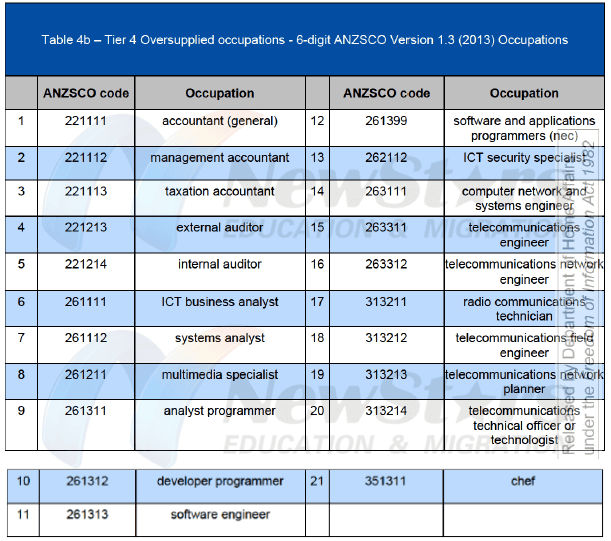
These occupations have a very large backlog of EOIs. The Department has consistently kept strict control of their quotas (number of invitations) — if the quota is set too high, a large share of available places is used up very quickly.Examples include the most popular accounting and auditing categories, IT, and chefs.
How is it calculated? Let’s work through an example.
Occupation A has 50,000 workers in Australia and sits in Tier 3 (1%). In the previous financial year, 1,000 people gained PR in this occupation via employer sponsorship (i.e. Subclass 186).
Scenario 1:1% of 50,000 is 500; after deducting the 1,000 employer-sponsored places from the previous year, the result is negative, so this occupation is unlikely to receive any invitations this year.
Scenario 2:However, if only 200 people in this occupation gained PR via employer sponsorship in the previous financial year, then 500 − 200 = 300, so there is still room to issue invitations.
So:
1.The higher the tier, the more favourable the outcome — for example, the various doctor / medical-related occupations
2.A large existing workforce for the occupation in Australia is a positive factor — for example, nursing and construction blue-collar trades
3.A high number of employer-sponsorship applicants in the occupation is a negative factor.
For reference, here are the top ten Subclass 186 occupations for 2023–24 (the 2024–25 figures have not yet been released).
Occupations such as Chef, Accountant, Software Engineer, Developer Programmer and ICT BA have both a large volume of employer-sponsorship applicants and the lowest tier (a ratio of only 0.5%), so invitation numbers will be small. Nursing has a fair number of employer-sponsorship applicants too, but sits in a higher tier and has a very large existing workforce, so we still see a decent number of invitations. If you are thinking of learning a trade, moving into skilled migration via a chef qualification has already become relatively difficult. By contrast, blue-collar trade occupations have a very large workforce and it is difficult to apply directly for Subclass 186, which helps secure their share of invitations under Subclass 189.There are now a number of lighter physical trades, some of which are even well suited to women — for example, tiling — feel free to contact us to discuss course options. We have also visited a tiling school in person. Finally,this algorithm is intended to give everyone a rough sense of where their occupation sits — the quota is a ceiling on the number of invitations per year, not a commitment that that many will be issued; it is for reference only. The Department has indicated that, in theory, there is also a per-occupation floor of 500, but actual issuance depends on how many invitations are planned for each round. The document also outlines the origins of this algorithm.Having an algorithm is better than having none, and having a plan is better than having none. In truth, simply improving communication with state governments and reducing duplicate invitations is already a significant step forward — though whether it works in practice remains to be seen. About the Newstarsec Group
(photographed in 2021)
WA issues 1,800 invitations — even 80-pointers invited! Subclass 189 issues 10,000 — estimated numbers by occupation!
Tough case — success | Onshore partner migration with no valid visa: Schedule 3 waived and work rights granted on Bridging Visa C!
Subclass 189 issues 10,000 invitations | Specific invitation numbers for the “Big Four” and several common occupations this round, with an estimation table
Migration information-sharing group
2025
Step 1: press and hold to add our client service
Step 2: once added, please
follow the NewStars official account
use the chat box [search by number only] to view articlesCode: 01 — Australia’s most popular skilled migration programs: Subclass 189 / 190 / 491 Code: 02 — work-to-migration in one step via employer-sponsored visas: Subclass 482 / 186 / 494 Code:03 — study-first, migrate-later: recommended majors and courses Code:04 — high school / Gaokao / bachelor pathways for overseas studyCode:05 — essential for international students migrating: Subclass 485 Temporary Graduate visa Code:06 — to arrange straight after PR: Parent migration and visasCode:07 — Master of Marriage: Partner migration Code:08 — pivoting to Hong Kong: Quality Migrant Admission Scheme and General Employment PolicyCode:09 — essential for parents / relatives / friends visiting: Subclass 600 visaCode:10 — weekly updates of visa grants / invitations / skills assessments — success stories
Enquire
Free initial study-abroad and migration consultation