Skilled / Investor / Partner Migration Grant Report | Partner Migration from Mainland China Overtakes Skilled Stream; Top Five Skilled Occupations Revealed


The FY24-25 Migration Program Report has arrived later than usual — in past years it landed around October, but this time it was not published until late December. Even so, the data is no less valuable, and we have picked out a few highlights to share.

The report only covers capped categories, so data for the 191/888/801/100 subclasses is not included.

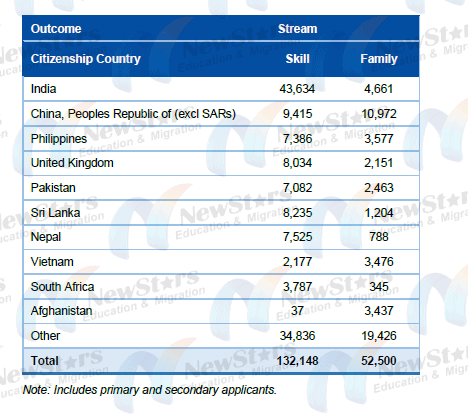
Mainland Chinese applicants take the top spot in family migration
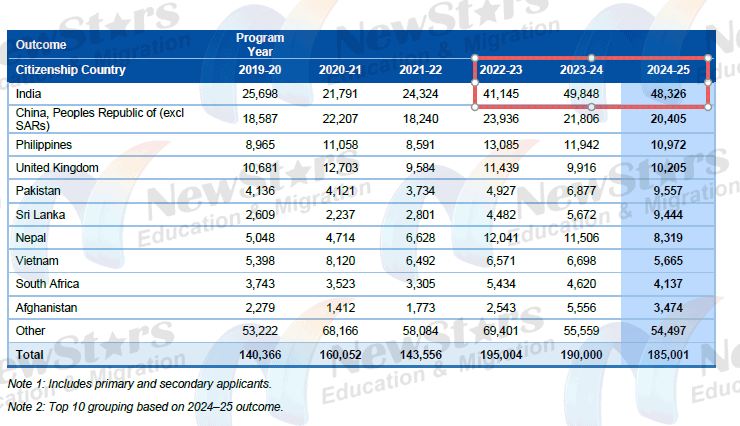
India continues to lead the skilled migration stream, with volumes climbing year on year, and more than 43,000 grants in FY24-25 — while every other country or region has either declined or simply held steady, and aside from India no other country now breaks 10,000.
Mainland Chinese applicants migrating via partner, parent and child streams have now surpassed those coming through skilled migration — something that has almost never happened in previous years. On the strength of family migration, mainland China holds firm as the second-largest source of migrants overall.Every other country or region still sits well below its own skilled total.


WA state nomination bucks the trend with an uptick
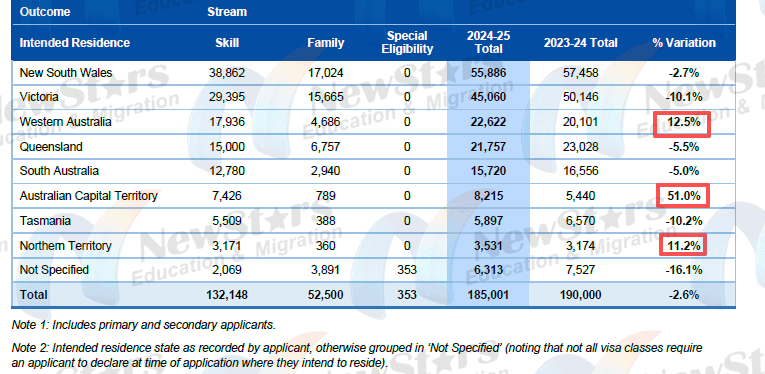
In FY24-25 the number of primary applicants nominating WA as their intended state rose 12.5% on FY23-24 — the only one of the larger states to grow — showing that more applicants have been securing PR through WA state nomination against the broader trend. The NT and the ACT also recorded increases.

Subclass 491 is the practical option for offshore applicants
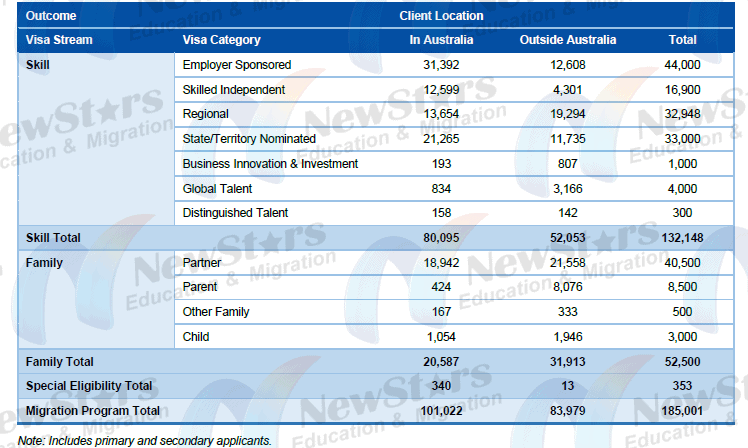
In FY24-25 nearly 20,000 Subclass 491 grants went to applicants offshore, versus fewer than 14,000 onshore. Setting aside the small number of onshore applicants who happened to be overseas at the moment of grant, this shows that among the various skilled migration streams, Subclass 491 is comparatively friendly to offshore applicants — every other stream is dominated by onshore applicants: offshore Subclass 190 grants account for only 35% of the total, Subclass 186 fewer than 30%, and Subclass 189 just 25%.

Top five skilled-migration occupation groups in FY24-25

*Counts primary applicants granted via Subclass 189 + 190 + 186 + 491 + 494

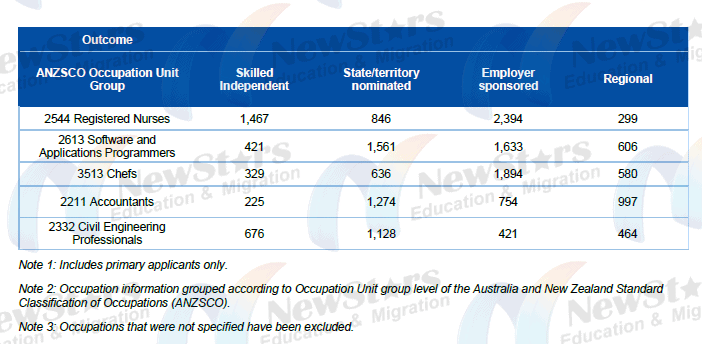
ANZSCO 2544 Nursing had more than 5,000 grants, and the largest share surprisingly came through Subclass 186 employer sponsorship.

2613 saw around 4,200 grants, with Subclass 190 and Subclass 186 running neck and neck.

ANZSCO 3513 Chefs totalled close to 3,500 grants, with Subclass 186 employer sponsorship clearly dominant.

ANZSCO 2211 Accountants had 3,250 grants, mainly via state nomination.

ANZSCO 2332 Civil Engineering Professionals totalled close to 2,700 grants, mainly via state nomination.

Nursing and early-childhood teaching are neck and neck among priority occupations

*Counts primary-applicant grants only

Among the priority occupations under Ministerial Direction 105Registered Nurses nec received 1,600 grants, and Early Childhood (Pre-primary School) Teachers received more than 1,500 in FY24-25 — making them the top two occupations overall. Broken down by sector, healthcare-related grants are still well ahead of teaching。


Top 10 occupations under Subclass 186 employer sponsorship

*Counts primary-applicant grants only

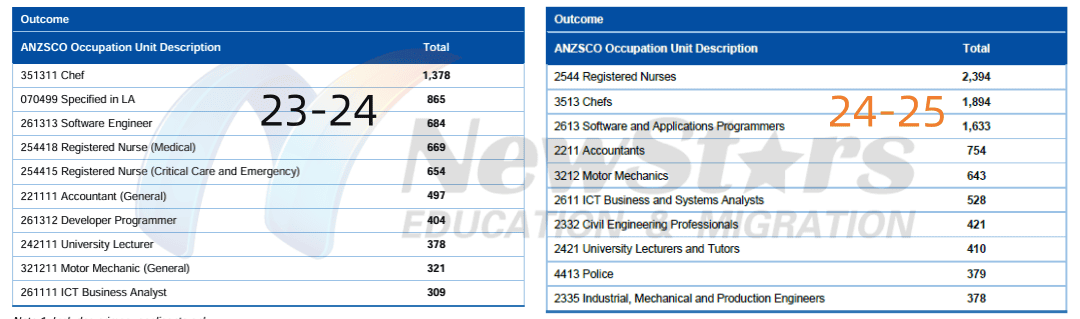
Registered Nurses took first place, Chefs second and Software Engineers third — all three cleared the 1,000 markThe FY24-25 employer-sponsored grant volume for each occupation is one of the inputs that drives the FY25-26 Subclass 189 invitation allocation — for details see:New 189 Invitation Strategy, Full Document Released | The Formula for Each Occupation’s Invitations and How It Coordinates with State Governments to Avoid Duplicate Invitations!Most occupations in the last two financial years are familiar faces — with Police perhaps the notable exception.

Subclass 186 backlog up by more than 50%

*Includes both primary and secondary applicant grants

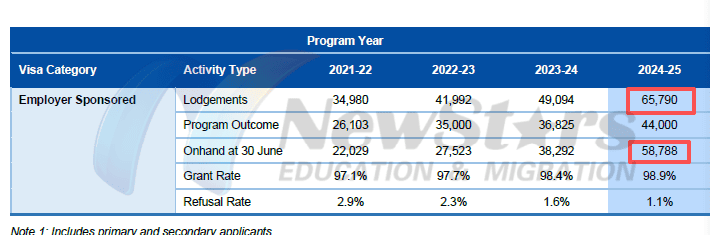
After last year’s easing of employer-sponsored policy settings, applications for Subclass 482 and Subclass 186 Direct Entry have risen in step. Combined Subclass 186 TRT + DE lodgements exceeded 65,000, and although FY24-25 grants also rose by several thousand, by 30 June 2025 the Subclass 186 backlog sat above 58,000 — an increase of 20,000 year on year.

Subclass 189 backlog has shrunk further

*Includes both primary and secondary applicant grants

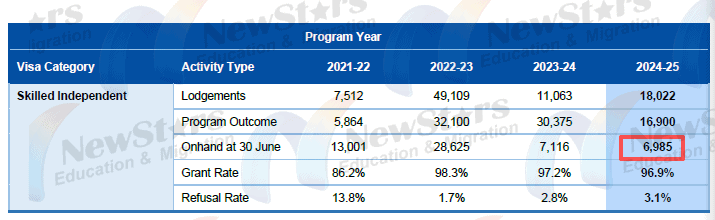
Consistent with the figures we previously pulled, the Subclass 189 backlog was brought below 7,000 by the end of last financial year. This is what makes it feasible to hold a steady three-monthly invitation cadence through FY25-26, with the next round expected in February.

Subclass 491 is absorbing more of the regional quota

*Includes both primary and secondary applicant grants

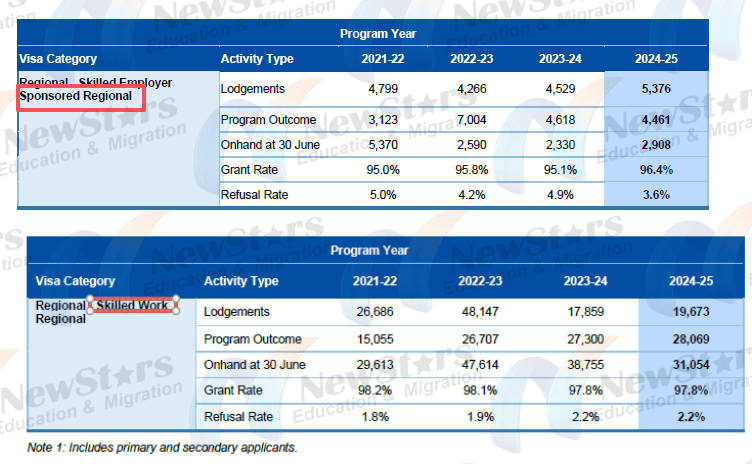
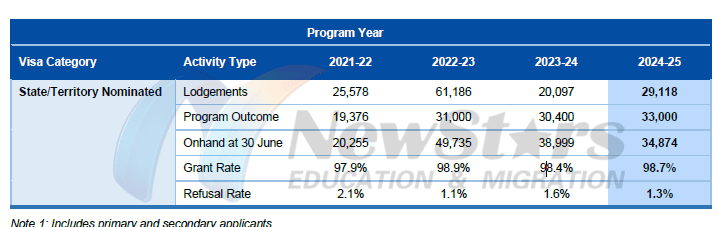
Subclass 491 and Subclass 494 share a combined 33,000 places. In FY24-25 new lodgement volumes in both streams grew by several thousand; Subclass 494 grants slipped slightly, while Subclass 491 rose steadily, so the Subclass 491 backlog fell by more than 7,000.

Across all skilled categories, however, only the regional stream fell short of its cap in FY24-25 — by just 52 places — with every other stream landing right on quota.
Subclass 190 backlog is also falling
By 30 June 2025 it had dropped to under 35,000.

So the combined Subclass 190 and Subclass 491 backlog at the close of the financial year stood at roughly 66,000 — an improvement overall, although new lodgements rose by more than 10,000. That is likely why the Department is once again trimming invitation allocations this financial year to ease the backlog.

Subclass 188 withdrawals outpace grants
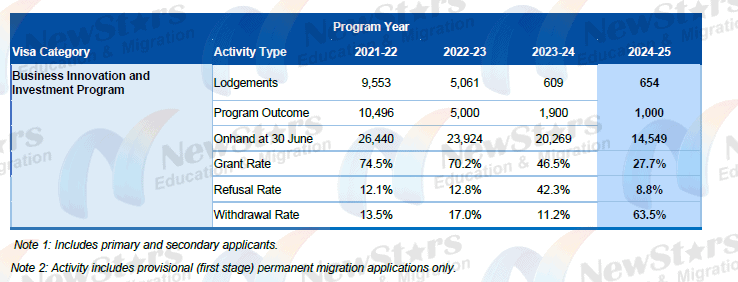
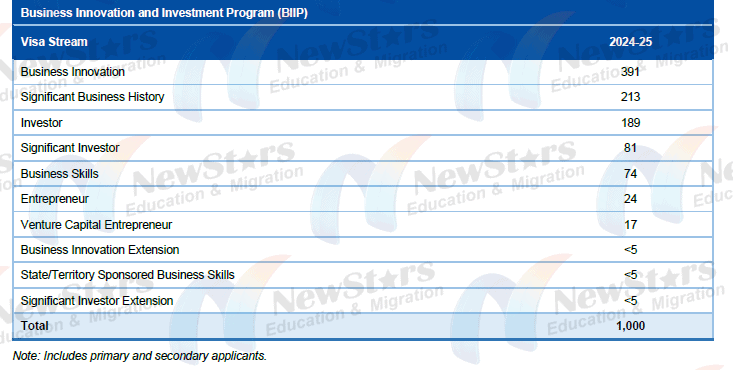
The 1,000 places available each year were fully used up in FY24-25, but spread across each stream the numbers are modest.

As at 30 June 2025, 14,549 applications remain on hand, a reduction of close to 5,000. The withdrawal rate is higher than the grant rate, with most applicants choosing to pull out.

DigiTech makes up roughly half of GTI

43.7% came from the DigiTech sector, with close to 20% from Financial Services and FinTech
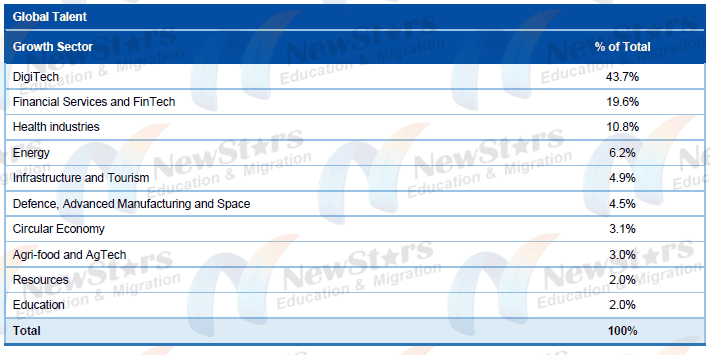
, and Health Industries just over 10%. Because these are the FY24-25 Subclass 858 grant figures, they refer to the former GTI Subclass 858 — not the new NIV.

Partner migration backlog approaching 100,000
*TR stage only
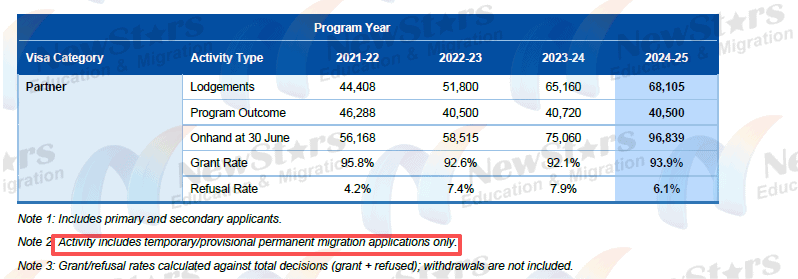
Partner migration at the TR stage (Subclasses 820/309) has, since FY22-23, been climbing by 20,000 a year, and by 30 June 2025 had passed 96,000 — yet new lodgements alone do not look as though they have risen by that much. FY24-25 used up every available place, on par with FY23-24, so why has the backlog grown so sharply?

Parent-migration lodgements are down, yet the backlog remains stubbornly high
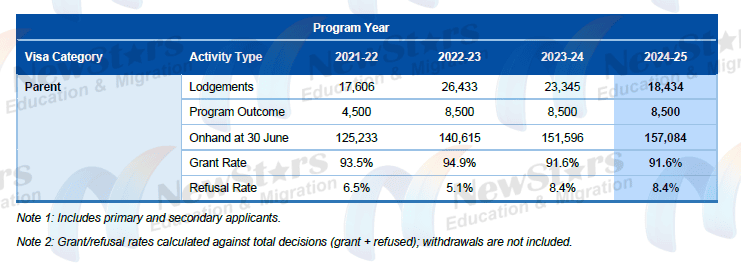
The number of parent-migration applications lodged each year is edging down, but the backlog is still creeping towards 160,000. Subclass 143 has been relatively quick on RFIs recently, but lodging now still means a wait of 14+ years. Once a child has their PR granted, parents should still be arranged to lodge as early as possible — even if that means putting in a Subclass 103 application first simply to get in the queue.

We hope that in the FY25-26 annual report, your own successful case is one of the numbers!


(Filmed in 2021)

QLD and TAS are still issuing pre-invitations! Could points-test reform take shape early next year?


Latest skilled-migration visa data! Big jump in Subclass 190/491 grants, with more than 12,000 Subclass 191 grants in four months

Subclass 189 issues 10,000 invitations | This round’s exact numbers for the “Big Four” and other common occupations, with a projection table!

Migration Information Sharing Group


2025


Step 1: Long-press to add our client liaison

Step 2: After adding, please note

Follow the NewStars Official WeChat Account


In the chat window, [search by code number] to open the article
Code: 01 — Australia’s most popular skilled-migration streams: Subclass 189 / 190 / 491
Code: 02 — One-stop work-to-migration employer sponsorship: Subclass 482 / 186 / 494
Code: 03 — Study first, migrate later: recommended majors and courses
Code: 04 — Pathways for high school, Gaokao and undergraduate study abroad
Code: 05 — An essential step for student migrants: the Subclass 485 Temporary Graduate visa
Code: 06 — What to arrange right after PR is granted: parent migration and parent visas
Code: 07 — Master of Marriage: partner migration
Code: 08 — Pivoting to Hong Kong SAR: the Quality Migrant and Top Talent Pass schemes
Code: 09 — A must for visiting parents, relatives and friends: the Subclass 600 Visitor visa
Code: 10 — Weekly updates on grants, invitations and skills assessments: success stories


Q

Free initial study-abroad and migration consultation  

Sydney

Melbourne

Brisbane

Adelaide

Canberra

Hobart


Perth

Beijing

Guangzhou

New Zealand — Auckland


Leave a comment