491
As I was putting together this article on the NSW Subclass 491, a few questions came to mind:
Is NSW’s current 491 policy worth pursuing?
What kind of applicants are suited for NSW 491?
How can you maximise your chances of receiving a NSW 491 invitation?
With these questions in mind, I reviewedthe current NSW 491 policy and the situation over the past two years,compared the basic requirements for the Subclass 189, NSW 190, and other states’ 491 visas, then reviewed the occupation lists of NSW’s individual RDAs and recent invitation cases,and explored and summarised those three questions — hoping to provide some useful information and insights for our readers.
-
First, what is the NSW 491? The NSW 491 is a five-year provisional visa for which invitations are issued by the NSW Government and then granted by the Department of Home Affairs. During the validity period, visa holders can work full-time and access the Australian healthcare system.One key benefit of the 491 visa is that holders who, within five years, complete three years of full-time work and residence in a regional area and meet the taxable income threshold of AUD 53,900 each financial year may apply for the Subclass 191 permanent residency visa.
-
AsSubclass 189 Skilled Independent visa allocations have dwindled(only 450 Subclass 189 invitations have been issued nationwide this financial year, with the majority expected to be allocated through pathways for New Zealand and Hong Kong Special Administrative Region passport holders)and as the NSW 190 requirements have been further tightened(accounting, auditing, cooking, and the vast majority of IT occupations now require three years of work experience to receive an invitation),the acceptance of the 491 visa among prospective applicants has grown considerably.
-
Our own experience tells us thatmore and more clients are abandoning the pursuit of the 189 and 190, instead looking for pathways better suited to them — and many have chosen the 491. After all, having a long-term visa with a clear goal to work towards is far less stressful than perpetually worrying about uncertain policy changes or invitation rounds.
-
So what exactly is the NSW 491 we’re discussing today? In fact, NSW’s 491 programme has always been evolving. Back when it was the predecessor Subclass 489, arrangements were managed separately by different RDAs, each with their own policies, occupation lists, and invitation timelines. NSW then consolidated all allocations for unified release — a period that saw the major mass-invitation event around May 2020, where virtually anyone living in a regional area with a skills assessment who had lodged an application received an invitation;NSW subsequently struck a balance: unified invitation conditions were set, while each individual RDA retains the ability to set its own occupation list — and this is the policy currently in operation.
-
The NSW 491 currently has three streams, open to the following:
Stream 1: applicants with a skills assessment in an occupation on the list, who are living in a regional area and have one year of work experience in a nominated position in that area.
Stream 2: applicants with a skills assessment in an occupation on the list, who are recent graduates of a regional institution.
Stream 3: applicants who hold a skills assessment in an occupation on the list.
Of these, Stream 1 has the highest requirements and the highest priority, with its own occupation list covering the vast majority of occupations. Stream 2’s priority is also high, but Stream 3’s priority is noticeably lower.It is worth noting that Stream 2 and Stream 3 use the same occupation list, but each RDA sets its own list for those streams. The full list is available by contacting us or via the NSW Government website.
-
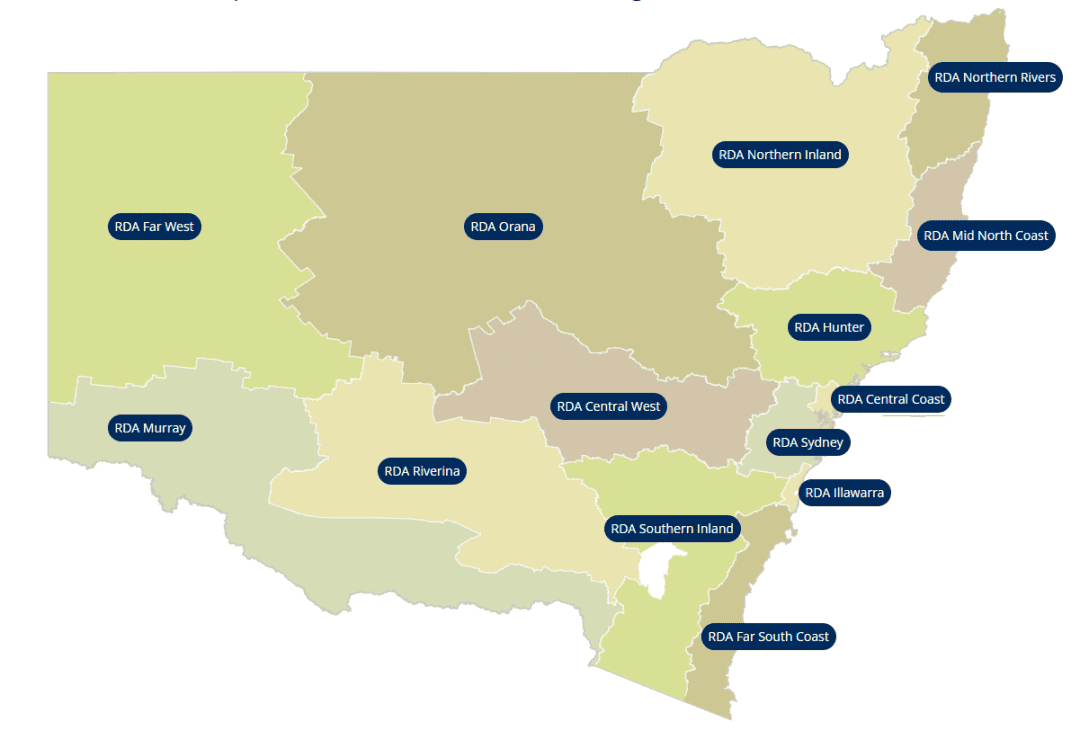
For those new to the NSW 491, the RDAs and their respective occupation lists can be difficult to navigate. The following image shows the distribution of RDAs in detail:
-
As you can see, the regions closest to Sydney are the Central Coast, Hunter (home to Newcastle), and Illawarra (home to Wollongong).The more remote regions are Orana, Far West, Murray, and Riverina to the west. The eastern RDAs include some coastal areas and others bordering Queensland or Victoria, with varying climates and industries. Consequently, each region’s occupation list also differs.
-
For example, the Central Coast — close to Sydney — has approximately 30 occupations on its list, while the slightly more distant Central West has close to 60.
This shows that the more remote the region, the greater its need for skilled workers — and the better the chances of invitation for applicants based there.Each RDA has its own hub, which is typically a well-serviced regional town.


Our Australia-return group with up-to-date information is now active
If you’d like to join,
add our customer service and note: Return to Australia



-
To assess whether the NSW 491 is attractive, it must not only be compared against other visa categories, but also benchmarked against other states.
-
Across the 491,Victoria and Queenslandhave very limited occupation lists,while Tasmania and Western Australiatend to strongly favour local graduates.
Canberra and South Australia stand out as regions with stronger 491 policies and invitation records,with Canberra operating its own matrix-based ranking system — making competition quite fierce — while South Australia generally requires six months of work experience, though for certain occupations such as some IT roles, the requirement is one year.
-
In terms of allocation, given NSW’s size,its quota is relatively generous compared to other states, so the situation where 491 applicants need to compete purely on points has not yet arisen.
How to Increase Your Chances of a NSW 491 Invitation
Given these policies, does simply lodging a Stream 3 application guarantee an invitation? The answer is no. So how can you maximise your chances of receiving a NSW 491 invitation? Here are a few useful points to consider:
–Settle in a specific RDA region and secure relevant employment in your nominated occupation.After a year, your chances of a Stream 1 invitation become quite strong — even if you fall one or two months short of the one-year mark, you may still be considered;
–if you are living anywhere in a NSW regional area, and you genuinely cannot find relevant employment in your nominated occupation,aim to have stable employment or run your own business with a reliable income source; alternatively, even if you haven’t yet found work, you can still lodge a Stream 3 application — applying to the RDA where you reside should carry higher priority than applying elsewhere. Previous invitation rounds have included cases where applicants without employment but living in a regional area were invited;
if you are not yet living in a NSW regional area, or are currently overseas, you may lodge a Stream 3 application — however, the NSW Government has explicitly stated that the chances for overseas applicants, at least for the current financial year, are very low;
When lodging your application, confirm that your occupation is on that RDA’s occupation list.
For example, only five RDAs have accounting on their list:they are:Central West, Far West, Northern Inland, Orana and Southern Inland.So when ‘airdropping’ (applying to an RDA where you don’t reside), always confirm your occupation appears on that RDA’s list. In previous invitation rounds, a small number of applicants ‘airdropping’ from Sydney have indeed received invitations.
Over the past six months, we have seen many NSW 491 invitations across a wide range of occupations and streams. Combined with quarterly lodgement windows and increasingly stable invitation rounds,it is clear that NSW has developed its own 491 invitation mechanism,and its commitment to the 491 programme has been quite genuine.In particular, for applicants whose nominated occupation now requires three years of work experience, regardless of English proficiency, now is the time to consider options beyond the Subclass 189 and 190.Those with relevant employment can accumulate experience and explore employer sponsorship; those without relevant work may find the NSW 491 to be a viable pathway.
Having read this far,
Is NSW’s current 491 policy worth pursuing?
What kind of applicants are suited for NSW 491?
How can you maximise your chances of receiving a NSW 491 invitation?
Do you now have answers to these three questions? If you have any queries, views, or thoughts, feel free to add us on WeChat and get in touch ↓↓↓


Below are some of our successful cases from the most recent invitation round:
*The next NSW 491 lodgement window is in January, with invitations expected in early February.

Nominated occupation: Accountant
EOI score: 75+15
English: 6 in each band
Regional work experience: 1 year

Nominated occupation: Computer Network and Systems Engineer
EOI score: 80+15
English: 6 in each band
Regional work experience: 1 year
Studied in regional area: Yes

Nominated occupation: Food Technologist
EOI score: 80+15
English: 7 in each band
Regional work experience: None

Nominated occupation: Accountant
EOI score: 85+15
English: 7 in each band
Regional work experience: None

Nominated occupation: Architect
EOI score: 85+15
English: 8 in each band
Regional work experience: None
Studied in regional area: No
For a consultation, add our advisers directly to get started!
Study Abroad / Migration
Tips & Guides
Videos
Past Articles

New migration opportunity for overseas applicants! Canberra state nomination opens for offshore 190 & 491!
New migration opportunity for overseas applicants! Canberra state nomination opens for offshore 190 & 491!

Migration pathways “exclusively” for outstanding talents in the arts, culture, and sport

Djokovic detained and visa cancelled — what happened from a migration law perspective?

One-year programme, no prior background, skills assessment passed, language exempted — Subclass 190 achieved!
One-year programme, no prior background, skills assessment passed, language exempted — Subclass 190 achieved!

Migration information sharing and Q&A group

Step 1: Long-press to add customer service

Step 2: Once added, please




Three great developments for overseas migrants to Australia in the new year — how do you choose between three state nominations?Click “Original Link”to watch the video guide!