We’ve just received an email from the ACT Government: newly established for the new financial year, theSmall Business Owner Stream (SBO) has been finalised and sent to agents — the official announcement will go live next Monday, 5 July 2021.

The official version released next Monday is unlikely to change further,
so
with the ACT Government’s approval,
we’ll now walk you through the requirements in detail.
The Small Business streamisstate-nominated skilled migration‘s new branch — once you meet the relevant conditions, you can apply for a Subclass 190 or Subclass 491 visa.
Yes, it’s not just Subclass 491 —
there’s also Subclass 190, straight to PR in one step!
Almost every occupation can apply!
As long as the occupation is on any one of the federal migration occupation lists(MLTSOL/STSOL/ROL/PMSOL)you can apply — not limited to the Critical List ACT currently uses, so basically every occupation can apply!
So if any of the following applies to you:
No hope of a Subclass 189 invitation all year, a complete “zero invitations” year
for example accountants/auditors/architects/lawyers/teachers, etc.
Your occupation isn’t invited in this state
for example accountants in NSW/VIC, quantity surveyors (QS) in QLD…
There are invitations, but the points/work requirement is out of reach for you
for example NSW ICT/engineering, or you can’t find work in TAS…
You’ve just graduated, and the road to scraping together points/finding work is a long one
for example not enough work experience to go for employer sponsorship, or you’ve smashed PTE 8s
in short, students who feel they’ve “run out of options”
and who have some investmentbudget available to you —
the ACT SBO is for you!

Canberra Small Business
Major First-Release Seminar
tonight, 2 July,
9:30pm (7:30pm Beijing time)
First-hand information,
the most important content,
the most professional advice and analysis —
all of it tonight. Press and hold the QR code below to register now!


→ About the Canberra program ←
The original intent behind the Small Business category →Canberra wants more!
In the months leading up to the end of the financial year, the ACT Government had already begun reviewing its 2020-21 state nomination policy, and was actively seeking feedback from outside stakeholders. From what we’ve gathered through our discussions,the government is broadly satisfied with this year’s Matrix invitations and formal nomination allocations, and with how the whole system has been running and performing.However, officials also noted that in the final months they saw a large surplus in the Subclass 491 nomination quota, so on the principle of not wasting a single place, they ran several rounds inviting Subclass 491 only, with the points bar for many occupations dropping to 50/55.In response, they hope to make Subclass 491 more attractive next financial year, broadening the range and type of applicants, so that — with the border closed — more interstate applicants can help fill the gap.This is especially so given they’ve actively secured a bigger quota allocation for the ACT in the new financial year.(It’s now confirmed the ACT has 2,000 places in the new financial year — 1,400 for Subclass 491 and 600 for Subclass 190.)
That’s how the ACT Government’s idea for a small business stream took shape from early May — after canvassing feedback from relevant groups, it moved into final drafting in early June, and with the new financial year in July, the ACT SBO has arrived.
The government’s attitude →Keep up the good momentum, open up a bigger picture
Everyone already knows that migration arrivals help drive the economy. Many state nomination teams sit within economic departments — take Canberra as an example,the Skilled Migration Team sits within ACT Treasury and Economic Development, as part of the economic portfolio,so the most important goal is still driving economic development,and every decision, big or small, carries some degree of economic consideration.

Canberra was only designated a regional area from late 2019 (being the capital, appearances matter, after all). But in terms of population and economic scale, Canberra genuinely sits at a regional-area level, and needs the population growth and economic contribution (business start-ups, spending, etc.) that migration brings.Being designated a regional area brought a series of favourable migration policies, and combined with the effective running of the Matrix system itself, this has attracted a large number of overseas and interstate applicants to apply for ACT state nomination.The pandemic hasn’t slowed this progress either — sound policy design and a well-set occupation list have kept a sufficient flow of interstate applicants coming in.
The government wants to keep this trend going and broaden its scope further still, taking things to the next level through the Small Business stream.
Treated as a long-term program →A careful start, confidently managed
What we’ve learned from the government is that its position is clear:the government understands that this kind of business investment involves a substantial commitment of an applicant’s money and effort, so it has been very careful in designing the policy, and once it’s finalised and in effect, it will do everything possible to keep it stable.
There’s also another advantage to Canberra’s Small Business stream:it sits within the Matrix system, with invitations still governed by Matrix points,so language, qualification and partner points are shared with current general/employer-sponsored applicants, with additional small-business-related bonus points and baseline threshold requirements layered on top.
This means the government can manage the program with confidence, without needing to worry about applicant numbers running “out of control” and having to overhaul the requirements on short notice — which is itself a guarantee of stability for applicants.Invitation scores may rise or fall as the government manages invitation numbers,but the program itself will remain in place, and its conditions won’t swing wildly.
→ Specific policy requirements ←
This is a skilled migration program,
so you need to meet///the basic skilled migration requirements.
Canberra’s skilled migration program already has a general applicant stream (with a small PhD sub-branch underneath it) and an employer-sponsored 482/457 visa-holder stream, and the SBO is the third stream.
So applicants still need to meet the basic conditions for a skilled migration applicant:
At the most basic level, you needa full skills assessment for the nominated occupation,
and thenyour English level.If you’re inGroup 1 (Managers) or Group 2 (Professionals), your English needs to be at least four 7s (PTE is also fine)
Other requirements,such as bringing a partner— your partner also needs to be living in Canberra before you lodge (currently 3 months for Subclass 491, 6 months for Subclass 190), and you’ll needa marriage certificate/cohabitation certificate, or a jointly-lodged visa application on record with the Department of Home Affairs, to prove the relationship.
There are two pathways —
either Subclass 190 or Subclass 491,///each with its own conditions:
Subclass 190 goes straight to PR in one step;
Subclass 491 is provisional PR — you hold a 5-year visa, and once you meet requirements such as pre-tax income of $53,900 a year and living in a regional area for 3 of those years, you can convert to PR.
Based on the Matrix system
it likewise uses Matrix points///less competition this financial year
It still runs on Canberra’s Matrix points, but as a separate stream.
The minimum indicative invitation score the government has given so far:
the minimum Matrix invitation score for Subclass 491 is 65 points
the minimum score to be invited for Subclass 190 is expected to be higher —
specific details on this will be updated later.
65/80 are the threshold scores; of course, if there are more applicants than expected, the score could rise accordingly,but in this financial year, when the program has just launched, the minimum threshold requires only 6 months of operating the business, and with an extra 600 state nomination places on top, we don’t think competition will be especially fierce this year.
Take an applicant who’s just come from interstate:a Sydney-educated Master of Accounting graduate, with a partner, who’s scored a perfect 7 across the board in English.
Before any small-business bonus points, the score they’d typically reach:
Primary applicant’s English: 10 points
Partner’s English (perfect 7s): 5 points
Partner holds a higher education qualification: 5 points
Occupation on the ACT Critical Skills List: 20 points
Master’s qualification: 15 points
that’s already 55 points right there.
There are other points reasonably within reach too, such as
primary applicant’s English at perfect 8s: 15 points (5 more than perfect 7s)
living in Canberra for 1-2 years: 5 points
and don’t forget the corresponding small-business bonus points too (10 points for 6 months of operation, 20 points for 12 months)
The ACT Matrix has plenty of bonus-point categories — if you’d like your own points assessed, get in touch directly via the consultant QR code below!




→ Prerequisites for a state nomination application ←
Canberra small businesses that can be used for an application:
1. Setting up your own new company
2. Buying a small business, holding a stake of 51% or more, and meeting the requirements by running it
The difference between Subclass 491 and 190:
there isn’t much difference in the operating prerequisites, but the longer you operate the business, the more points you earn;
but in terms of the applicant’s visa status:
Subclass 190 applicants need a visa allowing at least 35 hours of full-time work per week,
while Subclass 491 applicants only need a visa allowing at least 20 hours of work per week — meaning a student visa is fine too.
Requirements for Subclass 190
Residence requirement:
at least 6 months of continuous residence before submitting Matrix
Business requirement:
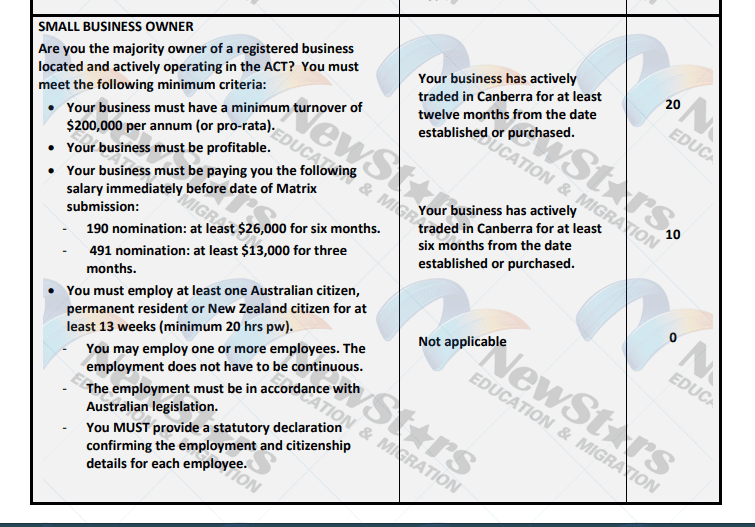
— As the majority shareholder (holding over half the ownership) of an ACT-registered local business, you must have operated the business for at least 6 months.
— The business must have an annual turnover of at least $200,000 AUD (pro-rated for a period under/over a year)
— The business must be profitable during that period
Employment requirement:
— As majority shareholder, the applicant must draw a salary of at least $26,000 from the business over 6 months (the applicant must have full-time work rights)
— Must employ at least one Australian citizen/PR holder/New Zealand citizen, for at least 13 weeks before submitting Matrix, working no less than 20 hours a week. The employment doesn’t need to be continuous, and doesn’t have to be a single person (for example, you could employ A for 7 weeks, then, 2 months later, employ B for 6 weeks)
Requirements for Subclass 491
Residence requirement:
at least 3 months of continuous residence before submitting Matrix
Business requirement:
— As the majority shareholder (holding over half the ownership) of an ACT-registered local business, you must have operated the business for at least 6 months.
— The business must have an annual turnover of at least $200,000 AUD ($100,000 AUD for 6 months)
— The business must be profitable during that period
Employment requirement:
— As majority shareholder, the applicant must draw a salary of at least $13,000 from the business over 3 months (the applicant’s visa doesn’t need full-time work rights — a student visa is fine too)
— Must employ at least one Australian citizen/PR holder/New Zealand citizen, for at least 13 weeks before submitting Matrix, working no less than 20 hours a week. The employment doesn’t need to be continuous, and doesn’t have to be a single person either (for example, you could employ A for 7 weeks, then, 2 months later, employ B for 6 weeks)
there are a few things you can’t do:
① The operating period must be evidenced by BAS statements— in other words, 6 months of operation needs at least two BAS statements submitted; 12 months needs four.
② The ACT Government does not recognise the following as a “business”:sub-tenancy, ride-share (things like Uber), taxi driving, delivery or courier work,or a business already used for a previous Small Business stream application (this mainly has implications later on)
As well as meeting the prerequisites,
you can also meet the bonus-points requirements.
Whether you’re a Subclass 190 or 491 applicant, meeting the Small Business prerequisites can also satisfy the bonus-points criteria.
Small business operation bonus points:Meeting the above conditions while operating a Canberra small business for 12 months can also earn bonus points — 20 points for 12 months, 10 points for 6 months.
Hours-worked bonus points:If the applicant works at their own business, this can count towards hours-worked bonus points — 5 points for 6-12 months, 10 points for over 12 months.
The advantages of Canberra’s Small Business stream!!!
Covers all skilled migration occupations — no need to worry about list changes
Occupations on all four current occupation lists can apply, so the vast majority of students will be able to find their own occupation on there. Also, Canberra’s current critical skills list is reviewed every four months, and while the adjustments each time aren’t usually large, they do genuinely make some students nervous.SBO applicants going forward can put that worry to rest.
No minimum investment requirement, and turnover requirements aren’t high
The government deliberated at length over the investment and turnover figures, and we also gave repeated feedback to the government during the process, before finally settling on a $200,000 AUD turnover figure, with no minimum investment requirement. First, the government looked into the general operating costs and models of small businesses currently being started by international student graduates.Second, it’s very clear about who it wants to attract — mainly international student graduates,not business owners who already have many years of commercial experience.
So,not setting a minimum investment requirement is meant to encourage them to try the business they want to try at a lower threshold,and through this, bring new vitality and business opportunities to Canberra. At the same time, though,the government also wants applicants to genuinely put their heart into running the business, ideally growing it sustainably, rather than treating it as a “one-off deal” purely for migration purposes,keeping a constant eye on their own turnover — which is why the $200,000 target was ultimately set.
Lower difficulty for interstate students to scrape together points
Previously, compared with local graduates, part of the challenge for interstate students was scraping together points — they lacked a local qualification, and also didn’t have enough residence/work time behind them.With the boost of the Small Business stream’s 20/10 bonus points, meeting the 65/85-point requirement isn’t difficult at all.
Take the same example as before — a Sydney-educated Master of Accounting graduate with a partner and perfect 7s in English — we worked out earlier that they already have 55 points.
If applying for Subclass 491, running a small business for half a year adds 10 points, taking it to 65 — meeting the invitation score outright.
If applying for Subclass 190, running a small business for 1 year adds 20 points, and a full year’s residence adds 5 points, taking it to 80 — just 5 more points needed.
Overall, Canberra’s Small Business stream shows real substance, offering applicants with some financial means and a willingness to start a business a different path into skilled migration.
We’ve already consulted comprehensively with leading Canberra accounting firms, lawyers, business sale agents, small-business start-up incubators and more, and can provide applicants with end-to-end guidance in partnership with these collaborators.
For details on the program’s state nomination rules, company formation, acquisitions and more, please contact the consultant below!

Newstars Education & Migration · Canberra
Canberra’s largest migration agent and lawyer team, at your service!
“Canberra’s Best Migration Agent” — as voted by Canberra’s leading local English-language media

⭐ Market share as high as 59.5%!
⭐ Years running as the clear leader in state nomination submission volume!
⭐ Over 300 five-star Google reviews!
⭐ Named “The Best Immigration Agents in Canberra” by Canberra’s local English-language media!
⭐ Providing study visa and migration services to clients from over 30 countries!
📍 Charting the course for your study and migration journey!
📍 Your dream, one step closer with us!

This video series is presented byReed — an officially registered Australian migration agent who has handled a large number of migration cases, known as the “State Nomination Queen” —explaining the best-quality option in Australian skilled migration:Canberra state nomination. The content coversnew policy updates, document preparation, risk avoidance, and application essentials,and more. Everyone’s welcome tosearch for and watch “State Nomination Talk” on Video Channel (WeChat Channels), Xiaohongshu, YouTube, and Tencent Video!