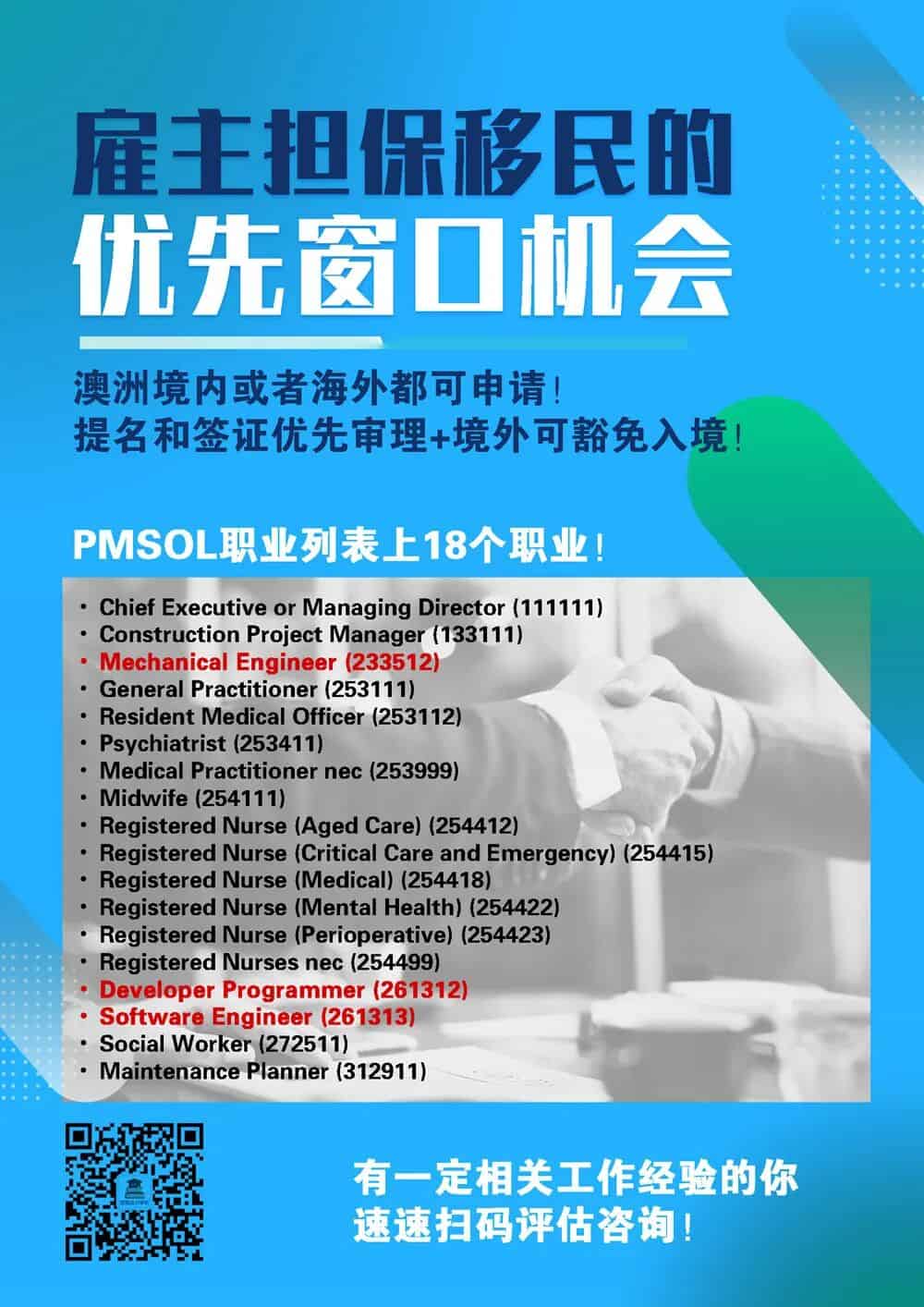
Australian employer-sponsored visas are mainly divided into employer-sponsored temporary visas and employer-sponsored permanent visas. The employer-sponsored temporary visa categories currently include the Subclass 407, Subclass 482 and Subclass 494 visas. The employer-sponsored permanent visa is the Subclass 186 visa. Our previous article covered the Subclass 482/494/186 visas in detail — you can revisit it here: Accounting, ICT and other occupations have recently been getting approvals! Still scrambling for points for the Subclass 189/190/491 visas? Still waiting anxiously for an invitation? You can switch to this Plan A!
This article, however, mainly introduces a lower-threshold, stepping-stone option: the Subclass 407 Employer-Sponsored Training visa, while also answering some of the questions that applicants frequently raise.
Subclass 485 about to expire? Have some work experience?
The Subclass 407 could be a good fit
The Subclass 407 Training visa was introduced by the Australian Government on 19 November 2016, replacing the Subclass 402 Training and Research visa. The government’s original intention was to promote Australia’s successful training system, encouraging Australian organisations to offer training opportunities to help professionals enhance their skills. If your current student visa or Subclass 485 visa is about to expire, but you still want to remain in Australia to build relevant professional work experience, the Subclass 407 Training visa may be a very suitable option for you.

The Subclass 407 visa is generally granted for a period of 2 years. It can also include family members in the visa application.
Which applicants can be “trained”?
There are generally three types
of training. Under the Subclass 407 visa framework, training is divided into three categories:
1. Training to obtain registration for a specific occupation.
2. Training to improve occupational skills.
This is the most common category. Sponsoring organisations can offer, for applicants who already have some professional experience, work-practice-based training programmes to help them improve their occupational skills.
3. Occupational training for overseas capacity building

A closer look at skills-improvement training
Let’s focus on the second training category — training to improve occupational skills.
This type of training is particularly suited to graduates who already have some qualifications or work experience in Australia.
The following conditions must be met:
1. Obtain nomination from an employer.
2. The employer must be an organisation legally registered and legally operating in Australia.
3. When applying for nomination, the employer must identify the nominated occupation and provide a training plan specifically tailored to the visa applicant.
4. English at Functional level (equivalent to an IELTS score of 4.5).
5. Demonstrate a genuine intention to reside in Australia only temporarily.
6. Within the past two years, the applicant must have at least one year of full-time study or work experience closely related to the nominated occupation.
7. Have sufficient funds to support their stay in Australia.
8. Have adequate health insurance.
The Subclass 407 is one of the best choices —
it comes with several advantages:
1. The official visa application fee is low — just AUD 310 for the primary applicant.
2. You can obtain full-time work rights for up to 2 years, with multiple entry; paid training is allowed; you can bring your spouse and children; and your spouse can work full-time.
3. No cumbersome occupational registration or skills assessment is required.
4. You can change employers.
Therefore, the Subclass 407 visa is one of the best options while you wait for a skilled migration invitation, or as a follow-on visa once your Subclass 485 or Subclass 500 visa expires. For detailed advice, please contact one of Newstars’ professional migration consultants!


Frequently asked questions

What is the employer sponsorship application process and timeline?
A1: Generally speaking, all employer sponsorship application processes are largely the same, and consist of three steps.
Step 1, Sponsorship
— that is, the employer sponsorship eligibility application. This mainly assesses the sponsoring company’s qualifications, company size, profitability, number of employees, and so on. It generally takes 1–4 months to process.
Step 2, nomination
— the employer nomination application. This is the key and most difficult part of the whole employer-sponsorship process, and generally takes around 2–6 months to process.
Step 3, Visa application
This is the final step — obtaining the employer-sponsored visa. It generally takes 3–6 months to process; the Subclass 407 and Subclass 482 visas tend to be faster, at around 1–3 months, while the Subclass 186 and Subclass 494 visas take around 3–6 months.
*The processing times above are for reference only — every case is assessed individually (case by case).
Which employer companies can act as sponsors? Is the employer I’ve found on my own suitable?
A2: A qualified and suitable employer is the key factor in your entire employer-sponsored visa application. You therefore need to find an employer that suits your own circumstances to sponsor you, so as to ensure you ultimately obtain the visa. The right sponsoring employer varies by occupation, but generally speaking, the longer the employer has been established, the greater its growth potential, and the stronger its profitability, the higher the likelihood of passing the employer sponsorship eligibility assessment. This needs to be assessed case by case, so once you find an employer willing to sponsor you, be sure to consult a professional migration consultant to help assess whether that company is suitable to sponsor you.
Is there any risk with employer sponsorship?
A3: There is a degree of risk in everything. Applicants — especially those inside China — often ask me whether employer-sponsored migration is high risk. I often need to spend a lot of time explaining that it’s because people generally know very little about employer-sponsored migration visas, so they assume it carries a lot of risk, since it’s not the same as the Subclass 189 skilled independent visa or the Subclass 190 state-nominated skilled visa, after all.
But in fact, employer-sponsored visas also fall within the skilled migration visa category, and are in fact one of the visa types with the highest share within the skilled migration category, provided the applicant meets the relevant conditions and the employer they have found satisfies the Department of Home Affairs’ requirements, the risk with an employer-sponsored visa can be well managed — in fact, it is a faster migration pathway than independent skilled migration.
What are the fees for an employer-sponsored visa? Are they refundable?
A4: The fees for an employer-sponsored visa mainly include the application fee, the SAF Levy, third-party costs, and so on.
Generally speaking, all visa application fees are non-refundable. Once the Department of Home Affairs begins processing your case, that means it has already put in the work — so regardless of the final outcome, the visa application fee will not be refunded. SAF LevyThis is also a fee collected by the Department of Home Affairs, and it too is non-refundable.
As for third-party costs and so on, these also need to be assessed case by case and cannot be generalised.
Who is suited to applying for employer sponsorship?
A5: The Subclass 407 visa and the Subclass 482/494/186 visas suit a very wide range of applicants — the eligibility conditions for applicants have already been covered in detail above.
The Subclass 407 visa suits young people holding a Working Holiday visa, recent international graduates who need to build up work experience, and applicants who, while holding the 407, can look for a suitable sponsoring employer with migration as their eventual goal;
while the Subclass 482/186/494 visas, among others, suit onshore and offshore applicants whose own circumstances don’t meet the points requirements for independent skilled migration or state-nominated migration, and who have 1–3 years of work experience, to ultimately obtain permanent residency in Australia — this can be a more suitable and faster pathway than the Subclass 189/190 skilled migration categories, and considerably easier than persisting with the 189/190 skilled migration route.
If you have quite a long period of work experience in China or elsewhere, going via the 482-to-186 pathway, or applying directly for the Subclass 186 employer-sponsored visa, to obtain Australian permanent residency is very convenient and cost-effective.

One-on-one assessments welcome
If you’d like to assess your role, work experience and employer,
or plan out the migration option that currently suits you best,
feel free to contact me directly for a one-on-one assessment!
Recommended short videos
GTI update

Click the image to read the full article

Hailed as Canada’s easiest study-to-migration pathway! Manitoba’s relaxed policy, suited to applicants across a wide range of circumstances

Subclass 189 & 190 grants pouring in! PR quotas for popular categories already used up! “Australia’s high-volume migration intake is planning a comeback!”

Teachers/doctors/architects/researchers… all being invited! A low-cost, no-language-requirement, fast Australian migration program — opportunities across every industry

Will Australia’s borders only reopen in 2024?? NO! Here’s what everyone is actually saying! Subclass 190/189/491 processing wait-time data — updated!

“The Australian Government is clearly planning to restore high migration numbers!” “It needs a large, selective migration program more urgently than other countries!”


A green card in one step! What low-cost programs are there for Australia-based/China-based applicants to migrate to Canada?

Migration information-sharing and Q&A group

Step 1: Press and hold to add our customer service contact

Step 2: After adding, please










Great value! Highly flexible! Extremely low threshold! Suited to all kinds of applicants!! Click ‘Original Link’, to learn about work-while-you-study options!