Here we are at the start of another month, and once again we’re bringing you an update on the Subclass 189 EOI backlog. This time we’re focusing on secondary school teachers, early-childhood teachers, social workers and nurses. February should see another invitation round, so the data up to the end of January is particularly meaningful.We’ll also touch on early-childhood teacher registration — we’ve contacted the various state governments and responses are starting to come in.
First, let’s look at how much of the Subclass 189 quota is left
The Subclass 189 allocation for this financial year is 16,900. The first half of the year has already seen two rounds totalling close to 17,000 invitations, so on this data alone the second-half invitation volume is likely to be smaller than the first half.
However, the August acceptance rate was under 70%, and the final November acceptance rate is still uncertain. Invitees have 60 days to lodge after receiving an invitation, and we’ll soon have the lodgement data up to the end of January — once in hand, we’ll have a fuller picture of acceptance rates.
Now let’s look at the Subclass 189 EOI backlog for the four key occupations
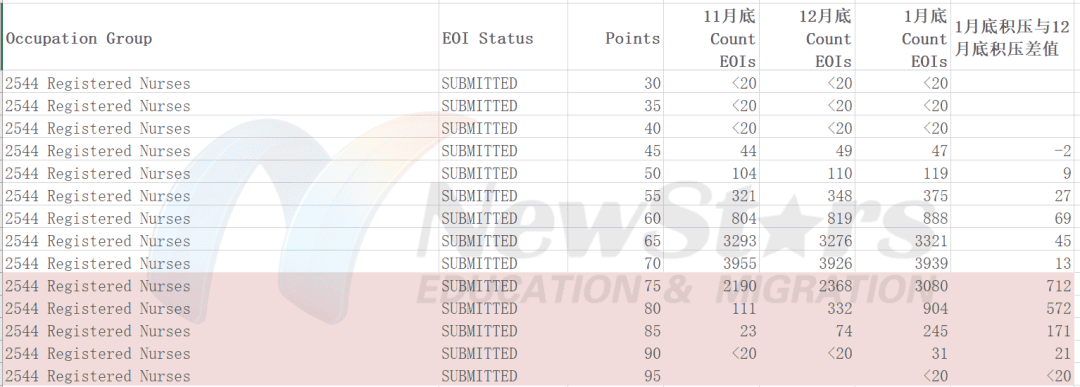
Nursing —
The nursing backlog is always huge, but it’s offset by very large per-round invitation volumes. The 75-and-above backlog already exceeds 4,000; based on the 2,000+ invitations issued in the last round, we expect at best a partial invitation of 75-point candidates — so 80 points and above remains the safer mark for nursing.
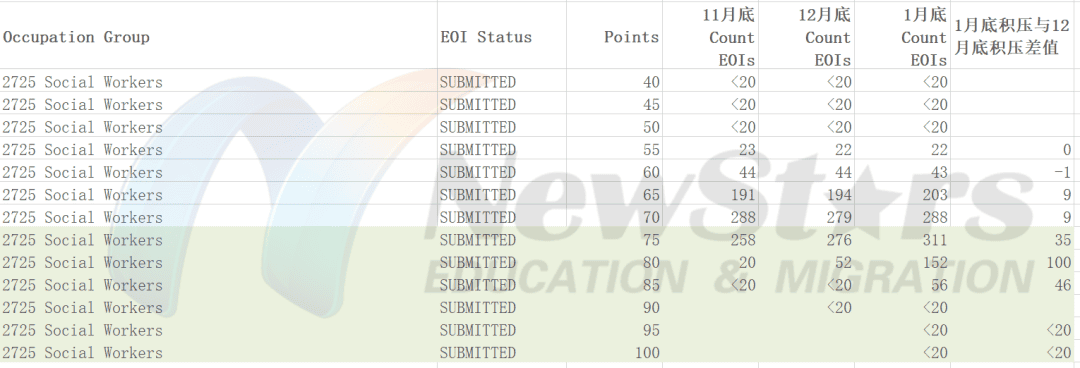
Social Work —
Social work is probably the healthiest of the three “treasure” occupations in backlog terms. The 75-and-above total backlog is around 500, but we can already see competition intensifying at the higher score bands, with 95- and 100-point applicants starting to appear. Based on the last round, 75-point applicants still have a realistic chance of being invited.
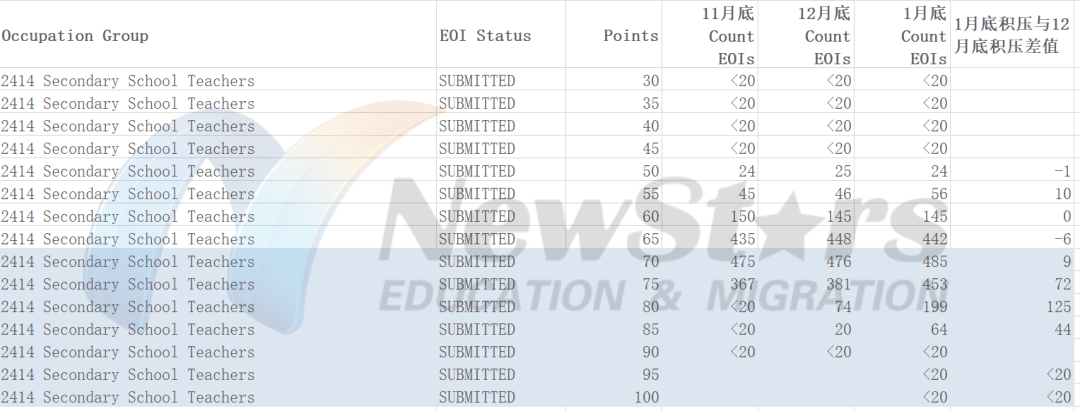
Secondary School Teachers —
The backlog here is relatively healthy. In the last Subclass 189 round, 75-point secondary teachers were invited (around 400–500 issued), but high-score competition is still strong. Although the November round cleared out the 80-and-above backlog from late October, the 80-and-above backlog has already rebuilt to almost 300, and high-score applicants are increasing. The next round’s invitation threshold will likely again sit at 80 points and above; whether 75-pointers get through depends on how many invitations are issued.
Early-Childhood Teachers —
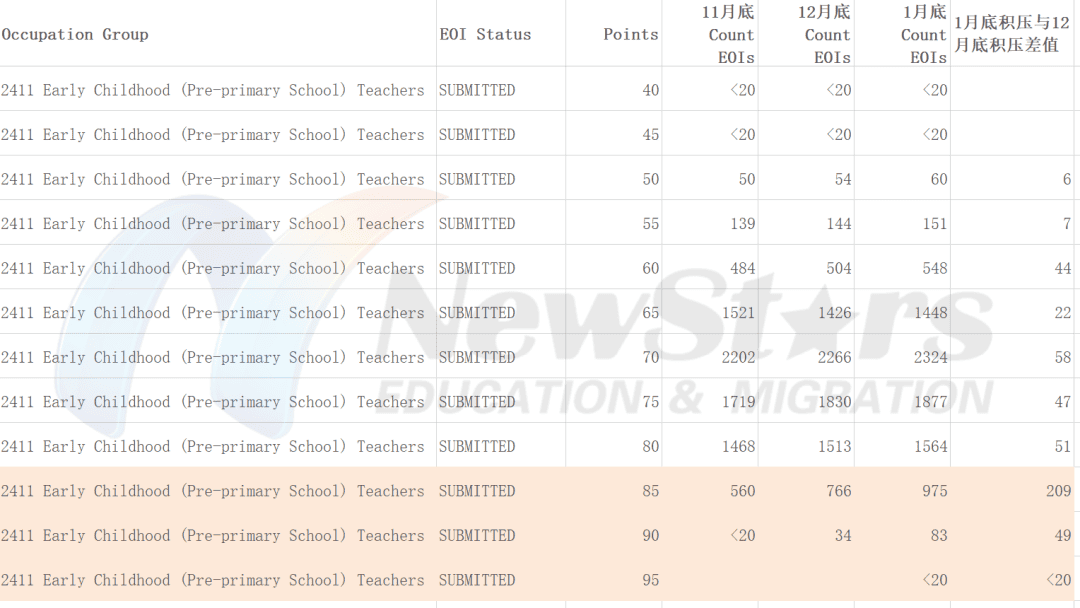
The early-childhood 85-and-above backlog exceeds 1,000, with 85-point numbers growing by over 200 per month, and 90-point numbers up by 49 in a single month.
For early-childhood teachers, the only play is to push your point score as high as possible. If a suitable opportunity opens up in another state, commit to it — don’t let it slip. We’ve mentioned before the example of an applicant who decisively moved to WA, found work and secured a Subclass 190.
[The recent early-childhood teacher registration issue]
How it started
NSW and SA have adjusted their registration requirements for Early Childhood Teachers (ECTs). From January this year, completing a Graduate Diploma (GD) no longer satisfies the ECT qualification requirement — GD holders can work only as educators, not as ECTs. Those already in the role are unaffected.
What does this mean for ECTs applying for skilled migration?
First, a key distinction:
1、teacher registration is not the same as the skills assessment required for migration. ACECQA, the early-childhood skills-assessing authority, has not changed any of its assessment requirements.
2、Whether you need teacher registration to work in early childhood depends on each state
States that do NOT require it —
ACT: not required unless you’re attached to a school
QLD: not required unless the employer asks for it
NT: ECTs don’t need it; preschools attached to schools do
TAS: ECTs don’t need it; kindergartens attached to schools do
States that DO require it —
NSW: mandatory registration since July 2016; GD has not satisfied registration since October last year, but students enrolled before 2026 are unaffected
SA: mandatory registration since 2016; even with later amendments, the GD course is still not recognised
VIC & WA: registration required, GD recognised
Although SA and NSW are strict, teacher registration is portable between states — so there are cases of applicants registering in a GD-recognising state and then transferring to SA.
So what’s the actual impact?
No impact on skills assessment, no impact on Subclass 189, and the impact on teacher registration is limited in scope
The impact on Subclass 190 and 491 is also not at the skills-assessment stage — it’s at the state-nomination employment requirement: if you can’t secure an ECT offer or relevant experience, you may not be able to apply or you may not be competitive.
The core issue for early-childhood is still the sheer competition
1. Even 85 points means a longer and longer wait
In last November’s round for the three “treasure” occupations, nursing and social work were invited at 75 points, but early-childhood only at 85. And while nursing has a big backlog, it also gets big allocations — the last round issued 10,000 invitations in total, with 2,000+ going to nursing, but only 200–300 to early-childhood.
At a cadence of roughly one Subclass 189 round per quarter, the next round is around February, the quota is 16,900, and the first two rounds have already used 17,000. The August round had a 70% acceptance rate and the November round’s rate is unknown, but we can expect that not many more invitations will be issued. If the allocation is similar to the last round, almost half will go to 90-pointers, and the wait for 85-pointers will inevitably slow further.
2. If you’re still planning to start a one-year early-childhood GD, proceed with caution and prepare mentally
Competition in early-childhood is already intense, and any policy ripple amplifies the anxiety. This adjustment sends a clear signal: the path of using a one-year GD for fast-track early-childhood migration should now be planned for a long wait — the “quick path” is gradually disappearing.Early-childhood already has a high backlog and low allocations, and with industry changes on top, the future is even less certain.That said, for many people there may not be a better pathway than early-childhood. In that case, the only thing to do is walk the current road steadily: push for more points where you can, look for work where you can, and don’t miss opportunities. If moving interstate presents a good option, consider it.
If there are further updates from teacher-registration authorities or ACECQA, we’ll pass them on promptly.
Invitation outlook for the first half of 2026
Overall, given that the remaining Subclass 189 quota isn’t particularly generous, invitation numbers and cut-off scores in the second half of the financial year are unlikely to produce big surprises (though of course we’re hoping for some). High scorers can still be optimistic; middle-band scorers should adjust expectations. If your visa is nearing expiry, start mapping out your fallback options early.
However, because state-nomination allocations arrived relatively late this year, we can expect state-nominated invitations in the second half of the financial year,so keep pushing for points. If adding points isn’t realistic, take a closer look at the various state policies — as we always say, opportunities don’t wait, and the more roads you walk, the fewer you find left. Wishing everyone a successful landing, sooner rather than later!
For professional advice, please contact us via the QR code below ↓

(Photographed in 2021)
The full story behind “Perth to be removed from the regional area” — who may be affected and how to respond

Latest processing data: Subclass 190 and 491 grants continue to accelerate!

A wave of Parent visa Queue Letters arrived over the weekend — revisiting the 143/103 “queue letter”

Migration news sharing group
2025
Step 1: Press and hold to add our consultant

Step 2: Once added, please


follow the NewStars official WeChat account

Free initial study-abroad and migration consultation
Sydney

Melbourne

Brisbane

Adelaide

Canberra

Hobart

Perth

Beijing

Guangzhou

New Zealand — Auckland