Today, the Sydney Morning Herald published an article that has sparked plenty of discussion.

Already overtaken
Significant Urban Area
(Significant Urban Area)
Population data is most authoritatively published by the Australian Bureau of Statistics, and after the 2021 Census, they revised the boundary of Melbourne’s Significant Urban Area, adding Melton on Melbourne’s north-western fringe. MeltonThis addition meant Melbourne’s Significant Urban Area population had already reached 4,875,400 by June 2021, which means Melbourne’s Significant Urban Area population had already exceeded Sydney’s back in 2018.

So why did the Australian Bureau of Statistics change the boundary?
Andrew Howe, a demographer in the regional population division, said the change to Melbourne’s boundary was driven by the rapid population growth on Melbourne’s western fringe. Between 2011 and 2021, the population of the Melton area grew by 61%. “The 2021 Census tells us that, statistically, Melton and the rest of Greater Melbourne are now a single continuous area.
“Before the 2021 Census definition, Sydney’s Significant Urban Area population was higher than Melbourne’s. However, with Melton folded into Melbourne under the latest Significant Urban Area classification, Melbourne’s population is larger than Sydney’s — and has been since 2018.”

Still almost 10 years away
Greater Capital City Statistical Area
( Greater Capital Cities
Statistical Area)
The Greater Capital City Statistical Area is another common measure of a major city’s population.
Including the Central Coast, Greater Sydney had a population of 5.26 million in June 2021, while Greater Melbourne had 4.98 million.By this measure, Greater Sydney still has a larger population than Greater Melbourne.However, the latest population report released in January predicts Greater Melbourne will overtake Greater Sydney in 2031–32.
Professor Nick Parr, a demographer at Macquarie University, said the main reason for Melbourne’s faster growth is the difference in net internal migration.Sydney continues to lose people to other parts of Australia, with residents moving from Sydney to regional NSW, Queensland and Victoria.
Because of the pandemic, both Melbourne’s and Sydney’s population growth rates went through a “collapse” phase in 2020 and 2021, but both are now recovering. Professor Nick Parr also noted that Melbourne’s net overseas migration rate also tends to be higher than Sydney’s.
NSW — still firmly the largest state
The latest figures, to 30 September last year, make this clear. Comparing NSW and Victoria alone, NSW’s overseas-migration advantage is gradually no longer enough to offset its interstate-migration losses. But NSW’s position as the largest state remains fairly secure: NSW has a population of 8.23 million, about 1.5 million more than Victoria’s 6.72 million.
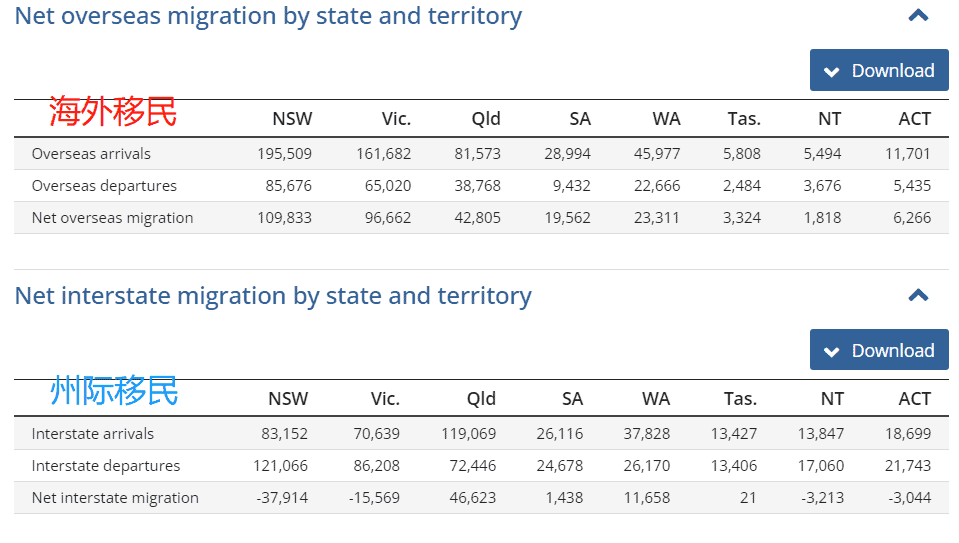

Speaking of migration and population, many people naturally think of the “rental crisis” that erupted earlier this year. Rents in cities such as Sydney, Canberra and Melbourne have soared. The return of temporary migrants such as international students is of course one factor, and the Treasurer has acknowledged that the inflow of temporary migrants has been larger than the government expected. But many people simply pin the blame solely on temporary migrants.
And today, the Minister for Immigration “liked and shared” the following article


The author is this person:

A “side effect” of the pandemic: more people want a place of their own
When the pandemic struck in early 2020the average Australian household size rose from 2.51 people per household to 2.55 people. That may not look like much, but in real terms it reduced the number of households across Australia by 162,000, which played a significant role in the drop in rental demand in the first few months of the pandemic.
The pandemic then had all sorts of effects on people’s living arrangements. Whether out of weariness with overly close family living, or because house prices and rents were falling, more and more people in Australia wanted a place of their own. Between the third quarter of 2020 and the second quarter of 2022, the average household size fell from 2.55 people to 2.48 people. This increased demand for housing by 288,000 dwellings, more than offsetting the drop in demand in the early months of the pandemic.
For this reason, rents in capital cities had already begun to rise, climbing 8.5% in 2021, at a time when interstate borders had opened but international borders remained largely closed.
Temporary migrants during this period: a double-edged sword
Between March 2020 and December 2021, the number of temporary migrants who might need housing fell by 328,000, which, at Australia’s average rate, reduced housing demand by 131,000 dwellings.
In 2021, with international borders still closed, the number of temporary visa holders who might need housing fell by 147,000, putting enormous downward pressure on rents. But people already in Australia could move about freely, and seeing cheaper rents — combined with the psychological impact of lockdowns — more and more people already in Australia wanted a home of their own.
In early 2022, the latest figures from the Department of Home Affairs, up to February, show that the number of temporary visa holders who might need housing had risen to 444,000 — 116,000 more than in 2020.
So the author argues: yes, the number of temporary migrants has surged; yes, new permanent-residency numbers have hit a record high in recent years — but the root cause of the rental crisis is not migration; it is the rapid changes the pandemic has brought to the way we live and work.It is simply that the normalisation of temporary migration has intensified the rental crisis.
So the fundamental question is: where will all renters in Australia — citizens and visa holders alike — be able to live in the future?
RBA Governor Philip Lowe predicts that, at least until 2025, Australia’s population will continue to grow faster than its housing stock.
And ultimately, it is federal government policy that has caused the projected population growth to outpace home building — not the choice of individual migrant families.
Migrants and locals can probably do the same thing: there are signs that share-housing is on the rise, with more and more people sharing with family and friends.
Finally, picture this little scene. A migrant stands there muttering quietly to themselves: You said you needed me, you told me to come, so I came. Now that I’m here you make me the scapegoat — as if being the scapegoat means I don’t have to pay rent…
Past articles worth a look
Migration reform report to be released before 9 May! Engineering/IT and other occupations invited by NSW on 50–65 points

NSW Subclass 190 latest round invites as low as 65 points! These occupations are getting invited so easily

March visa and state-nomination processing snapshot | Skilled categories speed up, states ramp up formal nominations

Migration news sharing group
2023
Step 1: Press and hold to add our customer service

Step 2: After adding, please


Study, migration and visas — we are the professionals



Attention!Please verify a genuine NewStars consultant!

Study and migration enquiries — customer service by location

Sydney

Melbourne

Canberra

Brisbane

Adelaide

Hobart

Beijing

Guangzhou
Follow the NewStars official account
On our official account, reply with one of the numbers or any keyword below (not in the article comments) to get the most timely and professional migration news!Reply [A] to view the directory (covering every topic)!
Reply: 0000 → view the 16 Nov new-policy update (491 + skilled migration points test)
Reply: 000 → latest visa/citizenship processing wait times
Reply: 001 → latest 189 EOI official report
Reply: 002 → 189 Skilled Independent migration
Reply: 003 → state-by-state 190 nomination
Reply: 004 → 489 regional state nomination
Reply: 005 → international-student start-up and investor migration
Reply: 006 → parent migration visas
Reply: 007 → employer-sponsored visas
Reply: 008 → Subclass 485 visa
Reply: 009 → partner migration/points
Reply: 010 → work-experience points
Reply: 011 → PY points
Reply: 012 → NAATI/CCL points
Reply: 013 → regional points
Reply: 014 → tourist and family-visit visas
Reply: 015 → working holiday visa
Reply: 016 → TAFE study
Reply: 017 → Australian graduates migrating to Canada
Reply: 018 → 407 Training visa
Reply: 019 → 408 Temporary Activity visa
Reply: 020 → New Zealand migration
2023 recommendations