A six-year wait for a single PR grant — challenged for marriage fraud, hit with a serious S57, and finally approved after a long written submission plus multiple rounds of further information!
by Qiqi CHEN
A 2019 client first contacted us back in to lodge an onshore partner-migration application. After six years, the 820 and 801 PR visas were finally granted together. Let’s look at what they went through over these six years.
Timeline
September 2019 — application lodged2021 — received the first S56 request for further informationDecember 2023 — received a serious S57 noticeJanuary 2024 — S57 response lodged through usAugust 2025 — received a second S56 request for further informationOctober 2025 — received a third S56 request for further informationEarly November 2025 — visa grantedThroughout this period, we proactively assisted the client with multiple rounds of additional supporting material
Four years of waiting, and what arrived was an S57
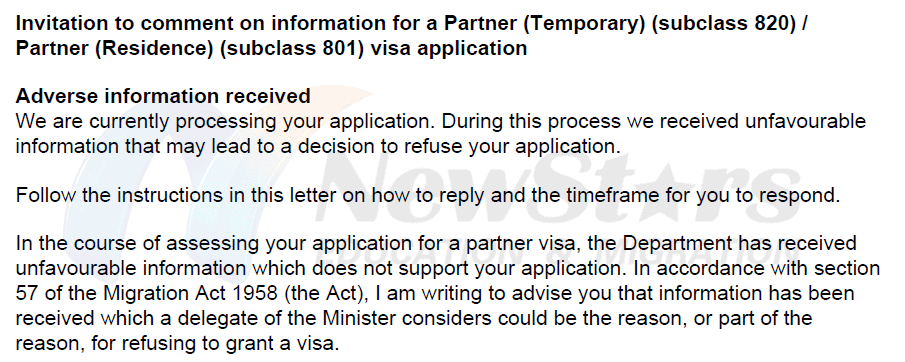
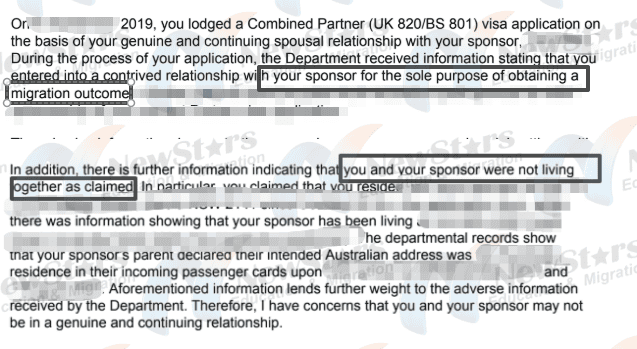
After the application was lodged in 2019, processing on this couple’s file ran noticeably slower than other partner-visa applications of the same type. We proactively submitted additional material on our own initiative, and in 2021 received the first request for further information — a routine top-up of relationship evidence. Another two-year wait followed.At the end of 2023 the S57 serious notice arrived. The Department of Home Affairs suspected marriage fraud, citing unusual financial movements between the couple and what appeared to be non-cohabitation. If the S57 could not be successfully addressed, based on our experiencethe most likely outcome would be refusal plus a three-year PIC 4020 bar. We immediately sat down with the client for a detailed conversation to understand the real story behind each concern raised by the Department.From the client’s account, although the fact that the couple had no children together would make the explanation and evidentiary burden even harder, we believed there was enough room to argue and explain the position.After we walked the client through the overall strategy and the reasonable risks involved, they decided to work with us and give it their best shot. Once the full line of reasoning was mapped out, we immediately began drafting the S57 response.Based on the client’s circumstances, our lawyer dug deep into migration law and case law for supporting authority, drawing heavily on case law in particular. At the same time, we kept helping the client gather as much corroborating evidence as possible from every angle, going through many rounds of back-and-forth communication and revision in the pursuit of a polished, watertight submission.The S57 response, together with the supporting material, was lodged in January 2024.
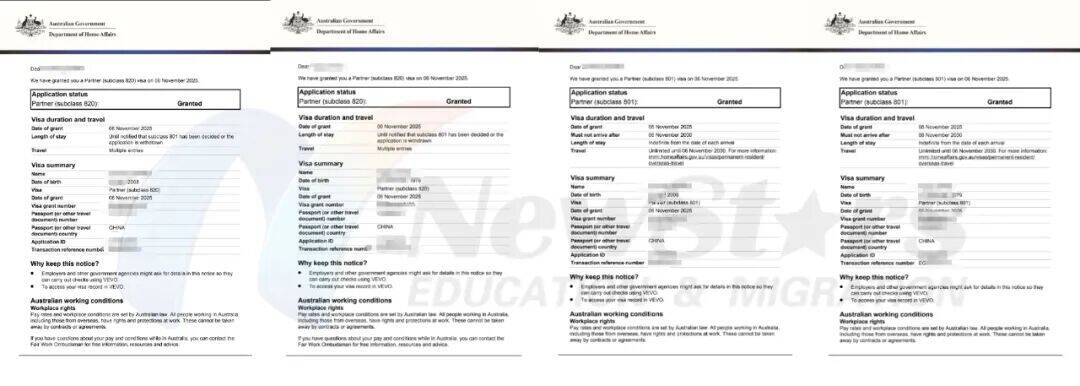
After the S57 response was submitted,the wait that followed stretched past another year and a half. The next contact from the Department did not come until August this year — and it was not a refusal letter,but a routine S56 request for further information,asking for an updated AFP check, additional relationship evidence, and some documents for the applicant’s child.This usually signals that the S57 explanation has been accepted and the application is back on the “normal processing” track.Two months later, we topped up with medical-exam results and other remaining items. In early November this year, the applicant — together with her child from a previous marriage — received both the 820 TR and 801 PR visas in a single grant. From lodgement to grant, the file spanned more than six years. This long journey has finally come to an end, and the family can now settle in Australia with peace of mind.
What is an S57?
What is PIC 4020?
Whether it is a temporary visa such as a Student visa or a permanent visa such as a Subclass 189 or 190, once an application has been lodged,if any information or document is found to be inconsistent with the rest of the file,requiring the applicant toexplainthe so-calledfalse or misleading information issue. Alternatively, if the case officer has concerns aboutthe authenticity of a document itself, and concerns are raisedbogus documentsrequiring an explanation, the case officer will issue the applicant aSection 57 (S57) notice — the so-called “serious” request for further information. If the explanation is not accepted,the application will most likely be refused under4020that clause.
What kind of inconsistent information
can trigger PIC 4020
The first category isfalse or misleading information for example, as with the client in this case, where the case officer identified clues frominformation on an incoming passenger card. Another example is the Student visa program, where assessments have tightened recently and case officers willcontact banks or call employersin order to verify the source of funds. In our day-to-day practiceS57the majority of cases fall into this category. The second category is wherebogus documentthe applicant has been found to have providedfalse documents — for example, a skilled migration applicant found to have submitted a falsified English test result. This is relatively rare.
How case officers identify
inconsistent information
First, from the material lodged with the application itself
Second, from information held internally within the Department of Home Affairs (or the broader federal system)
Third, from information the Department obtains through telephone verification
Fourth, fromopen sourceinformation obtained
Fifth, from information pulled from other relevant bodies (such as state governments and skills-assessment authorities)
Consequences of a refusal with PIC 4020 attached
Once refused under PIC 4020, the applicant cannot apply forthe vast majority of Australian temporary and permanent visas for three years, and a 4020 finding can also affect visa applications by other family members.
How to respond after receiving an S57
1. Withdraw the application, This option is generally only recommended where the applicant still holds a substantive visa, or where our assessment shows thatanother visa pathway is still available.
2. Fight it head-on.Where the issue is inconsistency between documents,and the case officer has treated it as
false or misleading information, there is stillarguea genuine chance of success.。Where the case officer has treated material as bogus documents, explaining the position becomes substantially harder.
It is worth emphasising here: when we say the situation can be explained with a real chance of success,we are not saying it will be easy to get past.We have come across refusal-help enquiries wherethe applicant DIY-lodged the visa, was hit with an S57,,believed their documents and circumstances were all genuine, treated the S57 as a mere “minor misunderstanding” by the Department, used AI to draft a sincere-sounding explanation and response — and still ended up with a refusal.
Our response (submission) must strictly follow the Department’s conventions and address every concern the Department has raised, point by point.A superficial reply is very likely to be given no weight by the Department and will usually lead to a refusal.An S57 gives you only one chance to explain. Once the case officer has read the response, they will not offer a second opportunity to add to it or clarify further.
Becauses57cases come in countless variations, there isargue no fixed playbook — each case has to be analysed on its own facts. We have a strong track record of successfully handling S57 and PIC 4020 refusal cases, and you are welcome to contact us for an assessment.
Newstarsec group introduction video
(filmed in 2021)
Subclass 189 invitations released on the 13th! Full NSW / ACT / Tasmania allocations revealed, with QLD and WA signalling invitations to come!
Offshore visa refused with PIC 4020 and no appeal right — we secured the visa back through four rounds of review and appeal applications
Latest full NSW 190 invitation figures, Tasmania issued 100 invitations, and 491 moves into the orange band!
Migration news-sharing group
2025
Step 1: press and hold to add our client service on WeChat
Step 2: once added, please
follow the Newstarsec official WeChat account
and use the chat box — [search by number only] — to pull up articlesNumber: 01– Australia’s most popular skilled-migration programs: 189, 190 and 491 Number: 02– Work-to-migration in one step: employer-sponsored 482, 186 and 494 Number:03– Plan to study first and migrate later — course and major recommendations Number:04– Study pathways via high school, gaokao and undergraduate entryNumber:05– Essential for international-student migration: the Subclass 485 Temporary Graduate visa Number:06– To arrange immediately after getting PR: parent migration and parent visasNumber:07– “Master of Marriage” — partner migration Number:08– Pivoting to Hong Kong: Quality Migrant Admission Scheme (QMAS) and Top Talent Pass SchemeNumber:09– A must-have for parents, relatives and friends coming to visit: the Subclass 600 visitor visaNumber:10– Weekly updates on visa grants, invitations, skills assessments and success stories
Q
Free initial study-abroad and migration consultation