It has been a while since any polling was done on migration issues. By the end of last year, most temporary visa holders had been able to return, and with the sudden wave of Omicron, the government had been rolling out policies since January, doing everything it could to bring international students, Subclass 485 holders, and other temporary residents back to Australia — whether to fill workforce gaps or boost consumer spending,what do Australians actually think about migrants living and working here long-term on temporary visas?

The Human Rights Law Centre conducted an independent survey, gathering the views of 1,095 Australians. The survey was conducted between 8–13 December last year, just before the border was set to reopen.
***All references to ‘migrants’ below refer to people who hold a visa allowing them to live in Australia long-term, including international students and Subclass 485 graduate visa holders.
Most Australians Agree Migrants Help Fill Skills Shortages
58% of respondents said the greatest benefit of migrants living and working in Australia is their targeted role in filling skills shortages,this was a multiple-choice question, and 54% also noted that migrants bring cultural diversity.
Meanwhile, only 33% believed that migrants merely fill low-skilled jobs that Australians are unwilling to do.
The Vast Majority Believe Migrants Who Live and Work Here Long-Term Deserve Permanent Residency
Temporary migrants living in Australia long-term far outnumber permanent residents; they work, live, and study here just like anyone else — in a broad sense, they are all migrants,and the vast majority of respondents either strongly agreed or agreed that they deserve to stay.The three questions in the survey image all carry a similar sentiment:
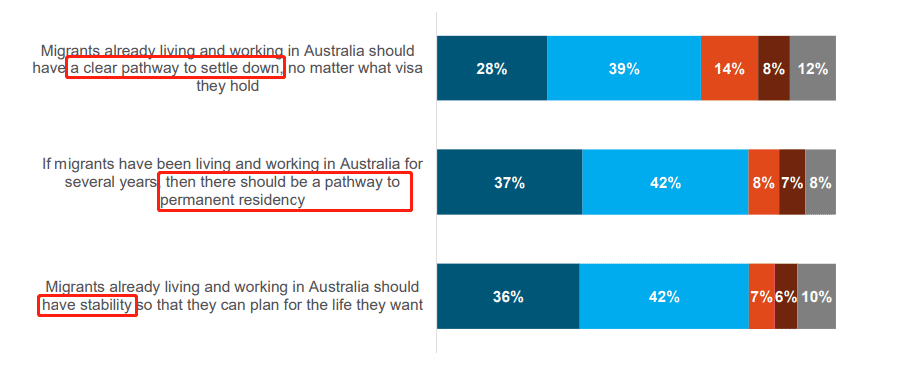
“Migrants who are already living and working in Australia, regardless of their visa type, shouldhave a clear pathway to settle here permanently. ” 28% strongly agreed, 39% agreed.
“If someone has already been living and working in Australia for many years,they should be given a pathway to permanent residency. ” 37% strongly agreed, 42% agreed.
“Migrants who are already living and working in Australiashould be given the stability to plan their future lives.” 36% strongly agreed, 42% agreed.
On a related question,only 26% of respondents believed that migrants should only work for an employer in Australia on a fixed-term temporary visa.
Looking more closely at the question “If someone has already been living and working in Australia for many years, they should be given a pathway to permanent residency” — let’s break it down by the major states,New South Wales and Victoria had the highest levels of agreement, with combined ‘strongly agree’ and ‘agree’ responses exceeding 80% in both states.


An up-to-date group for returning-to-Australia information has been set up
If you’d like to join,
add our customer service contact and note: Return to Australia



An Unjust Migration System
David Burke, Legal Director of the Human Rights Law Centre, says everyone should have the opportunity to plan their lives with a degree of security,but the federal government’s visa system leaves people in a constant state of uncertainty, and even after years of living and working here, they are often unable to reunite with their families.
These results show thatAustralians are well aware of this policy injustice,and that a visa status alone can push their neighbours, colleagues, and friends into a state of uncertainty.
Furthermore, the past two years of the pandemic disrupted the Australian government’s ability to reform its migration model,as the lockdowns drastically reduced migration of all kinds.
The Growing Imbalance Between Temporary and Permanent Residency
A November report from the Migrant Workers Centre also criticised the unhealthy imbalance within Australia’s migration system,“Australia’s migration system has lost its balance. The government issues unlimited numbers of temporary visas while strictly controlling the number of permanent visas. As a result, most migrants are forced to jump from one temporary visa to another until they are completely exhausted.”
The exploitation of migrants while they hold temporary visas has long been acknowledged, yet the issue remains unresolved,and the precariousness of their visa status is a key reason for this,The Migrant Workers Centre found through its research that migrants who already have a pathway to permanent residency are far less likely to be exploited at work.
The issues above reflect the real experience of many migration applicants — they are systemic problems within Australia’s migration system. On top of that, an extremely inefficient visa processing system means prolonged uncertainty and long waits, which is something virtually everyone on this path must endure. The government will inevitably act in its own interests and electoral calculations, so applicants can only try to find the best possible solution for themselves.
Study Abroad / Migration
Resources
Videos
Past Articles

At a crossroads with your migration journey and feeling stuck? Read these real stories…
At a crossroads with your migration journey and feeling stuck? Read these real stories…

2021 Australia Graduate Employment Outlook — Useful for Choosing Your Major, Job Hunting, and Migration!

What Recent Subclass 485-Friendly Policies Really Mean From a Migration Perspective — TAFE Graduates Could Be the Biggest Winners!

The 10 Most Critical ‘Sensitive’ Questions When Converting Your Subclass 491 or 489 to PR

Migration Information & Q&A Group

Step 1: Long-press to add our customer service contact

Step 2: After adding, please




Parents of PR holders and citizens — how can they enter Australia now?Click “Original Link”to watch the video guide