Kirk Yan:Head of NewStars Education and Migration Melbourne branch, registered Australian migration agent, with years of experience and in-depth research in interpreting migration policy and forecasting changes. Editor-in-chief of the Australian Migration Weekly, affectionately known by students as Kirk.
The newly released 2022-23 Australian migration report is out. Today we will mainly look at the data relating to parent migration.
Figure 1 shows parent visa lodgements, processing, backlog, grants and refusals, while Figure 2 contains the detailed figures. Let’s summarise them together.


First, lodgements have continued rising over recent years, from 12,000 in 2019-20 to 26,000 in 2022-23, essentially doubling. Compared with grants, the total allocation was cut to only 4,500 during the special circumstances of the past three years, then returned to 8,500 last financial year, and Home Affairs used the full allocation.
For the backlog, increasing lodgements and reduced grants caused the backlog to rise from 108,000 to more than 140,000 over the past four years, an increase of more than 30,000. Compared with the current annual allocation of 8,500, the backlog increase over the past four years is already equivalent to four full years of allocations. The waiting period is clearly still not optimistic.
Of course, the overall grant rate for parent migration remains high, generally above 90%. Only 2019-20 had a relatively high refusal rate, and I find the reason puzzling: an 18.8% refusal rate, not even including withdrawals.
By the way, the main reasons for parent visa refusals are issues with Assurance of Support, failing health examinations, and, of course, some details such as document errors. Because these visas have long application cycles, we remind everyone to prepare their documents as thoroughly as possible before lodgement.
Second, for parent visa applicant numbers, I did not see a country-by-country table specifically for parent visa lodgements, only family migration information (Figure 3). For family migration, mainland China should be the largest source, with more than 10,000 applications, though this includes the total for parent, child and partner applications.

In addition, for applicants’ location at lodgement (Figure 4), offshore lodgements account for the overwhelming majority. This is because parent migration generally needs to be lodged offshore, with only aged parent categories available onshore. Of course, special circumstances in recent years also produced cases lodged offshore but granted onshore.

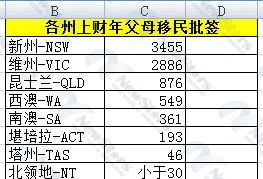
Finally, the state-by-state parent migration grant data (Figure 5) shows that NSW and Victoria account for the bulk, roughly around 70%.
There are currently many further-information requests for parent migration (Figure 6), still reaching applications lodged on 9 May 2017. Everyone knows May and June 2017 are two difficult months to get through. I have recently obtained daily lodgement data for May and June 2017 and am checking its reliability; I will share it later.

Of course, given the current large parent migration backlog, it is still better to lodge early and queue early. This is especially true in light of possible future policy changes, where earlier lodgement is likely to be less affected.
If you have any questions about Australian migration, you can add Kirk on WeChat directly for advice