Recently we have received many enquiries about the Australian Partner visa. As one of the most popular pathways to migrating to Australia, partner migration offers a steady annual quota and a comparatively lower application threshold, which is why it is attracting more and more applicants.
So what exactly do you need to qualify, and what are the key steps involved? Today we will walk you through it step by step, helping you complete your application efficiently and smoothly.
Why choose it?
Four core advantages
Ample quota, stable policy
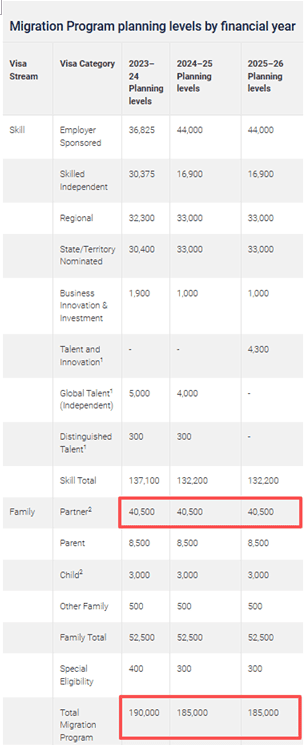
Partner migration has maintained an annual allocation of40500places for three consecutive financial years, accounting for77%of the family-stream quota and22%of the total migration program — a stable and important channel within Australia’s migration system.
Low application threshold
No education,/work,/or English requirements. Anyone aged18 or older can apply.
No invitation lottery
No need to wait for an EOI invitation — once your documents are complete you can lodge directly. As long as the relationship is genuine, you’re ready to go!
Benefits packed in
Access to Medicare, full work rights, and freedom to travel in and out of Australia.
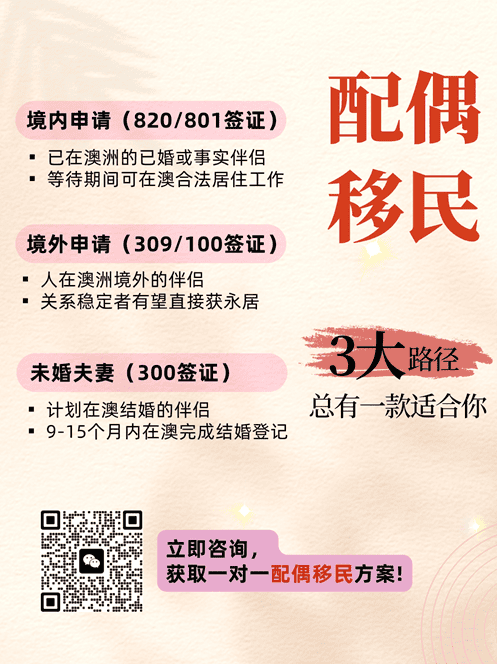
What types are there?
Onshore application (applicant in Australia)
820Visa: Temporary Partner visa
801Visa: Permanent Partner visa
Best for: married or de facto couples already in Australia holding a valid visa, who have cohabited for at least12months or haveDEFACTO.
Offshore application (applicant outside Australia)
309Visa: Temporary Partner visa
100Visa: Permanent Partner visa
Best for: married or de facto couples outside Australia.
Prospective Marriage visa
300Visa: Prospective Marriage visa
Best for: offshore applicants. Once granted, the applicant must complete lawful marriage to the sponsor in Australia within9to15months, otherwise the visa automatically lapses.

Indicative processing times
(data as at November)
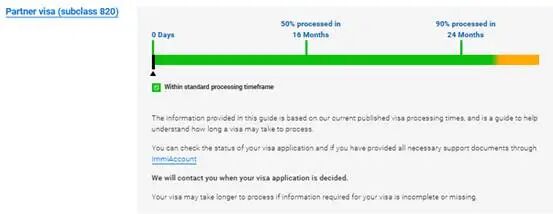
820Visa:50%Processing time:16months;90%Processing time:24months.
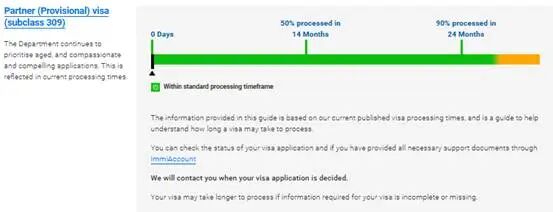
309Visa:50%Processing time:14months;90%Processing time:24months.
300Visa:50%Processing time:14months;90%Processing time:26months.
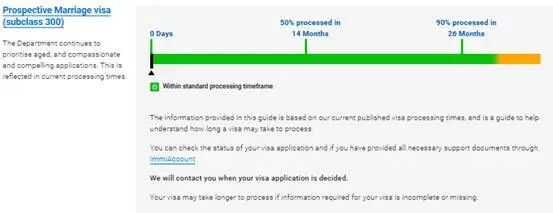
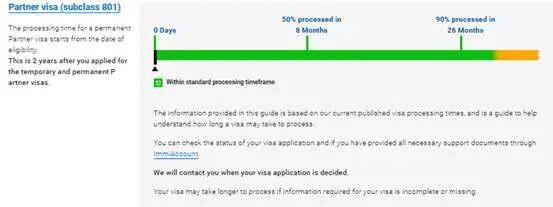
801Permanent visa:50%Processing time:8months;90%Processing time:26months.
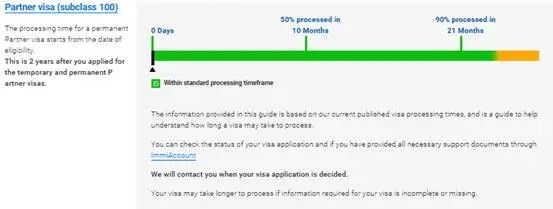
100Permanent visa:50%Processing time:10months;90%Processing time:21months.

2025-26 financial-year application fees
Primary applicant:$9,365AUD
Secondary applicant (aged18and over):4,685AUD/per person
Secondary applicant (aged18and under):2,345AUD/per person
If you hold a300visa,and lodge onshore for a820or801visa, an additional fee applies:
Primary applicant:1980AUD
Secondary applicant (aged18and over):990AUD/per person
Secondary applicant (aged18and under):500AUD/per person

Key application requirements
Applicant requirements
Aged18or older.
If applying onshore, hold a substantive visa with no“No Further Stay”condition restrictions.
Able to demonstrate a genuine and ongoing relationship with the sponsor.
Sponsor requirements
Must be an Australian citizen, permanent resident, or eligible New Zealand citizen.
May sponsor a maximum of2partners in a lifetime, with a minimum gap of5years between sponsorships.

Application process overview
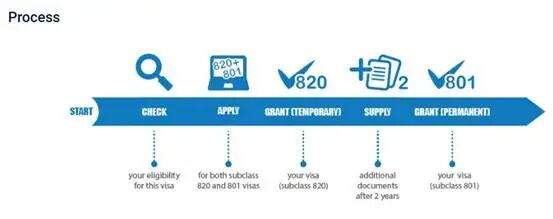
Confirm eligibility: make sure you meet every application requirement.
Complete and lodge the application online: upload every required supporting document at the same time.
Wait and cooperate with assessment: once lodged, the Department of Home Affairs will commence processing.
Receive the temporary visa:309/820the temporary Partner visa.
Apply for the permanent visa: after holding the temporary visa for2years, apply for the100/801permanent visa
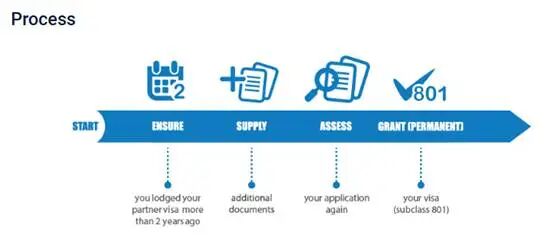
Three visa pathways which one suits you best
Onshore visa (820/801)
Advantages:During processing you can lawfully live, work, and study in Australia and access certain healthcare benefits.
Note:Processing times can be relatively long, and the Department applies tighter scrutiny to onshore partner visas, so you will need to provide thorough relationship evidence — shared address proof, mutual financial support, social-activity records, and the like.
Offshore visa (309/100)
Advantages:If the relationship has been stable long-term (for example, many years of marriage or shared children), the Department may grant the309temporary visa and the100permanent visa at the same time, shortening the wait. Compared with onshore applications, offshore assessments focus more on the genuineness of the relationship than on onshore residency status, so some applicants find the evidence pack more focused and easier to prepare.
Note:Before the visa is granted, without a valid visa to enter Australia the couple must remain apart, which can affect day-to-day arrangements and emotional connection — particularly inconvenient for applicants who urgently need to reunite.
Prospective / Marriage visa (300)
Advantages:A great option when relationship evidence is still thin and you cannot yet obtain a visa to enter Australia, marry, and switch to a partner visa. While on the300visa you can work in Australia and travel in and out freely.
Note:The visa is only valid for 9 -15months, within which you must complete the marriage formalities. Applying for the onshore partner visa afterwards adds another step and additional fees.

Document checklist
What the Department values most is the genuineness and continuity of your relationship.
Build your evidence around the following:
Identity and health documents
Passport, notarised birth certificate, health examination, and police clearance certificate.
Sponsor documents
Sponsor’s proof of citizenship or permanent residency, evidence of income (for example, an employer letter or tax documents), and proof of address (for example, a property title or lease agreement).
Core relationship evidence
Financial: joint accounts, jointly held assets or liabilities, day-to-day transfer records, and the like.
Household: joint tenancy agreement or property title, correspondence to a shared address, utility bills, etc.
Social: shared travel bookings (flights and hotels), photos of events attended together, supporting statements from friends on the888form, and so on.
Commitment: a relationship development statement and future plans for life together (for example, buying a home or starting a family).
Note
All non-English documents must be translated by aNAATIcertified translator. Organise your documents to the Department’s requirements and make sure every item is clear and complete, to reduce requests for further information that slow processing down.
Frequently asked questions (Q&A)

Q1: My sponsor has previously sponsored someone else — will that affect me?
A: Yes. A sponsor is limited to two sponsorships in a lifetime, with a minimum gap of5years between them. You will need to confirm your sponsor meets this rule.
Q2: What if our relationship evidence isn’t strong enough?
A: Don’t panic! You can shore things up from other angles — write a detailed relationship statement, provide more evidence of shared social activities, or explain the objective reasons the current material is limited. We can work through how to strengthen the evidence with you.
Q3: We don’t have a joint account — how do we prove financial ties?
A: Many couples don’t have a joint account early on. Transfer records between you, receipts for jointly paid bills, and proofs of jointly purchased items all work as valid evidence.
Q4: We don’t have children together — how do we make the application stronger?
A: The depth of a relationship is not measured by whether you have children. Your shared plans for the future, the trips and challenges you have been through together, and how friends see you as a couple are all powerful evidence. Many of the couples we have helped — including same-sex couples — have successfully been granted the visa on the strength of detailed plans and demonstrated commitment.
Q5: What if one of us has a complicated prior marriage history?
A: Honesty is the key! Provide clear divorce certificates or separation declarations, and give a reasonable account of how that history began and how your current relationship was built. With candid communication and well-prepared documentation, it will not be a barrier to your application.
Partner migration applications demand very high standards of completeness and consistency. Gaps or inconsistencies can prompt the Department to question genuineness, and may even lead to refusal. We strongly recommend completing your application under professional guidance for the best outcome.

X. Success stories
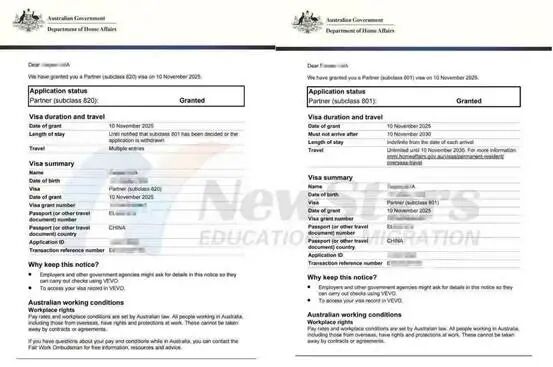
23/10 lodged onshore partner visa; 25/11/11 — 820&801granted simultaneously.
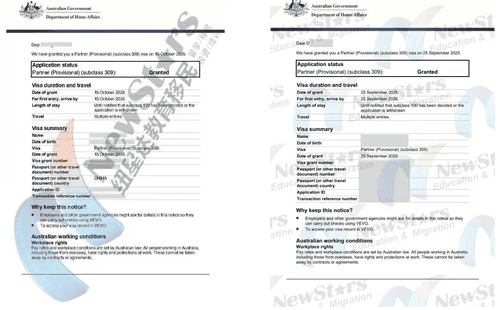
24/10 lodged offshore 309, 25/10/14 — visa successfully granted.
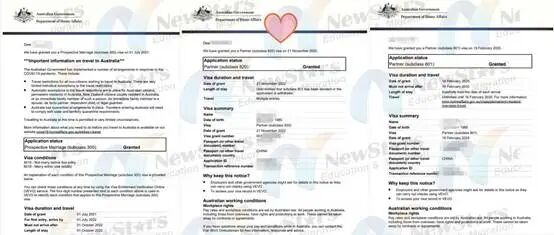
Covid: began the300Prospective Marriage application, entered Australia and transitioned to820/801 — nearly4 years in total, permanent residency successfully obtained.
NewStarsGroup introduction video (filmed in 2021) Migration news sharing group 2025Queensland more than doubles its quota to 2,600! Victoria issues invitations — non-trades construction category drops to 65 points

Offshore visa refused + PIC 4020, no appeal rights! Four rounds of review/appeal to win the visa back

Took six years to be granted! Accused by the Department of marriage fraud, heavy s.57 request for information — long-form explanation plus multiple rounds of further information finally got it across the line!

Step 1: Long-press to add the support consultant

Step 2: After adding, please


follow the NewStars official account

Free initial study-abroad & migration consultation
Sydney

Melbourne

Brisbane

Adelaide

Canberra

Hobart

Perth

Beijing

Guangzhou

New Zealand – Auckland