Australian Teacher Migration: Types, Skills Assessment, and the Study-to-Migration Pathway

In China, being a teacher involves significant pressure — preparing lessons, teaching a full weekly schedule, conducting research, publishing journal articles, and more. In contrast, in Australia, teaching is comparatively easier — it offers job stability, regular working hours from 9 am to 3 pm, four paid holidays per year, and public school teachers can enjoy superannuation contributions of up to 17%.

Australia Has a Major Teacher Shortage

Shortage


Data from SEEK, Australia’s largest job search website, shows an enormous number of teaching positions advertised — over 12,000 listings, demonstrating a significant shortfall. At the same time, the average annual salary for teachers in Australia reaches AUD 90,000, far exceeding other industry benchmarks.

Teaching Careers Require a Study-to-Migration Pathway

Study


Education is a highly sought-after profession for Australian migration. Many teachers in China may wish to apply for skilled migration directly; however, due to differences between the education systems, primary and secondary school teachers from China find it very difficult to pass the Australian skills assessment and obtain skilled migration from overseas. The main pathway is the study-to-migration route.


Of course, many Year 12 or undergraduate graduates who wish to come to Australia to study education find that the study-migration-employment pathway runs quite smoothly.


Popular Choices: Early Childhood and Secondary Teaching

Education


So if you are considering studying education, which specialisation should you choose? What are the differences?

Australian education can be divided into five categories: early childhood education, primary and secondary education, higher education, adult education, and other education.

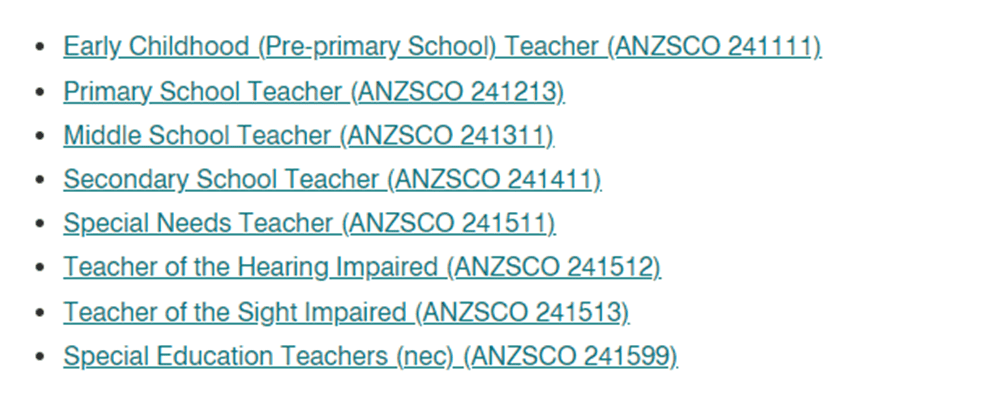
Teacher occupations on the migration list are classified as follows:
Early childhood (pre-primary school) teacher
Primary School Teacher
Middle school teacher
Secondary school teacher
Special needs teacher
Teacher of the hearing impaired
Teacher of the sight impaired
Special education teachers nec

Currently, the three most popular options for international students are:
1. Early Childhood Teacher
2. Primary School Teacher
3. Secondary School Teacher

From the perspective of receiving a migration invitation after graduation, early childhood and secondary teaching offer the best chances of being invited.

Skills Assessment Requirements

Migration


In this article, we will discuss the skills assessment requirements for these four types of teachers in detail. Only by passing the skills assessment can you apply for Australian skilled migration.

All four teaching occupations are listed on the Medium and Long-term Strategic Skills List and are eligible for the 189/491/190 visa pathways.

AITSL,the Australian Institute for Teaching and School Leadership Limited, is the designated skills assessment body appointed by the Australian Department of Home Affairs. It is responsible for ensuring Australian teaching and educational leadership standards. An AITSL assessment involves a comprehensive evaluation of teachers and school leaders by industry professionals. Every Chinese teacher is eligible to undergo an AITSL assessment.
AITSL’s skills assessment requirements for early childhood, primary, secondary, and senior secondary teachers primarily cover qualifications (including ITE (Initial Teacher Education) qualification requirements and other higher education qualification requirements) and English language proficiency.
1. Qualification Requirements
Applicants must have completed at least four years of full-time Australian-recognised higher education (at university level) and obtained a bachelor’s degree or higher qualification. The four years of education must include an approved teaching/teacher education qualification.
A minimum of 45 days of supervised professional experience (practicum) must be completed.

For Early Childhood Teachers
At least one year of full-time (or equivalent part-time) higher education (at university level) in early childhood teacher education.
At least 45 days of supervised teaching practicum with students aged 0-8, including pre-primary or early primary school students.


For Primary School Teachers

At least one year of full-time (or equivalent part-time) higher education (at university level) in primary school teacher education.

At least 45 days of supervised teaching practicum with students aged 5-12, including pre-primary or lower primary school students.


For Secondary School Teachers
At least one year of full-time (or equivalent part-time) higher education (at university level) in secondary school teacher education.
At least 45 days of supervised teaching practicum with students aged 13-18.

English Language Requirements
An overall IELTS score of 7.5 is required, with minimum scores of 8, 8, 7, and 7 in Listening, Speaking, Reading, and Writing respectively. Test results must be within 24 months prior to the application. (Please note: no English tests other than IELTS are accepted
If the applicant has completed at least four years of higher education in one of these six English-speaking countries: Australia, Canada, Ireland, New Zealand, the United Kingdom, or the United States and obtained equivalent qualifications, then the IELTS requirement may be waived.
Note: AITSL accepts combined IELTS scores from multiple sittings. If there is uncertainty about an applicant’s English language proficiency, AITSL reserves the right to require the applicant to sit an IELTS test

Other Higher Education Qualification Requirements
The applicant’s four years of higher education may include other qualifications; however, these must be at least at the level of an Australian Advanced Diploma or Associate Degree (equivalent to Australian Qualifications Framework Level 6) or above

AITSL skills assessment processing time: typically 4-6 weeks

Who Should Study Teaching in Australia?

Courses


In Australia, education undergraduate programmes are all four years, while master’s programmes are all two years — this is the standard programme duration in Australia. Upon graduation, you will definitely meet the qualification requirements. As mentioned, the 45-day practicum is arranged by the university during the programme, so there is no need to worry about that.


After graduation, the main challenge to overcome is the English language requirement, followed by obtaining the skills assessment. The invitation score thresholds for early childhood and secondary teaching are relatively low, so there is little need to compete on points


If you have already completed an undergraduate degree in Australia or one of the other five English-speaking countries and wish to study in Australia or switch to a migration-eligible profession, we highly recommend pursuing a master’s in education in Australia.

Why? Because the biggest hurdle for teaching registration and migration is the IELTS requirement of 8, 7, 7, 8. However, according to AITSL’s requirements, if you have completed four or more years of higher education in an English-speaking country, the IELTS requirement can be waived!


Summary:
For international students looking to stay in Australia and obtain permanent residency, studying education is undoubtedly one of the best choices. If you would like to learn more about secondary teaching and early childhood education programmes, feel free to contact us!

Early Childhood GD

One Year


If you have already completed at least three years of higher education in Australia, and wish to fast-track your path to permanent residency through teaching, you can consider a one-year Graduate Diploma in Early Childhood Education. Upon graduation, you can apply for the early childhood skills assessment with the IELTS 7, 7, 8, 8 requirement waived.

We recommend several institutions offering one-year Graduate Diploma programmes that do not require a prior education background, helping you meet skills assessment and migration requirements more easily:

Recommended Articles

Analysis of Invitations Issued This Financial Year — Could Your Turn Be Next?

15 Years on This Path: “If You Can’t Endure the Hardship of Study, You’ll Endure the Hardship of Life.”

Transferring from a Company in China to Australia — Is the 482 Employer-Sponsored Visa Easier?

Migration News Community


2023 


Step 1: Press and hold to add our consultant

Step 2: After adding, please


Study, Migration, Visas — We Are the Experts



Attention!Please verify authentic NewStars consultants!


Study & Migration Enquiries  Our Offices

Sydney Head Office
Melbourne

Canberra

Brisbane
Adelaide

Hobart

Beijing
Guangzhou

Perth
Next Office

Follow NewStars Official Account

Reply in the official account with the following numbers or keywords (not in the comments section) to receive the latest professional migration news!Reply [A] to view the directory (all topics)!

Reply:0000 → View 16 Nov policy update (491 + skilled migration points)

Reply: 000 → Latest visa/citizenship processing wait times

Reply: 001 → Latest 189 EOI official report

Reply: 002 → 189 independent skilled migration

Reply: 003 → State 190 nomination by state

Reply: 004 → 489 regional area state nomination

Reply: 005 → Student entrepreneur/investor migration

Reply: 006 → Parent migration visa

Reply: 007 → Employer-sponsored visa

Reply: 008 → 485 visa

Reply: 009 → Partner migration/bonus points

Reply: 010 → Work experience bonus points

Reply: 011 → PY bonus points

Reply: 012 → NAATI/CCL bonus points

Reply: 013 → Regional area bonus points

Reply: 014 → Tourist/family visit visa

Reply: 015 → Working holiday visa

Reply: 016 → TAFE study

Reply: 017 → Australian students migrating to Canada

Reply: 018 → 407 training visa

Reply: 019 → 408 temporary activity visa

Reply: 020 → New Zealand migration

2023 Recommendations