
The points-test reform has taken another step forward, with more than 200 submissions published on 29 January.
Background
The points-test reform opened for public consultation on 24 April 2024.
When the discussion paper was released, we wrote a detailed article you can revisit:Australian points-test reform: full discussion paper released! Skilled work, occupation lists, partners and English all in focus!
According to the latest news, the consolidated submissions report has now been handed to the government.
We have selected the submissions from the state governments, skills assessing authorities and MIA — the bodies most relevant to study and migration.

Here is a broad summary.
*The points below are the more representative or widely supported suggestions; they do not mean the Department will necessarily adopt them.
–Age points: support a tiered model; oppose an excessive push to make migrants younger.
–Partner points: include qualifications in the score, with a bonus for Australian qualifications.
–English points: score the sub-bands too, and narrow the gap between 7-in-each and 8-in-each.
–Qualification points: finer-grained scoring — diploma/certificate should also earn points, STEM should not get a bonus, and multiple qualifications should stack.
–Work-experience points: lower the year thresholds and align overseas and onshore experience.
–Current-employment points: add extra points, but do not require a job offer, and do not go purely for a “high-salary-wins” model.
–Skills recognition: certificates and licences should also earn points.
–Occupation list: plenty of problems, and sharply divided views on how to fix it.
–Regional points: use a tiered system — more remote areas earn more points.
–NAATI points: some support removing them.
–PY points: skills assessing authorities unanimously back them.
–A proper transition/buffer period is essential.
A comparison of the major bodies’ positions

MIA (Migration Institute of Australia)
–Remove points for PY, NAATI, regional study and STEM qualifications: they argue that earning these points does not indicate that a prospective applicant has the matching capability, cannot reliably predict long-term employment outcomes, and is instead used in practice to “pad the score”.
–Strongly opposed to requiring a job before entering the points test: this would expose prospective applicants to exploitation, fake jobs and the sale of job offers — problems that have been proven repeatedly in other migration pathways.
–Age + qualifications + work experience + English ability are the core factors: extensive research shows these four factors best predict a migrant’s future success.
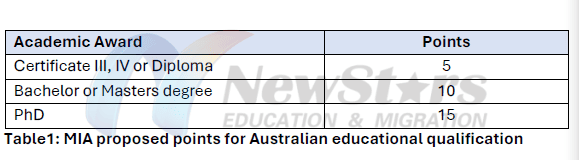
– On qualification points: points should be refined by qualification level; the chart below shows MIA’s proposed qualification points:
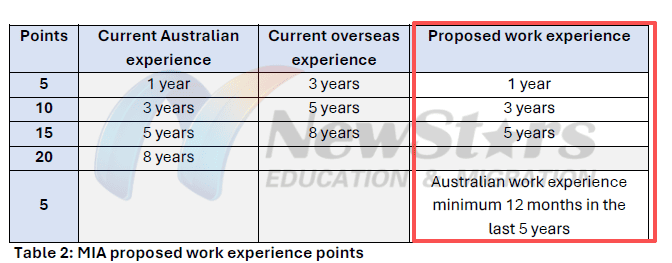
–Overseas and onshore work experience should be treated equally: overseas experience should not be “devalued” because of its location, although Australian experience within the last 5 years could earn an extra 5 points; the right-hand chart below is MIA’s proposed work-experience scoring:
–Against using salary level to filter applicants: salary ≠ skill; high-paying roles may come from non-shortage industries and can also harm the diversity of the skills mix. They recommend using the ANZSCO 4-digit Unit Group instead.
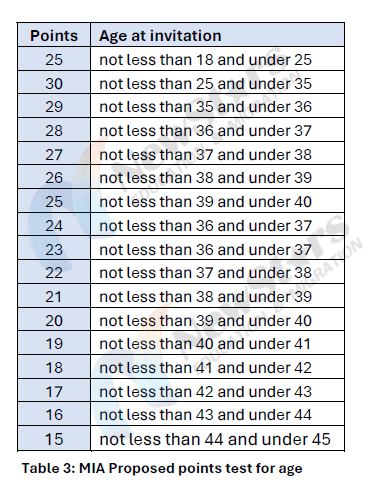
–Against a “youngest-wins” approach to age points; favour a tiered scale: also drawing on the Canadian model; the chart below is MIA’s proposed age scoring.
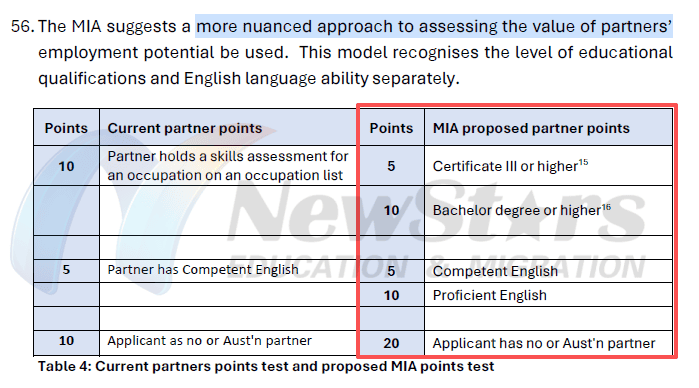
–Partner points: MIA proposes dropping the partner skills assessment and using a more granular approach,scoring the partner’s qualification level and English ability separately, stressing that the two should not be bundled; the right-hand chart below is MIA’s proposal:
– Transition arrangements: a 6–12 month buffer between announcement and implementation; cases already invited or lodged processed under the old rules; full review every 5–8 years.
ACT Government
– Qualification points: the principle should not be “the higher the qualification, the more points”,because qualified tradespeople, for example, may be scarcer than PhDs. Adjustments to qualification scoring should therefore take into account the real qualification requirements of different occupations, to avoid harming critical industries and future-shortage skills.
– Age points: the current 45-year age ceiling for skilled migration is too strict and is already hurting highly skilled, highly experienced migrants.ACT strongly supports raising the permanent residency age ceiling to at least 50 to better address talent shortages in healthcare and other critical sectors.
– Skills recognition: at present some skilled and experienced migrants still need additional training or a local Australian qualification before they can work. ACT recommends giving priority to applicants whose qualifications and experience are more readily recognised and transferable in Australia, to lift migrants’ employment success rate.
– ACT-specific challenge: many local roles require citizenship, so there is scope to explore ways for non-citizens to access sensitive positions.
TAS Government
– Regional points: Tasmania, as a regional area, continues to benefit from Subclass 189 at a share well below its population proportion, and simply awarding “regional state nomination +15 points” can let candidates who are not genuinely suited to regional areas into the pool. TAS therefore recommends that, if regional-study points are retained, a tiered system should be used, distinguishing “lightly regional (e.g. Gold Coast)” from “truly regional (e.g. Tasmania)”.
– Work experience and job offers: expecting every graduate to walk straight into a matching job is unrealistic, so mandating a job offer would delay recruitment in shortage industries and fuel fake offers.Tasmania recommends not requiring a job offer, but instead awarding progressive points where employment exists, scaled by duration and relevance to the applicant’s field.
– Occupation list: state-nominated occupation lists should have greater flexibility.
– Age: opposed to the 45-year ceiling, which sharply shrinks the high-skill talent pool — particularly harmful to teaching, healthcare and engineering. Tasmania recommends following the Canadian model,with no hard age ceiling — points taper off once the “prime age band” is exceeded — and allow state nomination to continue selecting older candidates for special skills.
– Partner points: support better recognition of partner skills, but efficiency and risk must be balanced; otherwise “sham relationships” could emerge.
ACS (IT skills assessing authority)
–ACS opposes removing PY points: the data show that students who complete a PY have significantly higher post-graduation employment rates than those who do not.
– Work experience: the current points test over-weights “years of experience” while ignoring whether that experience is “outdated”. They argue that work experience should weigh both “recency” and “continuity”; younger workers who stay in the field and keep their skills current should score higher.
– Occupation list: move from occupation-based to skill-based. IT job titles change extremely quickly, so reliance on an “occupation-name list” should be reduced in favour of an assessment model centred on skills and capabilities.
– Younger skilled migrants: Australia can follow the Canadian tiered age-scoring model, to avoid a cliff-edge drop in points as applicants age.
– Transition arrangements and system stability
EA (engineering skills assessing authority)
– Age scoring: for engineers, the 25–33 age group with 3–10 years of experience delivers the most value, so avoid cliff-edge age penalties;follow the Canadian model with a gentler scoring curve.
– Occupation list: defining occupations via ANZSCO alone is too coarse and cannot distinguish specific skills and experience levels. They recommend allowing assessment based on skill sets and transferable capabilities rather than a single occupation name,with extra points for specific experience in priority areas (e.g. renewables, net-zero transition).
–Recommend keeping engineering PY points: like ACS, they use data showing PY still helps employment outcomes. PY should be modernised rather than weakened — for example through flexible durations, digital delivery and sensible internship formats.
These submissions were handed to the government back in the second half of 2024. Their release now may mean the points-test reform has entered its “public” stage — but whether it is imminent, and exactly when, no one outside the government can say with certainty.What is clear is that it is no longer far off. Every body stresses the need for a clear, well-defined transition period — MIA, for example, proposes announcing the changes 6–12 months before they take effect, giving applicants at least six months of buffer and giving all affected organisations time to adjust.
(Photo taken in 2021) Migration news sharing group 2025New Subclass 189 invitation round imminent — late-January EOI backlog updates for hot occupations, plus invitation-score predictions!

Latest skilled-migration data — Subclass 190 and 491 grants continue to accelerate!

Student visa refusal appeals transformed! The ART reform legislation has passed, and appeal processing times are being shortened!

Step 1: long-press to add our client service

Step 2: after adding, please


follow the NewStars WeChat official account

Free initial study and migration consultation
Sydney

Melbourne

Brisbane

Adelaide

Canberra

Hobart

Perth

Beijing

Guangzhou

Auckland, New Zealand