The state nomination policy meetings organised by MIA, the Migration Institute of Australia, are continuing. In this session, the South Australian and Northern Territory governments outlined their state nomination arrangements for the 2026–27 financial year, focusing on nomination allocations, onshore and offshore applicants, priority industries, Subclass 491 pathways and SA DAMA.
1. South Australian state nomination: a larger allocation this financial year, with priority industries continuing to lead
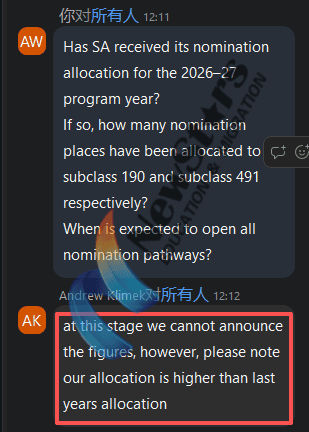
The South Australian Government said its state nomination allocation for the 2026–27 financial year had increased from the previous financial year, but it could not yet disclose the exact number.
State nomination figures for the 2025–26 financial year
South Australia had approximately 2,250 state nomination places last financial year and received more than 8,900 onshore ROIs and approximately 40,000 EOIs.
Of the nominations ultimately issued by South Australia last financial year, approximately 74%, or around 1,665, went to onshore applicants. Offshore applicants accounted for approximately 26%, or around 585 nominations.
Based on these figures, approximately one in every five to six onshore ROI applicants ultimately received state nomination last financial year.
Current invitation arrangements for the 2026–27 financial year
South Australia is currently open mainly to applicants who meet specific conditions. It has not yet been determined when other pathways will formally open, and the state government has not released its full invitation arrangements for the financial year.
Invitations are currently directed mainly towards onshore applicants in priority industries whose visas are about to expire, and eligible offshore applicants in priority industries.
South Australia’s main priority industries this year are:
Building and Construction, Defence, Education, Engineering, Health and Manufacturing.
Overall, application requirements across the pathways have changed little this year. Some occupation lists have been adjusted, while the selection methods remain largely consistent with the previous financial year’s rules.
Offshore applications are currently concentrated mainly in priority industries, while the scope for onshore applicants is broader. Applicants in non-priority industries also have opportunities to be invited, depending on their overall competitiveness.
Offshore applicants primarily supplement the state’s talent pool
More than 70% of state nomination places went to onshore applicants last financial year. The state government expects that, once the programme formally opens this financial year, the overall pattern may remain similar to that of the previous financial year.
Offshore applicants are primarily sought to supply people with extensive relevant work experience who cannot be found within South Australia.
2. South Australian NIV applications: strong applicants, but some do not meet the basic requirements
South Australia has also received a number of Expressions of Interest for the National Innovation Visa (NIV).
The state government said that, although some applicants have strong overall profiles, many still do not meet the basic NIV application requirements.
For those preparing to apply for the NIV, strong academic, professional or personal credentials alone do not necessarily mean they meet the state government’s requirements. Applicants still need to confirm first that they meet the basic application criteria.
3. SA DAMA applications continue to rise, with a new agreement expected to take effect in 2027
SA DAMA application numbers have increased significantly in recent years.
Application numbers increased by almost three times between the 2023–24 financial year and last financial year. They are expected to rise further this year.
SA DAMA processing times are currently approximately two to eight weeks.
The existing agreement will expire soon, and the new agreement is expected to take effect at the end of January 2027. Details are still being discussed with the federal government, and the South Australian Government hopes to announce transitional arrangements before Christmas.
Please note that SA DAMA applications can still be lodged as usual while the existing agreement remains in force.
4. Northern Territory state nomination: high EOI scores are not considered; greater emphasis is placed on a willingness to stay in the NT long term
At the start of the meeting, the Northern Territory Government made it clear that the NT does not place particular emphasis on high EOI scores.
Provided an applicant’s EOI meets the federal minimum of 65 points, the government places greater emphasis on whether they intend to stay in the Northern Territory long term and whether they can find work locally.
Current Northern Territory state nomination position
The Northern Territory has issued approximately 550 formal nominations so far, out of a total allocation of approximately 1,850 for this financial year.

However, because of a substantial application backlog, the Northern Territory has closed most state nomination application pathways.
The Subclass 491 pathway is currently open mainly to the following applicants: those whose visas will expire before 30 September 2027; those who have reached, or are about to reach, 45 years of age; and those whose EOI scores have fallen below 65 points because of their age.
For Subclass 190, both onshore and offshore application pathways are currently closed.
5. Northern Territory offshore Subclass 491 priority occupation pathway: processing continues this year, with reopening expected next financial year
Although the Northern Territory has not yet reopened its offshore Subclass 491 priority occupation pathway this financial year, the government confirmed that applications lodged last financial year which are still awaiting an outcome will continue to be processed.
The government expects applications from last financial year that have not yet been decided to receive an outcome during this financial year.
However, competition under this pathway is strong, and lodging an application does not guarantee an invitation from the government.
Looking ahead to next financial year, the Northern Territory Government said the offshore Subclass 491 priority occupation pathway is expected to reopen in the 2027–28 financial year.
The government also indicated that the occupation list may then place greater emphasis on applicants’ ability to find work in the Northern Territory. In other words, future occupation choices may be more closely tied to local employers’ actual workforce needs.