The week’s key migration news
- Parent migration places remain this financial year, but the Subclass 143 wait has reached 15 years
- State allocation use is still behind schedule, with some states having more than 80% left
- Severe partner migration backlogs and longer waits for child visas
- Did Victoria hold a round? Tasmania continues with weekly invitations
- This week’s visa grants, invitations and skills assessments
1. Parent migration places remain this financial year, but the Subclass 143 wait has reached 15 years
We recently obtained parent visa grant figures for this financial year, so here is a review of the first half of 2025–26.
As at the end of December 2025
There were 2,917 places remaining for Subclass 143 & 864 and 585 for Subclass 103 & 804. If we use the monthly average to account for January as well, approximately 2,270 Subclass 143 & 864 places would remain for February–June, the rest of the financial year—a slightly better position than last financial year. Subclass 103 & 804 would have 399 places left.
Looking more closely at monthly grants this year, Subclass 143 grants were fairly steady in July–September, then suddenly increased in October–November to more than 780 a month. That matches our experience: our clients received noticeably more grants during those two or three months.
There are 83,437 Subclass 143 applications and 15,008 Subclass 864 applications in the backlog, bringing the contributory parent backlog alone close to 100,000. Assuming the annual allocation remains at 6,800, the wait has stretched to 15 years. The Department’s website also currently gives an indicative timeframe of 15 years. The non-contributory queue is 33.9 years. It is best to lodge early.
For a more detailed analysis, see: Half-year parent visa grant figures released | How many places remain? Contributory parent waits extend to 15 years!
2. State nomination invitation allocations remain plentiful, with some having more than 80% left
As at the end of January 2026, 65% of the Subclass 190 allocation remained, while Subclass 491 had even more left, at close to 70%. States resumed work promptly after the late-December holidays. Almost all issued a pre-invitation round and some formal nominations. January saw a total of 1,462 formal Subclass 190 nominations and 779 for Subclass 491.
States with 50–60% remaining
Canberra Subclass 190 and 491, New South Wales Subclass 190, Northern Territory Subclass 190, Tasmania Subclass 190, and Victoria Subclass 190 and 491. Only Northern Territory Subclass 190 was below 55%.
States with 60–70% remaining
South Australia Subclass 190, Northern Territory Subclass 491 and Queensland Subclass 491
States with more than 70% remaining
Queensland Subclass 190 (83.95% remaining, or more than 1,550 places), Western Australia Subclass 190, New South Wales Subclass 491 (mainly awaiting processing), South Australia Subclass 491, Tasmania Subclass 491, and Western Australia Subclass 190 and 491 (mainly due to slow processing)
By proportion used, however, the only allocation that could be described as running low is Victoria’s Subclass 491 allocation: 400 of its 700 places have been used, leaving less than 43%. One reason is Victoria’s regular rounds and relatively fast processing; another is that its Subclass 491 allocation was small to begin with this year.
For more detailed figures and analysis, see: Department update: more than 8,400 Subclass 190 places remain, with almost 70% of Subclass 491 places still available! Some states have more than 80% unused!
3. Severe partner migration backlogs and ever-longer child migration waits
We recently obtained partner visa figures as well. Taken together with parent migration, the mismatch between family migration backlogs and allocations is actually more severe than for skilled migration. Skilled migration demand can be controlled by reducing invitations, whereas humanitarian considerations make it difficult to actively restrict family migration, so the backlog keeps growing.
The Subclass 309 backlog exceeds 30,000 and the Subclass 820 backlog exceeds 69,000, while the annual partner allocation is only 40,500 places (the temporary visa stage uses allocation places). Dividing a backlog of 100,000 by an allocation of 40,000 gives a theoretical wait of two to three years. If application numbers do not fall, waits will become longer. If you are still hesitating and comparing options, it is best to lodge sooner.
Partner visa grants were relatively steady in the first half of the financial year: nearly 9,000 Subclass 309 visas and almost 12,000 Subclass 820 visas, for a combined total of more than 20,000. Subclass 309 grants generally stayed around 1,500 a month, while Subclass 820 grants ranged from 1,500 to 3,000 and clearly accelerated in the second quarter. With half of the total 40,500 allocation remaining for the second half of the financial year, the pace should stay consistent with the first half.
The combined Subclass 100 and 801 backlog is close to 50,000. More than 3,000 Subclass 801 visas have been granted each month this financial year, and we have indeed noticed permanent visa grants speeding up recently. Processing has broadly reached permanent-stage applications lodged around the middle of last year.
The child migration visa backlog has risen dramatically in recent years. Child migration visas are not particularly complicated; the Department’s slow processing is still down to the small allocation. By the end of last year, the backlog was close to 8,000, but the current annual allocation is 3,000, producing a wait of two to three years. Grant figures also appear to be spread evenly in line with the allocation, at only about 200 a month.
4. Did Victoria hold a round? Tasmania arrives on schedule
Victoria issued a very small invitation round on 18 February. We only collected the data shown below, and all of it was for Subclass 491.
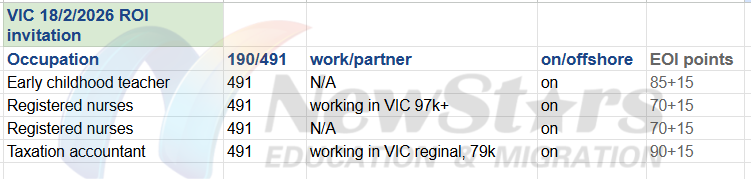
As mentioned above, Victoria still had 57% of its allocation left at the end of January. Even counting all January ROI invitations, it certainly should not have run out of places. We do not know whether Victoria is pausing because too many invited ROIs are still awaiting applications, or whether another round will be scheduled later in February.
Tasmania continues to issue invitations every week. This week it issued 44 Subclass 190 ROI invitations and 25 for Subclass 491. The lowest scores were 47 for Subclass 190 and 34 for Subclass 491, with scores falling. There are currently 321 Subclass 190 and 192 Subclass 491 invited ROIs awaiting processing. Nomination applications lodged on 8 December are being processed.
5. This week’s visa grants, invitations and skills assessments
State nomination
Canberra
Formal nomination
Lodged on 25 December 2025; ACT Subclass 491 invitation received on 16 February 2026. ICT Support Engineer.
Tasmania
Pre-invitation
Subclass 491, 35 points: lodged on 6 February 2026; ROI pre-invitation received on 19 February 2026.
Visa grants
Subclass 189 Skilled Independent visa
Lodged on 17 November 2025; granted on 16 February 2026.
Subclass 190 state-nominated visa
Lodged on 3 February 2026; granted on 19 February 2026, with no request for further information.
Lodged on 15 November 2024; granted on 17 February 2026.
Subclass 491 regional state nomination
None this week.
Subclass 191/887 regional permanent residence
Lodged on 15 May 2025; granted on 20 February 2026.
Employer sponsorship
None this week.
Investment visas/GTI visas
None this week.
Partner migration
Lodged on 3 June 2025; Subclass 801 granted on 18 February 2026.
Parent visas
Lodged on 5 September 2018; further information requested on 22 January 2026; second invoice sent in 2026 on the 18th; Subclass 143 granted on 19 February 2026.
Lodged on 29 June 2018; Subclass 143 granted on 17 February 2026.
Subclass 485 Graduate Work visa
Lodged on 8 October 2025; granted on 16 February 2026.
Subclass 500 Student visa
Lodged on 22 August 2025; granted on 16 February 2026. Lodged on 24 August 2025; granted on 20 February 2026.
Subclass 600 visitor visa
Lodged on 10 February 2026; granted on 20 February 2026. Offshore application by the parent of a permanent resident.
Subclass 155 visa
Lodged on 19 January 2026; granted on 19 February 2026 (had not lived in Australia for a full two years).
Lodged on 10 February 2026; granted on 16 February 2026 (had not lived in Australia for a full two years).
Lodged on 15 January 2026; granted on 14 February 2026 (had not lived in Australia for a full two years).
Skills assessments
ACECQA
Lodged on 2 December 2025; skills assessment received on 19 February 2026, with no request for further information.
AITSL
Lodged on 5 February 2026; skills assessment received on 13 February 2026, with no request for further information.
AIQS
Lodged on 15 December 2025; skills assessment received on 19 February 2026, with no request for further information.
EA
Lodged on 13 February 2026; skills assessment received on 16 February 2026, with no request for further information; priority processing.
VETASSESS
Lodged on 2 February 2026; skills assessment received on 13 February 2026, with no request for further information; priority processing.
TRA
Lodged on 11 February 2026; passed the TRA skills assessment on 16 February 2026. Painting Trade Workers.