For students currently studying an Australianfoundation programme — includingthose at Taylors College and UNSW Global’s foundation programmestudents, thinking about the university journey ahead and becoming an undergraduate soon — isn’t that a little exciting? Butif your GPA isn’t quite there and you’re worried about missing out on your dream university,don’t be discouraged.
This article will explain in detailhow foundation programme studentscan arrangeprogression to a bachelor’s degree, and the GPA requirements involved, especiallyforstudents with a foundation programme GPA of 6.0 or above (out of 10), recommendingthree excellent Australian universities they can transfer to.

This article is written byNewstars Sydney education consultant Jessica(Registered Education Agent Counsellor, QEAC No. O782) — feel free to add the QR code at the end of the article to enquire about the relevant courses.
Australia’s Diploma fast-track programmes
Considering that some students’ results don’t meet the entry requirements for direct entry into a bachelor’s degree,many Australian universities have designed Diploma fast-track programmes as a bridge.
For foundation programme graduates,a Diploma is equivalent to first-year of an Australian bachelor’s degree, and through specialised training,students’ abilities are quickly brought up to the same level as domestic Australian students. After successfully completing the programme and meeting the university’s relevant grade requirements,students go straight into second year of the bachelor’s degree, with the Diploma’s credits counting towards the total credits for the whole degree. First year!
This shortcut suits the majority of Chinese students particularly well, and is the fastest way to progress into a prestigious university’s bachelor’s degree. The final academic transcript and degree certificate are no different from those of a regular undergraduate!
+ + + +
What’s the difference between a Diploma and a regular first year?
1. Small-class teaching, giving every student more opportunities to interact directly with lecturers;
2. Additional tutorial-style support courses help international students adapt to English-medium assessment methods, such as essay writing, group collaboration and presentations;
3. When progressing from the first-year fast-track programme into second year, there are usuallyadditional requirements, though these are generally not high
+ + + +
Next, we’ll move into school and course recommendations
— or you’re welcome to contact me directly to find out more!

University of New South Wales
Global College
World ranking slightly above Shanghai Jiao Tong University

School introduction and rankings
The University of New South Wales (UNSW) is a member of Australia’s Group of Eight (Go8) — the country’s top eight universities — and is one of Australia’s largest leading universities.In the QS World University Rankings 2021, it ranked 44th globally. In the QS Graduate Employability Rankings 2020, it ranked 24th globally for employer reputation.In the QS World University Rankings 2020, it ranked 27th globally for graduate employability.

UNSW Global — the foundation programme of the University of New South Wales
— is affiliated with UNSW as its sole official foundation college, offering the teaching facilities and environment of a world-leading university.With 30 years of experience teaching foundation programmes and over 50 years of experience teaching English, it lays a solid foundation for students to successfully enter UNSW.
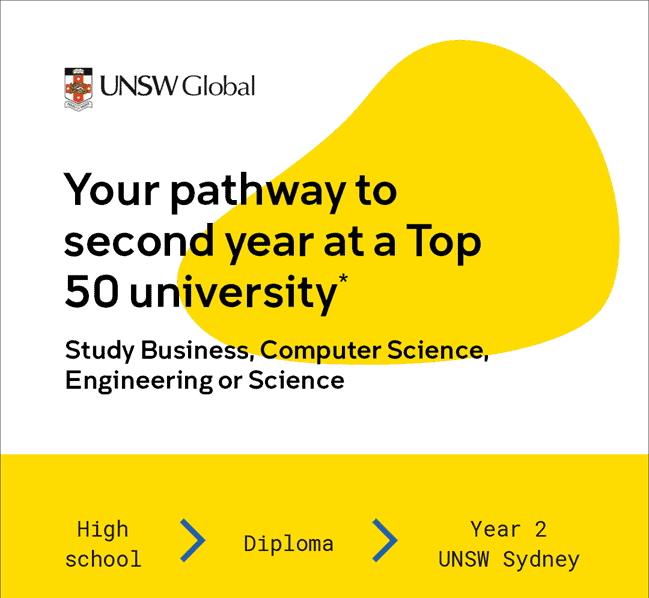
The UNSW Global International First Year Diploma
offers 4 categories in total, namely business, computer science, engineering and science,and on completing the programme and meeting the grade requirements,students can progress directly into year 2 of a UNSW bachelor’s degree.

+ + + +
1) Diploma in Business
Foundation entry grade requirement:
GPA 6.5 (based on the UNSW Global foundation programme; other schools’ foundation programmes may vary slightly)
English: foundation English result of 65%/C+
or IELTS 6.5, Writing 6.0 (no score below 6.0), or PTE 64, Writing 54
Intake dates: 3 intakes per year, in January, May and August
Leads to: Bachelor of Commerce & Bachelor of Economics
Bachelor of Commerce
Majors include:accounting, business economics, business law, business strategy and economic management, finance, fintech, human resource management, international business, management, and taxation;
Bachelor of Economics
Majors include: econometrics, economics, and financial economics;
Progression score requirement: Diploma result of 60% or above, English subject result of 70%;
2021 tuition fee: AUD 39,360

2) Diploma in Computer Science
Foundation entry grade requirement:
GPA 6.5 (based on the UNSW Global foundation programme; other schools’ foundation programmes may vary slightly)
English: foundation English result of 65%/C+
or IELTS 6.0, Writing 6.0 (sub-scores 5.5), or PTE 50, Writing 50
Intake dates: 3 intakes per year, in January, May and August
Leads to: Bachelor of Science (Computer Science)
Bachelor of Science (Computer Science)
Progression score requirement: Diploma result of 50% or above, English subject result of 70%;
2021 tuition fee: AUD 38,400

3) Diploma in Engineering
Foundation entry grade requirement: GPA 6.5 (based on the UNSW Global foundation programme; other schools’ foundation programmes may vary slightly)
English: foundation English result of 65%/C+
or IELTS 6.0, Writing 6.0 (sub-scores 5.5), or PTE 50, Writing 50
Intake dates: 3 intakes per year, in January, May and August
Leads to: Bachelor of Engineering
Engineering majors available include: aerospace engineering, bioinformatics engineering, chemical engineering, computer engineering, electrical engineering, environmental engineering, materials engineering, mechanical engineering, mechatronic engineering, mining engineering, petroleum engineering, solar engineering, sustainable energy engineering and telecommunications engineering.
Progression score requirement: Diploma result of 50% or above, English subject result of 70%
2021 tuition fee: AUD 38,400

4) Diploma in Science
Foundation entry grade requirement: GPA 6.0 (based on the UNSW Global foundation programme; other schools’ foundation programmes may vary slightly)
English: foundation English result of 65%/C+
or IELTS 6.0, Writing 6.0 (sub-scores 5.5), or PTE 50, Writing 50
Intake dates: 3 intakes per year, in January, May and August
Leads to: Bachelor of Science
Science majors available include: anatomy, biology, chemistry, food science, genetics, marine science, mathematics, pathology, physics, physiotherapy, statistics and more;
Progression score requirement: Diploma result of 50% or above, English subject result of 70%;
2021 tuition fee: AUD 38,400


Monash University
Monash International College
International College

School introduction and rankings:
Monash University is one of Australia’s Group of Eight (Go8) universities. Its overall strength ranks among the top universities, and it’s a renowned intensive research university, rated a five-star university in Australia.In the QS World University Rankings 2021, Monash ranked 55th globally.
Monash International College
Located within Monash University in Melbourne, it’s also one of the few Go8 universities offering a Diploma programme.Monash is well known for business, and favours an applied teaching approach — teaching knowledge that’s actually put into practice, not just theory.

Monash University’s eight fast-track programmes lead to the following bachelor’s degrees:Art, Design and Architecture; Arts and Social Sciences; Applied Data Science; Business and Commerce; Education (only available as a double degree combined with Arts, Business or Science); Engineering; Information Technology; and Science.
Majors: Art, Design and Architecture; Business; Bachelor of Arts; Education; Engineering; IT; Science
Duration: 8-12 months
Intake dates: February, June and October each year
Tuition fee: AUD 20,000+
Entry requirement:A foundation programme result of 6.0 or above is worth applying with
+ + + +
UTS — University of Technology Sydney
World ranking well above most Project 211/985 universities in China

School introduction:
The University of Technology Sydney, known as UTS, is located in the centre of Sydney, the capital of New South Wales, and is a dynamic university that places a strong emphasis on innovation — one of Australia’s leading universities.In the latest QS rankings for 2021, UTS is still regarded as Australia’s unofficial ‘ninth’ top university, ranking 133rd in the world.

UTS’s teaching approach is
practical and hands-on, and graduate employment rates are very strong.In particular, nursing, design, IT and engineering have an excellent reputation!Nursing and design are among the top-ranked majors of any Australian university! Students who’ve been following UTS’s rankings will already know that over the past few years, UTS has climbed 100 places on the QS rankings in just four years.

Direct entry to a bachelor’s degree:
The foundation programme result required isGPA6.2-7.6, and once the foundation programme is successfully completed, there’s no need to submit a separate English test result, nor is there any additional requirement for the foundation English course result.
Students with a foundation GPA of 6.2-6.9 could consider:music, media, arts, education, design (product design, interior architecture, photography) and more
Students with a foundation GPA above 6.9 could consider:business, design (animation design, architecture, fashion design, visual communication)

+ + + +
First-year fast-track programme:
Majors:business, design and architecture, media, engineering, IT, science — the course offering is broad and covers almost every field of study.
Duration: 8-16 months
Intake dates: February, May and September each year
Tuition fee: $28,000-34,500
Foundation entry grade requirement: GPA 6.0 or above
+ + + +
Things to note when transferring from a foundation programme
Requirements for applying to transfer schools after completing a foundation programme:
If you want to change schools, and you’ve been in your main course (bachelor’s degree) for less than 6 months, you’ll need to obtain an offer from the new school, then apply to your original school for a transfer consent letter (Release Letter). If the original school approves, you can take the Release Letter to the new school, pay the tuition fees as required by the offer, and obtain a formal CoE, completing the transfer process.
To gain approval from the original school, you’ll need to provide a detailed statement of your reasons for transferring, which largely determines whether approval is granted. Having analysed each student’s individual situation and background, we’ve already helped many foundation programme students successfully obtain a transfer consent letter from their original school — students who need help can contact us for a case-by-case assessment.
If you’ve already been studying your main course (bachelor’s degree) for more than 6 months, no transfer consent letter from the original school is required.
Anyway, progressing from a foundation programme into an Australian university~
— and for students in China who want to come and study a foundation programme or first-year Diploma programme,
feel free to get in touch with me!

Coming up next —
Due to space limits, we’ll publish a separate article next week explaining in detail how foundation programme graduates can transfer to the University of Adelaide, Macquarie University, Western Sydney University and others — stay tuned! Feel free to add the QR code at the end of the article, and we’ll tailor a transfer plan to your foundation programme study and needs, to help secure you a place at an excellent university.
↓Recommended short videos↓

Click the image to read the full article

GTI update! These newly added fields may be entering a bonus period with no long wait required! Bachelor’s and master’s holders are still receiving invitations steadily!

In 2021, you can’t migrate to Australia without “it”! One article teaches you how to judge whether your work experience is “useful” for migration!

As fast as 3 months!? Get PR in New Zealand quickly — these popular fields can do it!

Canada takes in a whopping 401,000 new migrants! Want in? We’ll show you how to get your Maple Leaf Card quickly?

Latest official migration news! Department officials believe Subclass 189 may pick up next financial year? Visa processing arrangements! State nomination quotas and application status across all states!


More in-demand occupations added, faster visa grants, lower employer-sponsorship thresholds, onshore applicants prioritised! Submissions from the Department and other parties offer advice on post-pandemic skilled migration!

Migration information-sharing and Q&A group

Step 1: Press and hold to add our customer service

Step 2: After adding, please












Here, there’s always a PLAN B suited to your occupation!Click “Read the original article”, to see Q&A on regional areas across all states!