In Australia’s new financial year the permanent migration quota holds steady at 185,000, while the employer-sponsored Subclass 186 category has been allocated as many as 58,000 places — more than 14,000 additional places, a remarkable increase. Recently, many offshore applicants have wanted to understand whether, following this reform, they can seize this window of opportunity.
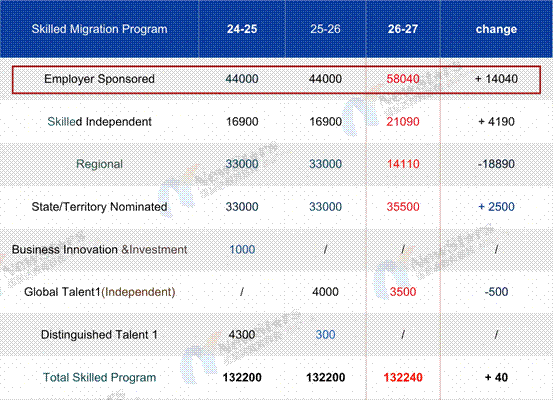
At the same time, many overseas applicants are worried: with the onshore-to-offshore quota split at 7:3, offshore applications seem to have only a 30% chance? Today we’ll take a closer look at where offshore applicants go from here under the new policy.
The Core Logic for Offshore Subclass 186 Applicants to Secure Approval Under the 7:3 Quota Rule
We pulled five financial years of Subclass 186 data by lodgement location, and over the past three years the onshore-to-offshore ratio has essentially stayed at 7:3. Offshore applicants have always made up only a small share of employer-sponsored cases, and this new policy is expected to mainly affect points-based skilled migration and family reunion, with limited impact on employer-sponsored migration. The key to approval still comes down to the employer’s credentials plus the applicant’s core qualifications.
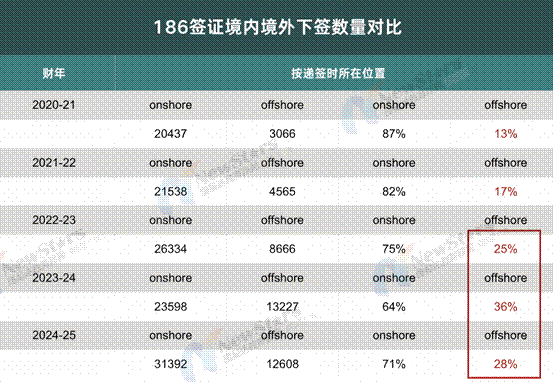
The impact on offshore applicants: it’s not that there’s no opportunity, but rather that, within a limited quota, the requirements must be met more precisely — both the individual application requirements and the employer application requirements have to be satisfied.
Key Advantages of Australia’s Subclass 186 Employer-Sponsored Visa
Subclass 186 Employer-Sponsored Visa Application Requirements

Programme advantages
(1) Obtain permanent residency directly, with full benefits and no restrictions on where you live
(2) One person applies and the whole family migrates, all sharing in Australia’s benefits
(3) Children can study in Australia and your spouse can work in Australia
(4) Live, work and study anywhere in Australia
The Full Set of Mandatory Requirements for an Offshore Subclass 186 Employer-Sponsored Application
Individual application requirements
1. Aged under 45
2. Have an employer willing to sponsor you
3. IELTS 6 in each of the four bands, or an equivalent English result
4. A skills assessment relevant to the nominated occupation
5 The nominated occupation is on the CSOL occupation list
6, At least 3 or more years of relevant work experience
The Subclass 186 is a permanent-residency (“green card”) visa in the employer-sponsored category. If you meet the individual conditions above, you’ll also need to assess the requirements for the employer and the nominated position.
Employer application requirements
1. Lawful and actively operating credentials: the employer must be a business that is lawfully registered in Australia and actively operating. If applying through a labour agreement, it must also demonstrate a good reputation, at least 12 months of operation and a sound financial position.
2. The nominated position is genuine and full-time: the nominated position must genuinely exist, and it needs to be full-time and ongoing.
3. Meets occupation list requirements: for the Direct Entry stream, the nominated occupation must be on the Core Skills Occupation List (CSOL); if applying through a labour agreement, the position requirements may be more flexible.
4. Salary meets market standards: the employer must offer a salary no lower than the annual income threshold (CSIT), which from 1 July 2026 is AUD $79,499.
A Precise Profile of Who Subclass 186 Suits for Offshore Approval
Who it suits: if you’re already over 32 and your age points have dropped sharply, you’re unwilling to move to a regional area, you have extensive work experience and outstanding professional ability, and you meet workplace English communication requirements, then the Subclass 186 employer-sponsored visa is worth considering.
Taxation Accountant — Subclass 186 nomination approved

Accountant — Subclass 186 nomination approved

ICT Sales Representative — Subclass 186 nomination approved
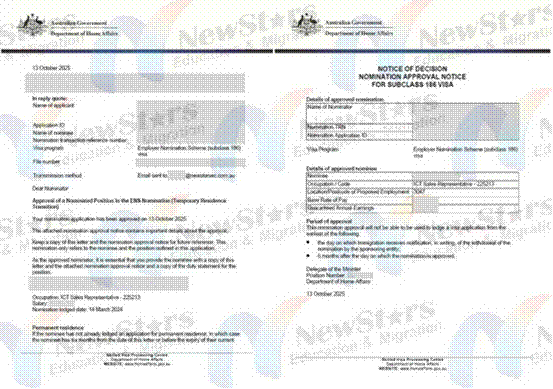
If you have 3 or more years of full-time work experience, have completed a skills assessment and achieved IELTS 6 in each of the four bands, and your employer is willing to sponsor you or you’ve found a job in Australia, the Subclass 186 may be a good fit.
The right choice matters more than effort alone — book a one-on-one session to map out your residency pathway.