Original author: MICHELLE CHEN (Published: 7 October 2021, source: https://www.sbs.com.au/chinese/mandarin/zh-hans/audio/australian-immigration-agent-initiate-petition-to-follow-nz-resident-visa)
New Zealand One-Off Resident Visa
Immigration New Zealand launched a one-off resident visa on 30 September, available to people currently holding temporary work visas in New Zealand.
Immigration New Zealand launched a one-off resident visa (2021 Resident Visa) on 30 September.
Eligible applicants must currently hold a temporary work visa in New Zealand, and must have applied for an eligible visa on or before 29 September 2021, with that visa subsequently approved.
In addition, applicants must meet one of the following three conditions:
– Have lived in New Zealand for three years or more, or
– Earn income equal to or above the median wage (NZD $27 per hour), or
– Work in an occupation on the shortage list
An estimated 165,000 people are expected to be eligible to apply for permanent residency as a result, with the first stage of applications opening in December this year, and most applicants expected to receive a decision within one year.
From 1 December 2021, some eligible applicants will be able to apply in two stages, while the remaining eligible applicants can apply from 1 March 2022. All applications must be submitted by 31 July 2022.
New Zealand’s Minister of Immigration, Kris Faafoi, previously stated that the policy provides a pathway forward for migrant families who have long faced disruption due to the pandemic, while giving businesses the certainty they need to plan for the future. He acknowledged that the pandemic and closed borders have brought uncertainty and hardship to New Zealand’s migrant communities.
He noted that the new visa creates an easier pathway to permanent residency for migrant workers caught in difficulty during the pandemic, including thousands of health workers whose residency applications had been delayed. Faafoi stated that most applications would be approved within a year of the December opening.
Most holders of work-related visas and their immediate family members are eligible for the “2021 Resident Visa”.
Immigration New Zealand estimates that eligible visa holders will include more than 5,000 health and aged care workers, approximately 9,000 primary industry workers, and more than 800 teachers, as well as approximately 15,000 construction workers and 12,000 manufacturing workers holding relevant visa types.
Petitioning Australia to Follow Suit
An Australian migration agency launched a petition on change.org last week addressed to Prime Minister Morrison, calling on Australia to follow New Zealand’s lead and offer a similar policy for temporary visa holders still working in Australia. As of 7 October, 7,024 people had signed in support.
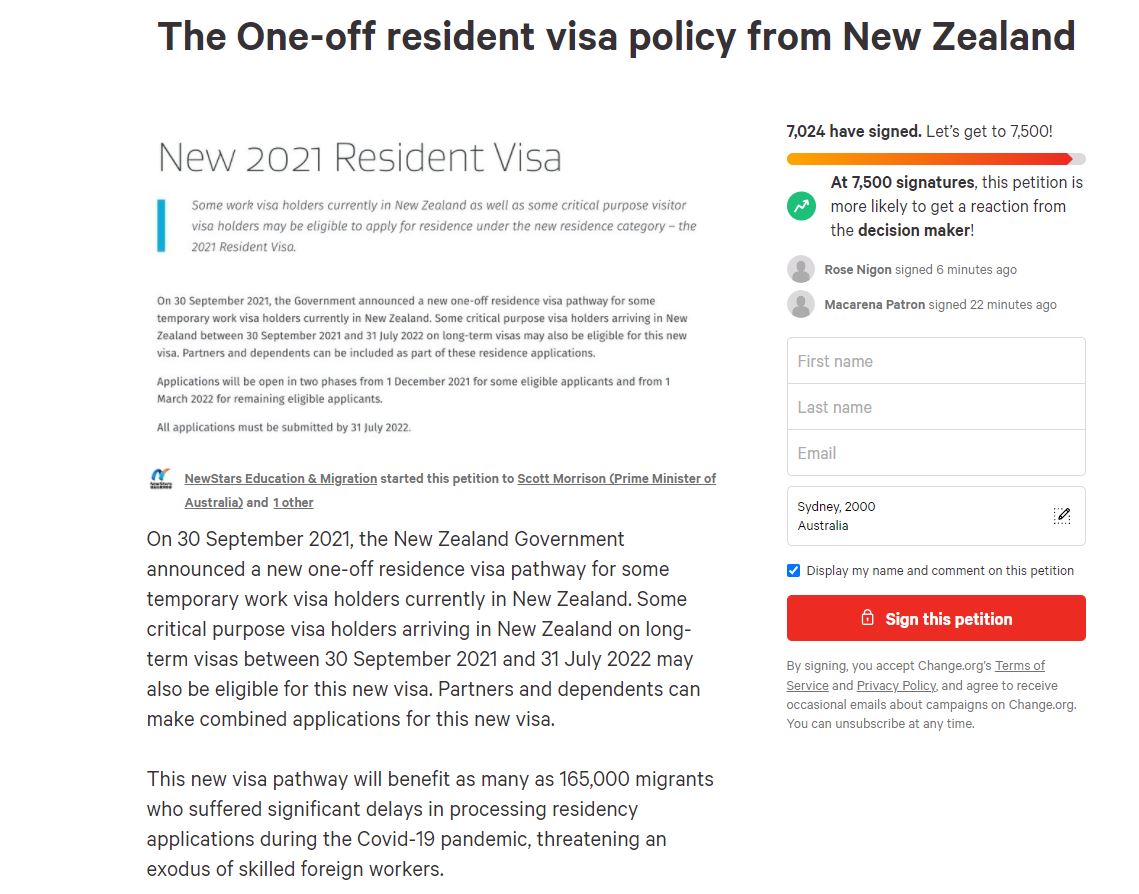
Take Action — Sign the Petition!
It takes less than a minute — a small gesture that could make a real difference for the migration journeys of your family and friends. Let’s fight for it together!
Click here to access the petition:https://www.change.org/p/scott-morrison-the-one-off-resident-visa-policy-from-new-zealand?utm_content=cl_sharecopy_30869310_en-AU%3A0&recruiter=797857276&utm_source=share_petition&utm_medium=copylink&utm_campaign=tap_basic_share
Kirk: On the Skilled Migration Shortage and the Case for Preferential Policy in Australia
Our reporter interviewed Kirk Yan, Melbourne Branch Director of Newstars Education & Migration and the organiser of this petition. He noted that Australia’s situation is similar to New Zealand’s — during the pandemic, strict border controls closed the country to movement, preventing skilled migrants from entering or leaving.
This situation has led to New Zealand facing a skilled migration shortage in the aftermath of the pandemic.
Kirk said that New Zealand’s total population is just under 5 million, and 165,000 spots represent approximately 3% of the population — which is why the word “amnesty” can be used to describe this policy. For most eligible applicants in New Zealand, this is “tremendously good news”.
Kirk Yan: Melbourne Branch Director of Newstars Education & Migration, licensed Australian migration agent with years of experience and in-depth research in interpreting and predicting migration policy changes. Editor-in-chief of the Australia Migration Weekly Bulletin, affectionately known by his clients as “K-God”.
He said that New Zealand is the first country to issue an “amnesty” of this scale for skilled visa categories — previously, small batches of one-off visa grants had only occurred for political asylum or refugee visa streams.
Kirk said, “Over the past year and a half, Australia’s situation has been almost identical to New Zealand’s, and the outcomes have been the same — overseas migrants couldn’t enter, and many temporary visa holders already in Australia chose to leave for various reasons. Australia’s net outflow of migrants over the past year reached 100,000. At the same time, skilled migration approvals in Australia over the past year were the lowest in a decade — not even 80,000 — compared with over 100,000 per year previously. Businesses have also been reporting difficulties recruiting staff.”
“By launching this petition, we hope the government will consider the contributions made to Australia by work visa applicants who have remained here throughout these difficult years, and offer them some form of preferential policy.”
Kirk Audio Interview Recording
One of the petition’s supporters, Annie, came to Australia in 2014 to attend high school and graduated with a Bachelor of Nursing from Monash University in Melbourne. After graduating, she began working as a nurse at a rehabilitation centre in February this year and currently holds a Subclass 485 Temporary Graduate visa.
She said that because the rehabilitation centre where she currently works is not within the occupation categories recognised by the Department of Home Affairs for permanent residency applications — such as aged care facilities, emergency departments, intensive care units, psychiatric wards, and paediatric wards — she is currently unable to pass a skills assessment, and whether she will qualify to apply for permanent residency in the future remains uncertain.
She noted, “Competition for occupations on Australia’s current migration occupation list is extremely fierce. For example, more than 100 people are competing for just 20 paediatric positions.”
Yet the ward where she works regularly cares for COVID-19 recovery patients, and she has contributed to Australia throughout the pandemic.
She said, “In reality, it’s already no easy feat to graduate from a nursing programme here and secure work at a local hospital — you’re competing with local applicants from the outset, and opportunities are limited. Then the Department of Home Affairs sets up so many hurdles. It’s quite disheartening.”
SBS Mandarin has contacted the Department of Home Affairs seeking a response.