As many of our followers know, the Subclass 143 grant queue has been stuck atthe May/June 2016 lodgement markfor quite some time now, and we keep receiving questions like:Aren’t there grants being issued? Why is processing still at this rate? Has something gone wrong? Has the information not been updated?
Based on the grant outcomes we have seen for our own clients, the processing remaining at the May/June 2016 lodgement mark is not a Department system error.
Our two most recent Subclass 143 grants were as follows:
Lodged Subclass 143 on 24 May 2016,and after years of waiting, multiple police clearance certificates, medical examinations, and other additional documents, the visa was finally granted on 20 January 2022!
A Subclass 103 parent visa lodged in 2015,which had already been waiting far too long, was converted to a Subclass 143 along the way, and was granted on 31 January 2022!
The most recent client of ours to receive a request for additional documents lodged on 22 June 2016. Each visa case has its individual differences, and it is also normal for applications lodged at a similar time — or even slightly earlier — to not yet have received a request for documents,so on an optimistic and general basis, we would say that the Subclass 143 queue has progressed to June 2016.
This week we obtained from the Department of Home Affairs the first-half FY2021–22 data onmonthly Subclass 143 Contributory Parent visa grant numbers,which gives us some useful insight.
Contributory parent visas currently come in two subclasses — 143 and 864. Subclass 864 is processed faster than Subclass 143, and the number of applications is vastly smaller, making the backlog negligible by comparison. This article will therefore focus on the Subclass 143 category.
Processing speeds for Subclass 143 this financial year remain, as ever, extremely slow…
As can be seen in the chart below,the number of grants in July — the first month of the financial year — was exceptionally high, reaching 1,031.This was because applications that had already been processed during the previous FY2020–21 could not be formally granted, as the permanent residency allocation for that year had been exhausted ahead of schedule,so once the new financial year began and fresh allocation became available, a large wave of grants was issued in July.In the months that followed, the numbers dropped quickly and stabilised, with a total of 1,948 grants issued by 31 December 2021.

Bear in mind that Subclass 143 has an annual allocation of only 3,600 places. With 1,948 already issued by the end of last year,the remaining allocation works out to fewer than 300 grants per month on average,which is precisely why parent visa processing is so slow.
So why is the queue stuck at May/June 2016?
Because the number of visas being processed is severely mismatched with the volume of applications lodged during that period.In June 2016 alone, 1,880 applications were lodged, and the months that followed saw similar volumes of several hundred to over a thousand per month — yet as the chart above shows, only 1,948 grants were issued over half a financial year.The lodgement data from June 2016 to June 2017 shows just how painfully slow the processing would be — and how severe the backlog has become — if fewer than 300 grants per month continue to be issued.
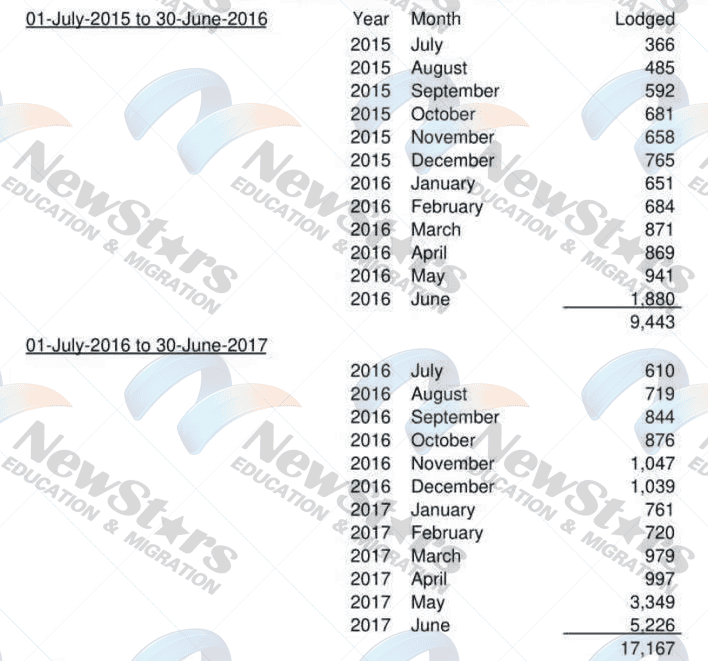
This is exactly why we have always advised everyone: once you receive your PR, regardless of your short- or medium-term plans, if your parents are eligible, lodge their application as early as possible to secure their place in the queue. At the current rate, applications lodged today could face a wait of 17 years or more. If you would like to learn more or proceed with an application, please contact our team via the link below!

We hope parent migration will see an improvement in the next financial year — that is the only way to truly address the underlying problem.
Processing for Subclass 143 parent visas was already slow before the pandemic,and quota cuts during the pandemic only made the situation worse,with any allocation diverted from the skilled migration programme to the family stream going exclusively to partner migration,leaving parent migration worse off than before — its allocation nearly halved.
With the 2022 federal election on the horizon,the budget for the next financial year will be brought forward to 29 March (rather than the usual May), and the parent migration allocation should become known shortly after the budget is released.Of the two major parties, Labor has generally taken a more positive stance on parent migration, so if Labor wins the election, there is reason to hope for better parent migration policies than what we have now. Of course, Australia has fully entered the COVID-19 recovery phase and has reopened its borders, which also gives grounds for optimism that the parent migration quota will be restored. Parent migration policy is typically a battleground issue that both parties will use to court voters.
We hope all parents still waiting in the queue will have their visas granted soon and be reunited with their families before long.
We have also included answers to a few frequently asked questions about parent reunification below.
Please read on.

A group for timely updates on returning to Australia has been set up
Those who wish to join
may add our customer service contact and note: Return to Australia



1. What other visa options are available for parents to stay in Australia for an extended period before their migration visa is granted?
Once parents have been notified that their application has been successfully queued, they can apply fora multiple-entry visitor visa valid for up to 5 years.
For those who have not yet lodged a migration application or who are not considering migration,they may wish to consider applying forthe Subclass 870 Sponsored Parent (Temporary) visa,The Subclass 870 visa allows parents to reside in Australia for 3 or 5 years with no limit on the number of entries, and can be renewed for a maximum total stay of 10 years,Current visa application charges are AUD $5,090 for 3 years and AUD $10,180 for 5 years. The child must first obtain approved sponsorship status, with the primary sponsorship requirement being a taxable income of AUD $83,454.80 (either from the sponsor alone or combined with their spouse or a sibling living in Australia). The Subclass 870 does not provide a pathway to permanent residency, and parents who have applied for or hold a Subclass 870 visa must wait until it expires before lodging a parent migration application.
Where the child holds PR or citizenship and the parents have not yet lodged a migration application — or where parents are not PR holders or citizens themselves — they can now apply for a visitor visa and enter Australia (having received two doses of an approved vaccine; in China, currently Sinovac or Sinopharm). For details on the visitor visa for parents, please contact our team:

2. If a Subclass 103 application has already been lodged, can it be converted to the Subclass 143 (Contributory Parent) category?
Yes. In addition to paying the contributory fee,the time already spent in the Subclass 103 queue can be counted towards the Subclass 143 queue time.
However, if a parent reaches the aged parent age threshold while waiting on a lodged Subclass 143 application, they cannot convert to Subclass 864. Subclass 103 can be converted to Subclass 143, and Subclass 804 can be converted to Subclass 864,but you cannot convert directly between the aged and non-aged parent categories.
What age is required to apply as an aged parent?
3. If one parent has already lodged an application and the other also wishes to migrate later, what is the best approach?
The other parent can be added as a secondary applicant during the waiting period. The queue time does not need to be restarted, and the contributory fee is charged at the rate applicable at the time of the original application.If one parent lodges a Subclass 143 application first and the contributory fee later doubles, which fee applies to the parent who joins later?
It is also possible for the other parent to migrate separately after the first parent’s PR is granted,but after one parent receives their PR, they must wait a further 5 years before they are eligible to sponsor the other parent through a partner visa application, which itself carries an additional wait of approximately two years,meaning the fastest the other parent could receive their PR is approximately 7 years later.
4. Which Subclass 143 applicants are entitled to a bridging visa that allows them to remain in Australia continuously after lodgement
Due to the special arrangements put in place during the pandemic, Australia currently still allowslodged Subclass 143 visas to be granted onshore.If parents who have lodged a Subclass 143 application while in Australiawish to additionally apply for a bridging visa,all three of the following requirements must be met:
1. The Subclass 143 application was lodged before 24 March 2021
2. A valid Australian visa was held at the time of lodging the Subclass 143 application (a Subclass 600 visitor visa is acceptable)
3. The applicant is currently in Australia and holds a valid visa
*From 21 February, bridging visa holders may also travel in and out of Australia freely
Study Abroad / Migration
Guides
Videos
Previous Articles

Post-pandemic “breakthrough” invitations for offshore skilled migration to Australia!
Post-pandemic “breakthrough” invitations for offshore skilled migration to Australia!

We witnessed an unexpectedly generous round of NSW Subclass 491 invitations in February — what happens next?

Applications now open! SA state nomination (offshore) surges by 259 occupations — 389 in total!
Applications now open! SA state nomination (offshore) surges by 259 occupations — 389 in total!

Which visa applications allow a spouse to be added after lodgement but before grant?

Migration Information and Q&A Group

Step 1: Long-press to add our customer service contact

Step 2: Once added, please







How can parents of a PR holder or citizen enter Australia now?Click “Original Link”to watch the video guide