Department of Home Affairs:
Has received substantial additional funding to clear the visa backlog
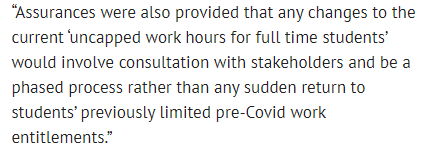
Full work rights for student visa holders guaranteed not to be suddenly cancelled
In the latter period of the Morrison Government,processing times for non-migration temporary visas also slowed considerably — visas such as the Subclass 500, Subclass 600 visitor, and Subclass 408 took longer than normal,with the tourism industry pushing for faster processing and the international education sector now demanding answers from the government, the second semester of 2022 is fast approaching and the pressure is on.
International Education Association of Australia CEO Phil Honeywood stated: “Just as we thought we were starting to recover from ‘Fortress Australia syndrome’, the Department told us about a series of problems that cannot be turned around quickly.”
At their quarterly meeting with the Department’s education visa advisory committee in late June, they were informed thatsome of the reasons includeCOVID lockdowns causing some visa applications to be processed in other countries,Australian embassies now lacking adequately trained staff to handle the current workload,and a surge infraudulent documents from certain student source countries.”

*Applications processed offshoreare mainly non-migration temporary visas,with visitor visas being the most common;
*Student visa processing is actually not extremely slow —Newstars has seen most recent grants in 2022 go to applications lodged in May or June 2022, both onshore and offshore,with only a very small number dating back to early this year or late last year, though processing does remain case by case.
The Department acknowledges that visa processing is currently slower than before the pandemic, but emphasises thatthe newly elected federal government has now provided substantial additional funding to clear the visa application backlog.

This funding covershiring large numbers of new staff at embassies,as well asextending working hours for existing staff willing to work overtime.

At the same time,regarding the temporary relaxation allowing student visa holders to work full time,the Department guarantees that any changes will be consulted with stakeholders before implementation,and that it will be a phased process — meaning there will be nosudden reversion to the original 40-hours-per-fortnight work limit with no warning.

Various industries:
Just as short-staffed as visa processing
It stands to reason that the staffing shortage in visa processing mirrors the staffing shortages across all industries. Australian Bureau of Statistics data showsthat in May 2022, there were 480,000 job vacancies across Australia, an increase of 58,000 from February,more than doubling compared to February 2020 (before the pandemic fully took hold).

Only a small number of industries saw improvement in filling vacancies between February and May,while the industries with worsening shortages are Retail trade (up 38%), Information media and telecommunications services (+18%) and Arts and recreation services(up 16%)
So just like the visa application backlog, these are major challenges that require various approaches to address step by step, and both are closely linked to migration — whether permanent or temporary, onshore or offshore.
Large numbers of people moved to regional areas
Since borders gradually reopened late last year, net overseas migration has shown a clear recovery

Net overseas migration: the net figure of overseas arrivals and departures, including permanent residents and those on temporary visas who can stay for at least 12 months (such as student visa/Subclass 485/Subclass 482 holders), though a full return to pre-pandemic levels will take time.
As at the end of last year,the recovery of net overseas migration shows Victoria, Queensland and Western Australia still have ground to make up——
Western Australiawas slower to open its state border and was affected to some extent;Queenslandis leading all other states in interstate migration (people moving there from other states), and with this winter colder than usual, even more people are likely to be considering a move to warmer Queensland.So, Victoria……


Over the past financial year,large numbers of people have moved from state capital cities to regional areas near those cities,withSydney and Melbourne seeing the greatest outflow.
Former Sydney residentsmost commonly choose to move to Newcastle, Lake Macquarie, and Wollongong — all coastal with plenty of greenery and good air quality — followed by Illawarra, Canberra, the Gold Coast, and the North Coast of New South Wales.
Former Melbourne residentsmost commonly move to Latrobe-Gippsland, Geelong, Hume, Wodonga, Bendigo and Ballarat.
Former Brisbane residentsare most likely to move to the Gold Coast or the Sunshine Coast,while those from Perthtend to prefer moving to Bunbury,and former Canberra residentstypically go to neighbouring New South Wales towns, Melbourne or Sydney.
Analysts note: “Some of these places offer a coastal lifestyle or a different way of life, while housing is also more affordable.”
As a result, former Sydney and Melbourne residents don’t particularly see eye to eye — Sydney didn’t even make the top ten destinations for former Melbourne residents moving house.
The destinations chosen by Sydney and Melbourne residents are overwhelmingly classified as regional areas for migration purposes. New South Wales and Victoria, given their large populations and high numbers of applicants, have the most competitive migration landscape,as the regional Australia definition continues to expand (now covering everywhere except Sydney, Melbourne and Brisbane) and state nomination becomes the mainstream pathway for points-based skilled migration,some people move because of housing prices and lifestyle,while others move to try a different migration pathway.
Finally, here’s a quick note: the regional area that Subclass 489/491 holders granted at different times are required to live in varies —make sure you don’t live in the wrong area! The specific regional areas for different Subclass 489/491 grants — officially confirmed by the Department of Home Affairs!
Around 1 July at the start of the new financial year,new policies are announced in quick succession— we have set up a2022–23 financial year Australia migration policy updates groupso if you’d like to stay informed on the latest news, please add our customer service contact below and note: New Policy, to request entry to the group.

This week’s Feifan English updates
Click the image to read the full article
Previous recommendations

Subclass 189 invitations to rise to 2,000–4,000 per round!? Industry continues to call for increased PR quota!

IT applicants — you don’t need to compete for state nomination, you could have applied already!

Subclass 485 Replacement: full legislative details — applications can be lodged and granted onshore or offshore!

Federal Minister: Australia needs to fully restore both temporary and permanent migration programmes

Migration information sharing and Q&A group

Step 1: press and hold to add our customer service contact

Step 2: after adding, please



Attention!Please verifygenuineNewstars consultants!





Each state is still waiting on its quota — one state wants 10,000?Click here for more on the past financial year’s trend of more people choosing to move to regional areas! Click ‘original link’ — Migration Weekly — video edition