Recent482/186 grants are coming through thick and fast, especially for occupations on the PMSOL — processing is lightning fast. Some applicants who are caught in the fierce queue of the competitive skilled-migration stream have, in fact, already met the requirements for an employer-sponsored visa, or are on their way to doing so,
so you might want to consider makingemployer-sponsored visas your primary migration pathway. And if youmeet the conditions for a 485 Replacementvisa, right now is the perfect time to be building up your work experience.
Most recent employer-sponsored visas granted within a few months
Still accelerating as we enter the new financial year
#
Accountant 482 Full process completed in under three months

Under three months start to finish! Nomination approved in mid-April 2022, visa lodged in early May, and comfortably granted in early July.
#
Accountant 482 Full process completed in three months
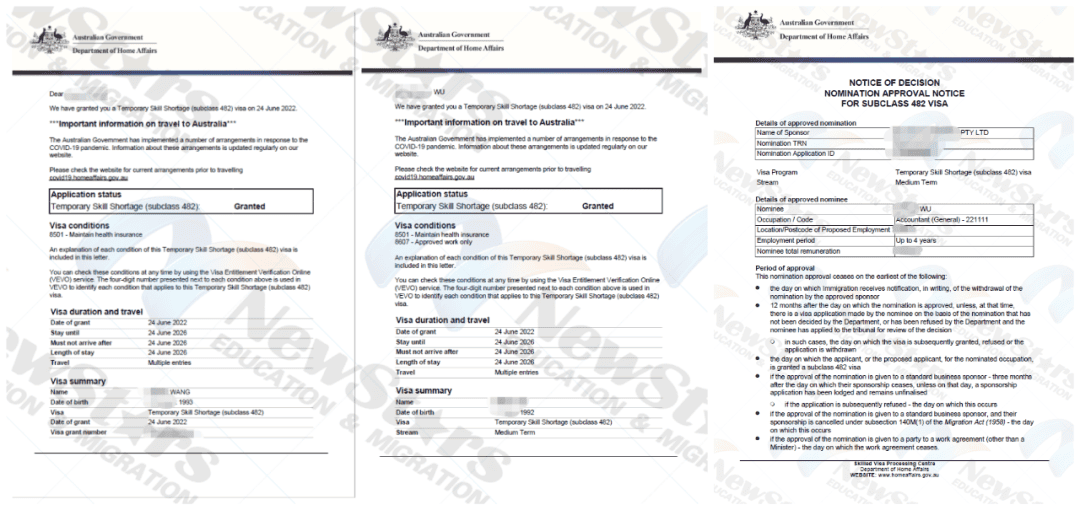
Three months start to finish — lodged in March this year, visa in hand by June! (Including spouse)
#
Accountant 482 Full process completed in two months
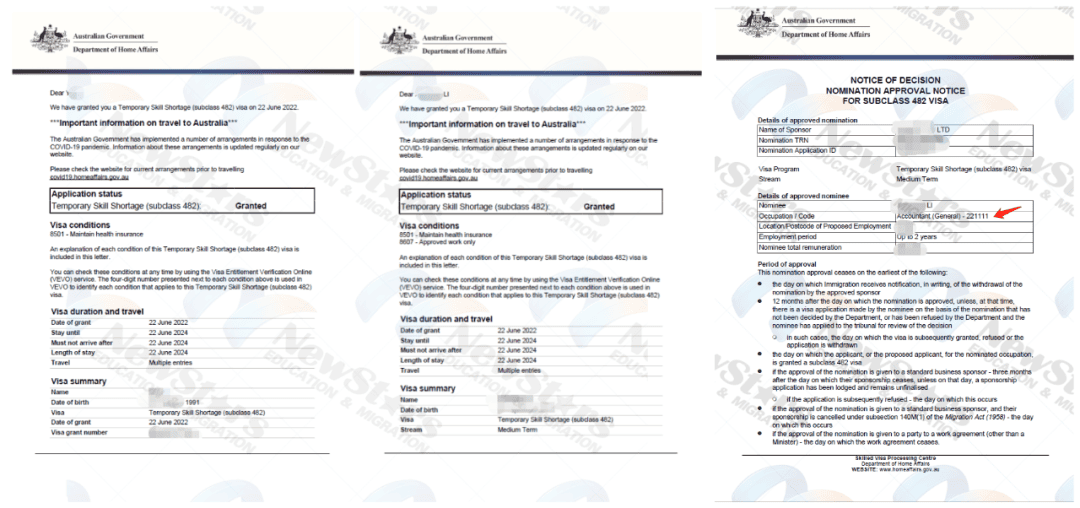
Applied in late April, nomination approved in late May, visa granted in late June (including spouse)!
#
Accountant 186DE PR in hand within six months

Application lodged early this year, nomination approved in early June, PR granted one week later (including spouse).
#
Engineering Technologist Nomination approved in one month

482 nomination approved, with a wait time of just one month.
#
Massage therapist granted in 2 months

Subclass 482 lodged in early May 2022, granted within 2 months.
#
Chef 2-month grant

Also lodged in early May 2022 — 482 approved in early July (including spouse).
During this period wealso had many employer-sponsoredcases — particularly rapid 482 grants — far too many to list individually.
The Department’spriority treatment and focuson employer sponsorship is no coincidence. Australia has fallen into an unprecedentedlabour shortageduring its post-pandemic recovery, and there is literally no industry or role that is not in short supply right now.
Employer sponsorship is seen by both employers and the government as the most direct way to fill the gap.
At that kind of pace, employers are still not “satisfied” — throughout 2022 there have been near-daily calls to relax employer sponsorship requirements, prioritise processing, and simplify procedures. As a result, we are seeing processing speeds pick up for occupations outside the PMSOL list as well.
And because the labour shortage is not a problem that can be solved overnight, this level of priority treatment and focus is expectedto continue for quite some time.
Advantages of employer sponsorship
Beyond speed, there are other advantages as well.
Employer sponsorship is divided into the temporary stream — the Subclass 482 / Skills in Demand visa,the permanent stream — the Subclass 186 / Employer Nomination Scheme visa,and the regional temporary stream — the Subclass 494 / Skilled Employer Sponsored Regional visa. Here we focus mainly on the 482 and 186.
An application for the Subclass 482 primarily involves three steps:employer sponsorship approval, employer nomination, and the applicant’s visa application.
An application for the Subclass 186 primarily involves two steps:employer nomination and the applicant’s visa application.
Key advantages:
– No points required
– No queue or waiting for an invitation round
– Most 482 occupations do not require a skills assessment
– Short processing times (particularly for in-demand occupations right now)
– Requirements for applicants are consistent across all states and territories — no state-specific conditions
– Policy is stable and does not change as frequently as state government schemes; applications can be lodged from onshore or offshore
Who is eligible to be a sponsor?
Important! Important! Important!
In the employer-sponsored visa process, many applicants assume that as long as an Australian employer is willing to sponsor them, that’s all that’s needed. There are also employers who string employees along with promises of future sponsorship and permanent residency.Whether an employer actually qualifies to be a sponsor is a critically important question.Here I’ll outline a few of the most basic benchmarks for assessing an employer’s sponsorship eligibility. If your employer does not meet the following criteria, you will need to think carefully before proceeding.
Employer
Prior conduct record
A company’s track record is also an important benchmark. For example, if a company has been penalised in the past, andthat penalty related to employment or labour relations, or if itpreviously held sponsorship status but had that status cancelled by the Department for breaching certain conditions, the situation becomes complex and the risks are higher.
Company
Annual turnover
Annual turnover refers to the company’s revenue.Many sponsored occupations require the company’s annual turnover to be at least AUD 1 million.Take our mostcommon example — accountants.
Of course, many occupations have no hard turnover requirement, but more is always better.
Company
Profitability
When assessing employer eligibility, the Department will consider whether the employer has the capacity to keep the business running and pay all employees’ wages.If a company is in a state of ongoing loss, the Department will question whether it can sustain continued operations and whether employees risk being made redundant or having their hours cut.
Please note, however,some companies may currently be operating at a loss due to the impact of COVID-19, and this does not automatically mean they are ineligible to sponsor.Each situation needs to be assessed on its own merits — feel free to contact me for an evaluation!
Existing workforce
Ratio of local & full-time staff
When assessing employer eligibility, the Department will look at the visa status of existing employees and the number of full-time versus part-time staff. Too few full-time employees or too few PR holders or Australian citizens is a red flag.
Core business
and genuine need for the role
Genuine need refers to the necessity for the company to employ you in the nominated position — and this is one of the main things the Department scrutinises.The main considerations are the duties of the role, whether this is a newly created position or one that has existed for some time, and whether the role is related to the company’s core business.
For example, sponsoring a software engineer in an IT company makes sense. But if a small company in another service sector has a website and offers online services, it can easily outsource those needs — setting up a dedicated software-engineering role would neither save money nor simplify things. It takes strong reasoning and evidence to convince the Department.
In addition,certain specific occupations impose special requirements on the sponsor.For example, sponsorship of aChefchef requires that the employer not be a mass-production factory or assembly line, and also not be a restaurant that does not offer a full dining service — such as fast food outlets, cafés, and food court restaurants.
Specific planning
If you’re wondering:
I have a job and some experience — can my employer sponsor me?
Or: my employer wants to sponsor me — is that possible? What does the process look like?
Feel free to contact me directly to find out
(Amber — MARA-registered migration agent, MARN: 2217836)


Basic requirements for 482/186 applicants
482
Basic requirements for applicants
– The occupation must be on the MLTSSL (Medium and Long-term Strategic Skills List) or the STSOL (Short-term Skilled Occupation List) (some occupations on the ROL regional occupation list may also be eligible for the 482)
– No age limit
– At least2 yearsof full-time work experience in a field related to the nominated occupation
– No skills assessment required (except for specified occupations)
– Occupations on the MLTSSL have a permanent residency pathway
– For MLTSSL occupations, English must be at least IELTS 5 in each of the four components, or equivalent (valid for 3 years)
– For STSOL occupations, English must be at least an overall IELTS band score of 5 with no component below 4.5, or equivalent (valid for 3 years)
186
Basic requirements for applicants
– The occupation must be on the MLTSSL
– Age must be under 48 years
– At least3 yearsof full-time work experience in the nominated occupation (not required to be with the same employer)
– A valid skills assessment is required
– English must be at least IELTS 6 in each of the four components, or equivalent (valid for 3 years)
The most essential criterion: work experience
The most fundamental requirement
Paid work
Work experience used for employer sponsorship differs somewhat from the experience we normally count for skilled-migration points purposes.
– Work must be paid; internships are not counted.
– Full-time means at least 38 hours per week; part-time work of at least 20 hours per week can be counted on a pro-rata basis.
482
Work experience requirements
The Department’s requirements for the 2 years of experience for the 482 and the 3 years for the 186 are different.
–The 2-year work experience requirement for the 482 only needs to be metbefore the visa is granted — it does not have to be satisfied at the time of lodgement.– The work duties and job requirements are less strict than for the 186,
and experience in related occupations is acceptable, though the work must still demonstrate a certain skills level.For example, if an applicant wants to be nominated as a chef under the 482, previous experience as a cook does not satisfy the requirement, because a cook has a lower skills level than a chef.Experience may be
–paidpre-qualification, or may include a research project during a Master (Research) or PhD — paidinternships and apprenticeshipsduring study count, and for occupations requiring registration,work experience gained while holding provisional registrationalso counts.– However, the work experience considered
is within the past 5 years,though if you have been out of the industry for too long, the Department may consider that you no longer possess up-to-date skills relevant to the industry. Work experience requirements
186
*This refers mainly to the Direct Entry stream
– The 186’s requirements for work experience are very strict.
First, your 3 years of work experience must be met before lodgement,though the 3 years do not need to be continuous.– Your work
must be in the nominated occupation — related fields are not acceptable.– It must be
post-qualification work,and apprenticeships and internships, even if paid, cannot be counted.For occupations requiring registration,only work experience gained after obtaining full registration can be counted.For example, pharmacists have a 12-month provisional registration period — that experience counts towards the 482 work experience requirementbut cannot be counted towards the 186.
Which visas allow you to accumulate work experience in Australia?
The primary prerequisite for accumulating work experience in Australia is holding a visa with work rights. Visas with work rights fall into two categories: full work rights and limited work rights.Here we focus on visas that come with full work rights.
Subclass 485 Graduate Work visa
The best option is of course the Subclass 485 Graduate Work visa. Especially giventhe recent windfall of additional working visas — graduates who lost 485 visa time due to the pandemic canapply for a 485 Replacement visa.
Most people are very familiar with the standard 485 — here I’ll focus on the Replacement. The Replacement visa is for graduates who previously held a 485 visa but were unable to enter Australia during the COVID-19 period due to border closures and similar circumstances. Eligible applicants must lodge their visa application before 1 January 2027.
If you previously held a 2-year 485 after completing a Master (Coursework) degree, the Replacement 485 will grant 3 years of working rights; if you had the older 1.5-year visa, the Replacement 485 will grant 2 years.In other words, you can regain at least the full 2-year visa. If you were originally a regional graduate, you can also extend by an additional 1 or 2 years if you continue working in a regional area on the 485 Replacement.It is truly a lifesaver for those who did not plan their migration pathway in advance.
Requirements for 485 Replacement applicants:
1. The applicant’s 485 visa was granted on or before 15 December 2021.
2. The applicant’s 485 visa was valid on or after 1 February 2020 (note: this means your visa was valid during this period, not that it was granted during this period).
3. The visa must have been granted before 5 December 2021 and must have been valid on or after 1 February 2020.
– If offshore:
The visa must have been activated before 15 December 2021 (for those whose visa was granted offshore, the 485 visa is activated upon first entry to Australia),
and after the visa was activated, there must have been at least one day outside Australia before 15 December 2021.
– If onshore:
There must have been at least one day outside Australia between 1 February 2020 and 14 December 2021.
The primary applicant who meets conditions 1 + 2 + 3 may lodge a Replacement application. Secondary applicants who meet 1 + 2 + 3 may apply together with a qualifying primary applicant — they cannot apply independently.
Subclass 407 Training visa
The Subclass 407 visa is a 1–2 year visa with full work rights, issued for the purpose of occupational training, allowing the visa holder to work for a nominated employer during the visa’s validity.
Requirements applicants must meet:
– A qualifying employer sponsorship and nomination (requirements and scrutiny are somewhat more relaxed than for the 482)
– IELTS of at least 4.5 in each of the four components, or equivalent
– Relevant qualifications completed within the past 12 months, or at least 1 year of relevant full-time work experience within the past 2 years
Furthermore! Because 407 visa processing times are currently lengthy, some applicants have met the 482 work experience requirement while holding a bridging visa after lodging the 407, and have then lodged a Subclass 482 application from onshore.We already have multiple success stories — the Department recognises work experience accumulated during the 407 bridging period! For details, see:Accounting/IT and other popular fields — no 190/189/491 outcome yet but have relevant work? Here is a fast-track “new” Plan B!
Subclass 408 COVID-19 visa
The Subclass 408 COVID-19 pandemic event visa was designed to support Australia’s economic recovery from COVID-19 and to address the local labour shortage, allowing visa holders to work full-time for a nominated employer.Visa duration is 6–12 months.
Requirements applicants must meet:
– Your current visa is due to expire within 90 days, or your current visa expired within the past 28 days (bridging visas are not considered)
– You are currently working or have received a job offer
– Applicants working in the following industriesmay be granted 12 months:
agriculture
food processing
health care
aged care
disability care
child care, and
tourism and hospitality
Specific planning
If you would like toassess your specific situation based on your current visa status and accumulated work experienceto determine which renewal pathway is most suitable for you, feel free to contact me directly!
(Amber — MARA-registered migration agent, MARN: 2217836)

This week from Feifan English
Click the image to read the full article
Previous recommendations

Good news from Tasmania’s state nomination programme — a roundup of the current situation across all state nominations.

Quota increased significantly — favourable policy for international students, possible direct application after graduation.

The Department has received additional funding to address the visa backlog! Student visa holders can work full-time and visas won’t be cancelled without warning!

After the Subclass 186 visa is granted, is it actually possible to resign voluntarily?

Migration news, Q&A, and community group

Step 1: press and hold to add our customer service contact

Step 2: after adding, please



Attention!Please verify you have found a genuineNewstarsconsultant!





States are still awaiting their quotas — one state wants 10,000?More people chose to move to regional areas in the last financial year! Tap “original link” — Migration Weekly Bulletin — video edition.