Business and investor migration
is getting younger
Looking at successful applications over the past one to two years, we have found that the main applicant group for business and investor migration is no longer dominated by overseas entrepreneurs — more and moreinternational graduates already in Australiaare beginning topursue entrepreneurship to meet the requirementsand apply forbusiness and investor migration.
More and more young people with entrepreneurial ambitions are starting their businesses and pursuing migration right after graduating, and applicants across the various Subclass 188 streams are becoming younger and younger.They generally have stronger English skills and a much better understanding of the Australian business market — qualities that put them in a great position to write a compelling business plan and run a successful enterprise.
Subclass 188A, the lowest-barrier option under the 188 stream, requires the business to have been operating for at least two complete financial years,which is why many graduates with innovative ideas have turned tothe lesser-known Subclass 188E,securing state government nomination through a strong business plan.
Today we introduce
Subclass 188E — the business and investor migration pathway that is increasingly attracting young graduates
188E
Who is it suited for?
The most extravagant freedom in life is the freedom to go wherever you please, whenever you want — your body and your spirit must always have one foot on the road.

The Subclass 188E visa, formally known as the Business Innovation and Investment (Entrepreneur) visa, is a brand-new visa category introduced by Australia on 10 September 2016. It is designed for senior management professionals and high-tech innovators with entrepreneurial spirit and strong innovative ideas.
Who Subclass 188E is suited for
1. International graduates looking to kill three birds with one stone — entrepreneurship, investment, and migration — through an alternative pathway
Because skilled migration currently requires points and most state nominations also require relevant employment, and state nomination quotas have increased significantly this financial year with the outlook brightening, English proficiency, a local Job Offer, and relevant work experience remain the key hurdles graduates must first overcome. Employer-sponsored migration requires at least two years of relevant work experience. So for those seeking an alternative route, the entrepreneur pathway under Subclass 188E is an excellent option. Australian graduates also bring a richer understanding of the local environment, stronger English, and solid academic credentials — all highly regarded factors in the assessment.
2. Young entrepreneurs who cannot yet meet the Subclass 188A requirements
Many applicants who are already running a business cannot meet the Subclass 188A criteria within a short timeframe.
In our assessment process, we find many applicants unable to satisfy the key mandatory criteria for 188A. For example: 1. Insufficient shareholding 2. Insufficient turnover 3. Family net assets that cannot be adequately explained 4. Insufficient points score (failing any one of these means the 188A cannot be lodged).
3. Corporate executives and high-tech innovators with strong English, academic, and research capabilities
New policy update —
New Subclass 188E policyalso removes the requirement to attract AUD 200,000 in venture capital investment,which is excellent news for both Australian-based graduates and overseas applicants.The third-party funding requirement has been devolved from the federal Department of Home Affairs to the individual state governments.
The Subclass 188E application process —

188E
Requirements from the Department of Home Affairs
Let’s first look at the specific federal requirements for Subclass 188E:
1. Receive an EOI invitation and state government nomination;
2. The primary applicant must be under 55 years of age;
3. The primary applicant must hold IELTS 6 in each band, or equivalent English proficiency;
4. Plan to, or already engage in, a qualifying entrepreneurial commercial activity in Australia,that activity must relate to an innovative concept, and must commercialise an Australian product or service, or foster the development of an enterprise or business in Australia;
The federal requirements appear quite minimal — the Department has clearly handed most decision-making power to the state governments. So what exactly do the states require? Let’s compare two states popular among Subclass 188E applicants —New South Wales and South Australia!
Additionally, this financial yearQueenslandhas confirmed it is reopening the Subclass 188E pathway.
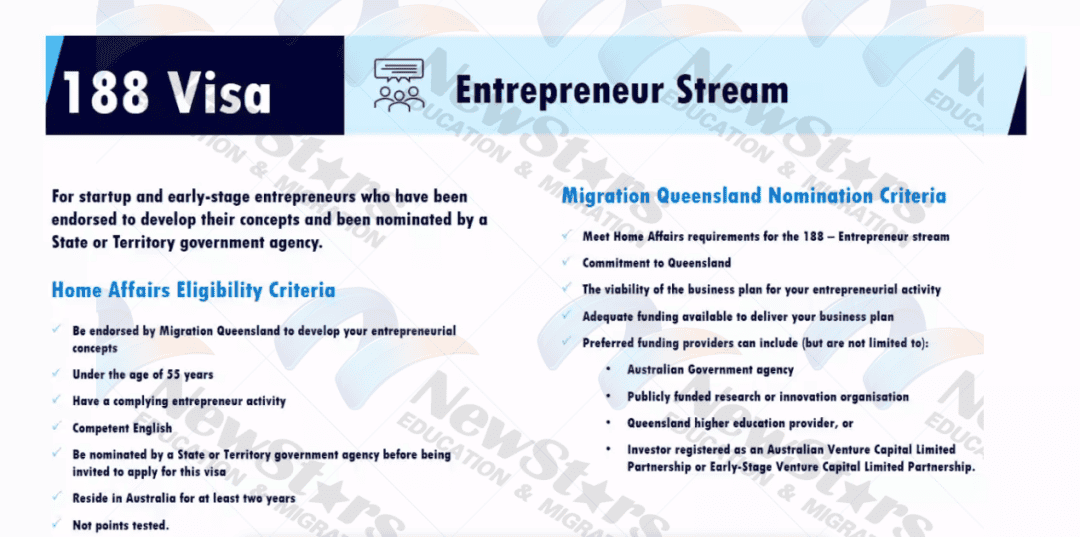
Success Story
The first Chinese applicant to receive a Subclass 188E visa in Queensland (also the first 188E visa ever granted under Queensland state nomination) is our Newstars Brisbane client. In April 2019, with the professional assistance of the Newstars migration team and the client’s full cooperation, the client successfully secured Queensland state nomination for Subclass 188E — approved with only one request for additional information and no interview!


Brisbane and the Gold Coast in Queensland have always been a favourite destination for investors,If you are interested in Queensland,feel free to contact me directly to find out more!

For details, see:Queensland’s first state nomination release this financial year — overseas applicants welcome, Subclass 188E reopens!
*The following reflects 2021–22 financial year policy; no major changes are anticipated for the current financial year.
Subclass 188E — New South Wales
state nomination requirements
1. Age: applicant must be under 55
2. English requirement:Applicant must achieveIELTS 6 in each band, or equivalent English proficiency
3. Entrepreneurship programme requirement:The applicant must be accepted into a New South Wales Startup Accelerator programme or Startup Incubator programme.Eligible programmes include (but are not limited to):
– Stone and Chalk — Australia’s largest dedicated startup and scale-up innovation community, with hubs in Sydney, Melbourne, and Adelaide
-The Studio
-25fifteen
-Cicada Innovations
-BlueChilli
-Fishburners
-Future Transport Digital Accelerator
-Microsoft ScaleUp Program
-Caltex C-lab
-Tank Stream Labs
-The Founder Institute

4. Third-party funding: the applicant must demonstrate sufficient funding from a qualifying third party to complete their project.
Qualifying third parties include:
-
Commonwealth Government agencies
-
New South Wales Government agencies
-
Publicly funded research or innovation organisations
-
Higher education providers designated as Table A or Table B under Part 2-1 of the Higher Education Support Act 2003, or
-
Investors that are Australian venture capital (VC/ESVCLP) entities
5. Business plan:The applicant’s business plan must clearly demonstrate how the innovative idea will benefit New South Wales, how the applicant intends to commercialise their product or service, and how they plan to grow their enterprise or business.
The business plan must show that the applicant has:
-
Completed proof of concept (e.g. customer interviews, surveys, or focus groups)
-
Potential business customers (B2B) or consumer market channels (B2C)
-
A scalable solution deployable across multiple customers
-
Intellectual property or commercialisation rights
6. Live and work in New South Wales: the applicant must make a genuine and realistic commitment to permanently living and working in New South Wales, and to continuing to contribute to New South Wales through entrepreneurial activities. The business must be headquartered in New South Wales and hold an ABN registered in New South Wales.
Subclass 188E — South Australia
state nomination requirements
Now let’s look at the South Australian requirements for Subclass 188E. From our review of South Australian state nominations, while the South Australian Government does not specify a third-party investment amount,it still requires a letter of support from a designated service provider,meaning the applicant’s entrepreneurial project must receive endorsement from an approved service provider.
1. Under 55 years of age at the time of invitation (age may be waived for those over 55 who demonstrate exceptional contribution)
2. Must hold at least Competent English — equivalent to IELTS 6 in each band (passport holders or citizens of the United States, United Kingdom, Ireland, Canada, or New Zealand are exempt)
3. The business plan must propose establishing a company located in South Australia, with the potential to meet the Subclass 888E visa criteria and achieve success factors within 5 years.
4. Before submitting an application, must obtain a letter of support from one of the approved service providers.
South Australia’s designated service providers are:
-
– Stone & Chalk — Australia’s largest dedicated startup and scale-up innovation community, with hubs in Sydney, Melbourne, and Adelaide.
-
– New Venture Institute (NVI) — Flinders New Venture Institute offers a range of programmes and services for vibrant startup and enterprise communities, across six focus areas: advanced manufacturing; creative industries; education; energy, water, and sustainability; health; and wine, tourism, and agri-tech.
-
– Moonshots — Focus areas: space, biotechnology, AI/high-tech, agri-tech, education, and defence industries.
-
– ThincLab — Helps entrepreneurs start and grow innovative companies. Supports early-stage and scaling entrepreneurs across all industry sectors.
-
-The Innovation & Collaboration Centre (ICC)

5. Holders of certain visas will not be eligible for South Australian state government nomination for Subclass 188E, including Subclass 500 student visa holders,Subclass 485 visa holders are eligible to apply.
6. If the business operates in one of South Australia’s9 priority industry sectors, applications will be prioritised — the 9 sectors are:
– Creative industries
– Defence
– Energy and mining
– Food, wine, and agribusiness
– Health and medical
– High technology
– International education
– Space and aerospace
– Tourism
7. Applicants over 55 years of age who can demonstrate that their proposed entrepreneurial activity will deliver exceptional economic benefit to South Australia may be eligible for an age waiver.

If you match any of the above situations, or are planning to start a business in an innovative sector, Subclass 188E may be the most suitable visa option for you. To find out whether this pathway is right for you, get in touch with our business and investor migration consultants for a personalised, comprehensive assessment!


Study and Migration Tips — Video
Click the image to read more
Past Recommendations

State nomination quotas rise as Australia’s demand surges — this occupation is highly recommended!

NSW state nomination opening soon — Subclass 190/491 requirements updated, major 491 changes!

Confirmed — 200,000 migration places, to continue for at least 2 years!
Confirmed — 200,000 migration places, to continue for at least 2 years!
Confirmed — 200,000 migration places, to continue for at least 2 years!

Victoria expands eligible occupations — Tasmania’s Subclass 190 quota nearly doubles!
Victoria expands eligible occupations — Tasmania’s Subclass 190 quota nearly doubles!

Migration Info Q&A Community

Step 1: Long-press to add our customer service contact

Step 2: Once added, please




Attention!Verify you’re speaking with a genuineNewstars consultant!


Western Australia invitation round wave — accountants on 80 points selected!Tap‘Read More’ for the Migration Weekly — Video Edition