Completed an undergraduate degree in Australia in a non-migration-friendly field, or finding it too hard to score enough points? Wondering which postgraduate pathway suits migration and can waive high IELTS requirements? Today, Newstars education consultant Claudia breaks down theearly childhood education pathway in full.
Teaching-related fields — always in demand
Even more so since COVID
Salary & Prospects
Teaching has always held a high social status in Australia and is a deeply respected profession. It is also one of the most in-demand skilled occupations in the country,with demand rising every year. Teachers enjoy stable incomes and consistent opportunities for salary growth.The latest data from Australian job site Indeed shows that the average annual salary for an early childhood educator in Australia is close to AUD 70,000,and salaries in the teaching sector grow steadily with experience.
Following two years of the pandemic,teaching-related occupations have been identified by the government as among the most critically short-staffed professions,with every state competing to recruit teachers. According to available data, over the next five years, government primary and secondary schools across Australia will have an average of approximately 3,000 teacher vacancies per year.
Early childhood education is arguably the most acute shortage within the teaching sector.

Historically, early childhood education was a less popular pathway for international students, partly due to higher language requirements (typically IELTS 7 overall, with some programmes requiring 7.5 or 6.5), which kept application numbers low.
But with Australia’s large-scale demand for early childhood educators, the bar for ECE migration has been steadily lowering. Compared with overcrowded fields like accounting and IT,teaching — including early childhood education — stands out as a refreshingly clear pathway.Many graduates in other fields have to work for years before achieving migration.Early childhood education and teaching more broadly offer a straightforwardly green, fast-track route — Subclass 189, state nomination across all states, and employer sponsorship are all available, and the vast majority of these pathways grant priority processing and invitation.
So if you’re looking tostudy abroad as a stepping stone to migration,we strongly recommend consideringearly childhood education!
(Those interested in other teaching-related fields are also welcome to get in touch.)

When it comes to migration, this is visibly
a preferred field
Every state prioritises early childhood education, and the Department fast-tracks visa processing!

State nominationshave shown preferential treatment towards early childhood education for a long time,and given current demand levels, this is expected to continue.Taking this financial year’s state nomination policies as an example,every state invites early childhood educators, and compared with other occupations, the thresholds are set very low, with the highest invitation priority assigned.
Take the most competitive state —New South Wales— as a case in point: most occupations require 85+ points for Subclass 190 and relevant work experience, whereas early childhood education requires only 65+5 points with no work experience required to receive an invitation.
Subclass 189 — Skilled Independent migrationWhile it is no longer the most mainstream pathway for international students, it has never stopped showing favour towards early childhood education — even in rounds where only 200 invitations were issued,early childhood education was never overlooked.In rounds where 1,000 invitations were issued,early childhood education was prioritised even more,with higher invitation numbers and lower score thresholds.
Skills assessment for early childhood education
at least one year of full-time (or part-time equivalent) early childhood teacher higher education (university-level) study;
and at least 45 days of professional practicum, working with children aged 0–8 in pre-primary or early primary school settings. When selecting a programme, it is essential to confirm that at least 45 days of supervised teaching practice is included.
Other qualifications may be counted within the four years of higher education, but none may be below the level of an Australian Advanced Diploma or Associate Degree.
Requirement 2: English proficiency
If the qualifyingfour-year higher education study was completed in AustraliaCanada, Ireland, New Zealand, the United Kingdom, or the United States, the English proficiency requirement is waivedand no English language test results need to be submitted;
otherwise, applicants must provide Academic IELTS results within the past two years:Writing and Reading: 7; Listening and Speaking: 8.AITSL reserves the right to require applicants to sit Academic IELTS if there is any uncertainty about their English proficiency.
Accordingly, international students in Australia who complete an eligible ECE programme, graduate successfully, and meet the language requirements can proceed directly to a skills assessment — no relevant work experience required!

Recommended Institutions
Gold Coast
Master of Teaching(Early Childhood Stream)
Master of Early Childhood Education (Birth–5)
Duration: 2 years
Academic requirements: Bachelor’s degree, no specific field of study required
Language requirements: IELTS 7.0 (7.0); language package available
Campus: Gold Coast
Graduate Diploma of Early Childhood Education
Graduate Diploma in Early Childhood Education
Duration: 1 year
Academic requirements: Bachelor’s degree, no specific field of study required
Language requirements: IELTS 6.5 (6.5); language package available
Campus: Gold Coast
Note: Students holding an Australian Subclass 485 visa may complete this programme online.
Melbourne
Graduate Diploma in Early Childhood Education
Graduate Diploma in Early Childhood Education
Duration: 1 year
Campus: Bundoora campus
Entry requirements: Bachelor’s degree, no specific field of study required
Language requirements: Academic IELTS overall 7.0, no individual band below 6.5
PTE: overall 65, no individual score below 58
Note: This programme includes a total of 60 days of professional placement
Melbourne
Graduate Diploma in Early Childhood Education
Graduate Diploma in Early Childhood Education
Duration: 1 year
Campus: Footscray Nicholson campus
Entry requirements: Bachelor’s degree, no specific field of study required
Language requirements: Academic IELTS overall 7.0
Listening 7.5, Reading 6.5, Writing 6.5, Speaking 7.5
PTE: overall 65–72
Listening 73, Reading 58, Writing 58, Speaking 73
Note: Students who completed a three-year undergraduate degree in an English-speaking country (UK, US, Canada, New Zealand, etc.) may be exempt from language requirements
This programme requires students to complete 60 hours of professional placement during their studies, supervised by qualified teaching staff
Adelaide
Master of Teaching (Early Childhood)
Master of Teaching (Early Childhood)
Duration: 2 year(s) full-time
Language requirements: IELTS 7 in all four bands, or PTE 65 in all four components. If English scores are insufficient, a language package can be added.
Virtually all Australian and Chinese undergraduate backgrounds are eligible to apply for the University of South Australia’s Master of Teaching (Early Childhood). A 400–600 word English personal statement, along with any ECE-related placement or work experience, will significantly strengthen your application.
Melbourne
Bachelor of Education (Early Childhood and Primary):
Bachelor of Education (Honours) in Early Years and Primary Education
Duration: 4.25 years
Background requirements: Must have completed a Diploma of Children’s Services awarded by an Australian Registered Training Organisation (i.e. TAFE or a private provider), with a credit grade, or an equivalent qualification as determined by the institution.
Master of Teaching in Early Years and Primary Education (Birth to 12)
Duration: 2 years
Entry requirements: IELTS average 7, Listening and Speaking 7.5, Reading and Writing 7.0.
PTE average 65, Listening and Speaking 73, Reading and Writing 65.
Students who completed their undergraduate degree in an English-speaking country — including Australia — will in most cases not need to provide English test results,
and there are already many successful cases on record.

In summary, teaching is a socially respected and highly regarded profession. The salary and benefits for educators in Australia are excellent, and demand for positions is strong. Unlike commerce,education programmes in Australia are largely taught in small classes.Based on available statistics, most classes have no more than 30 students, with local students making up at least 30–40% of the cohort.Schools also arrange professional placement, so graduates enter the workforce ready to work from day one!
This is a migration pathway well worth serious consideration. For enquiries about university applications, programme selection, and post-graduation career planning, please contact the Newstars study abroad team for a detailed consultation.


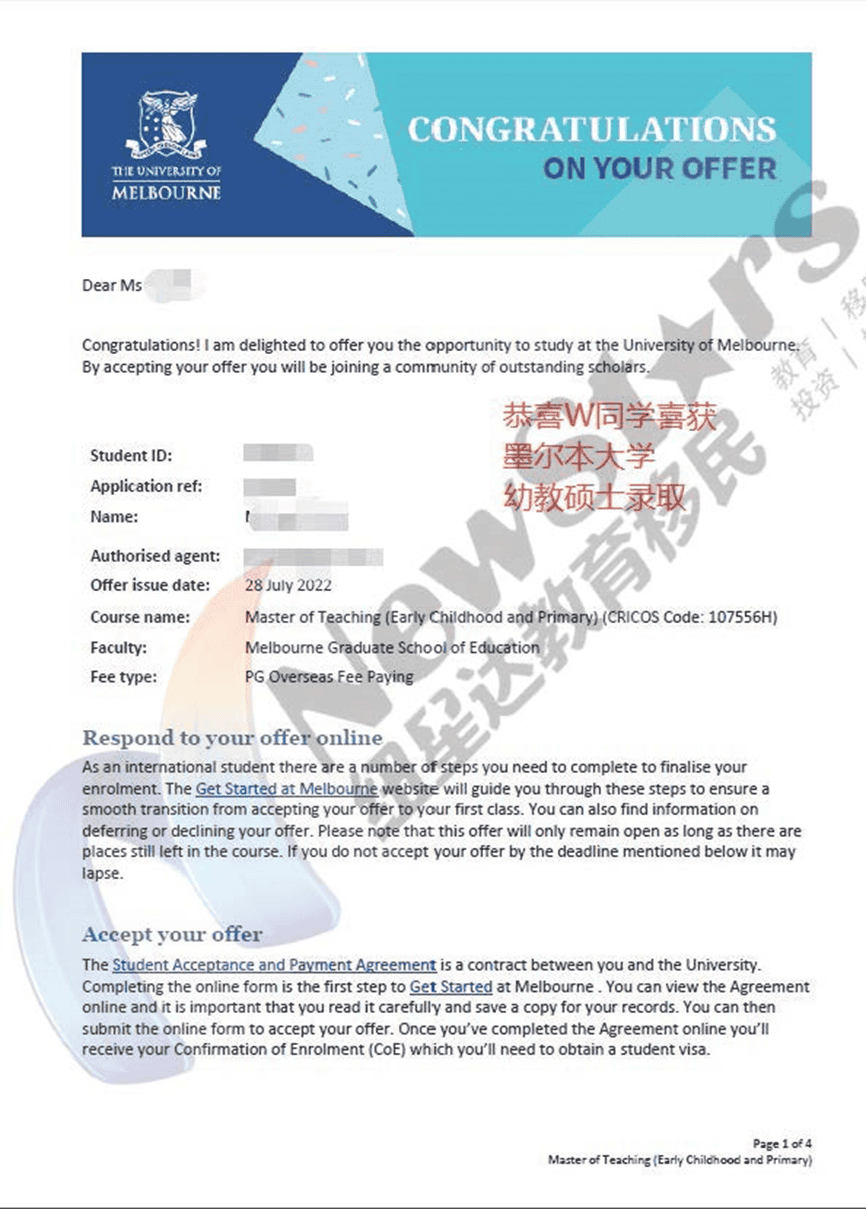
Recent Newstars Early Childhood Education Offers



Study Abroad & Migration Tips — Videos
Click the image to read featured articles
Previous recommendations

WA International Students: Fast-Track Your Migration with a Skills Assessment in a High-Demand Occupation!

Newstars is Hiring — Offices Across Multiple Cities!

Policy Meets Invitations → A Genuine Assessment of Each State’s Commitment This Financial Year
Policy Meets Invitations → A Genuine Assessment of Each State’s Commitment This Financial Year
Policy Meets Invitations → A Genuine Assessment of Each State’s Commitment This Financial Year

Recent Subclass 143 Parent Visa Processing Acceleration — How Long Can the Momentum Last?
Recent Subclass 143 Parent Visa Processing Acceleration — How Long Can the Momentum Last?

Migration Information & Q&A Group

Step 1: Long-press to add customer service

Step 2: After adding,




Attention!Please verify you are speaking with agenuineNewstars consultant!


35,000 More PR Allocations — Victoria Lowers Subclass 190 Requirements Again!Tap“Original link” — Migration Weekly — Video Edition