Art
icle by Jason ZHANG
• Australian MARA-registered migration agent, CTO of the NewStars Group, and gold-medal study and migration consultant at the Melbourne office; writing under the pen name “Mitu Weiyuan”.
• With extensive experience handling migration and study-abroad cases, he loves using migration law to solve all kinds of visa problems and specialises in tackling tricky, complicated cases. As the principal author of more than a hundred in-depth study and migration articles for NewStars, he helps applicants understand not just the what, but also the why.
More than ten years ago, when I came to Australia to study, just six months after I started,a classmate had his student visa renewal refused,so he went underground and was never heard from again.
If heaven could give me one more chance, I would surely say to him:“Appeal!” In fact, my classmate really did plan to appeal at the time, but the agent he engaged actually told himthe appeal period was 28 days after refusal(the law actually allows 21 days),,and so he missed the appeal window and lost forever any chance of turning things around.
Introduction
Can’t you just lodge again?
What is Section 48?
When his visa was refused, our initial thought was simply: if it’s refused, just lodge again. In reality,that doesn’t work, because it is restricted by Section 48.
The purpose of Section 48is to stop applicants from continually renewing visas onshore in order to remain in Australia indefinitely.Imagine if, after a refusal, you could simply lodge again, hold a bridging visa and keep waiting, then if you were refused again pay to lodge yet again — it would go on endlessly, with no end in sight.
To prevent this, the Department introduced Section 48, which provides that after a visa application is refused onshore (or a visa is cancelled),if you do not hold asubstantive visa(note:a bridging visa is not a substantive visa, whereas a student visa, visitor visa, Subclass 485 and so on are substantive visas),you cannot lodge a further visa application(except for a small number of prescribed visa categories). The text of the law reads as follows:

but you do have a right to appeal
What is an AAT appeal?
An AAT appeal is actually called a merits review. The AAT is an independent body that reviews visa decisions afresh, which meansthat until the appeal concludes, the visa application is not, in law, finally determined.。Once an appeal is lodged, your bridging visa changes from a 35-day validity back to indefinite validity, allowing you to remain in Australia while you await the appeal outcome.
Generally speaking,only a visa application lodged onshore carries a right of appeal. For example, an onshore student visa application that is refused can be appealed, whereas an offshore student visa application has no right of appeal.
In addition,a small number of sponsored visa applications also carry a right of appeal —for example,an offshore partner migrationapplication, if refused, can be appealed.
Furthermore,if you are onshore, the cancellation of a visa also carries a right of appeal; offshore it does not. We won’t go into that further in this article.
Perhaps you can lodge another visa
When is an AAT appeal necessary?
Section 48 only applies in certain circumstances —namely, it applies only when you do not hold a substantive visa.。
If your existing visa is still valid when the refusal occurs,thenyou can absolutely lodge another visa straight away, or even lodge a different visa altogether, rather than going straight to appeal. For example, if you lodge a Subclass 190 while holding a Subclass 485, and the 190 is refused, the 485 is still valid.
If, at the time of refusal, your original visa has already expired and all you hold is a bridging visa, then appealing really is the only path open to you.
21 days
The deadline for lodging an appeal
Under migration law, after a visa application is refused,thebridging visayou hold remainsvalid for 35 days. However,an onshore appealmust, in most cases,be lodged within 21 days of the refusal. The text of Regulation 4.10 reads as follows:

Appeal
Processing times
Owing to the inefficiency of the AAT (perhaps a shortage of staff),,appeal processing times tend to be quite long. For example, I have run a number of Subclass 485 appeals, which typically take around two years; student visa appeals also usually take one to two years,while partner migration usually takes three years or more, and skilled migration takes two to three years as well. You can find detailed processing times on the AAT’s official website:
https://www.aat.gov.au/resources/migration-and-refugee-division-processing-times

During
the appeal
Because appeal processing times are generally far from short,there is a great deal of room to manoeuvre during the appeal period.Even with Section 48 standing in the way during the appeal, there are still ways to lodge a visa application. These fall into two situations:
-
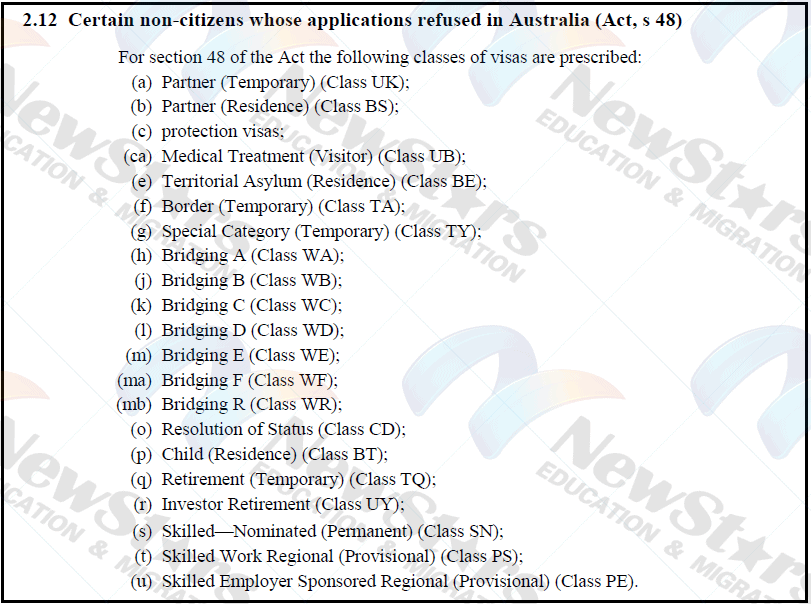
The first is lodging onshore:Regulation 2.12 of the migration law sets outthe visa categories that can still be lodgedwhile affectedby Section 48,common ones beingthe bridging visa, partner migration, and the Subclass 190, 491 and 494 visas (note that these donot include the Subclass 189)). The full list is as follows:
-
-
-
The second is applying for a Bridging Visa B and lodging offshore:If the visa you intend to lodge is not on the exemption list above, then the ultimate solution is tofirst apply for a Bridging Visa B(travel to a visa-free country, such as Thailand or Fiji),then lodge the visa offshore and return to Australia.
-

The appeal failed
but you haven’t received an invitation yet — what now?
If your AAT appeal fails and you still haven’t received an invitation, is that the end of the road, with no choice but to leave? No. If your AAT appeal fails, then, on the one hand,your bridging visa will still have 35 days of validity remaining, and on the other,you can still lodge a Judicial Review application with the Federal Circuit Court (FCC) within that 35-day window.(Note that after lodging the FCC application,you need to apply separately for a bridging visa.)
Owing to the inefficiency of the FCC (again, probably a shortage of staff),Judicial Review still requires a fairly long processing time, and dragging on for one to two years is entirely normal.While you wait,you can, just as during the AAT waiting period in the previous section, keep working on the relevant applications.
In summary
Technology
framework, there are quite a few lawful ways to rescue a visa. However, once a refusal occurs,the applicant’s subsequent steps and planning become absolutely critical, and a professional agent is very much needed to guide and assist,otherwise one wrong move can lead to everything going wrong.
No visa matter is trivial.If you want to make sure your visa is granted, it is well worth spending a little money to engage a professional agent. Leave the professional work to the professionals. Trying to save a little money and ending up with a work visa or PR application refused will not only delay your plans for PR but also cost you dearly — because whether you go to the AAT or the FCC, the application costs alone (excluding agent fees) start at several thousand dollars.
Finally, may there be peace in the world, and may this world have no visa refusals.
If you really do need help, you can contact me.
MARA-registered migration agent (MARN 1805429)

A look back at past articles

Migration Stories | Giving up the “iron rice bowl” — what did you come to Australia for?

How each visa type was processed in February! The latest on state-nomination quota usage

Department internal documents revealed → will the Subclass 189 still issue invitations in the second half of the financial year?
Department internal documents revealed → will the Subclass 189 still issue invitations in the second half of the financial year?
Department internal documents revealed → will the Subclass 189 still issue invitations in the second half of the financial year?
Department internal documents revealed → will the Subclass 189 still issue invitations in the second half of the financial year?
Migration news sharing group
2023
Step 1: press and hold to add our consultant

Step 2: once added, please


Study · Migration · Visas — we are the professionals



Attention!verify that you are agenuineNewStars consultant!

Study and migration enquiries — consultants by location

Sydney

Melbourne

Canberra

Brisbane

Adelaide

Hobart

Beijing

Guangzhou
Follow the NewStars official account
On our official account, reply withone of the numbers or any keyword below (not in the comments at the bottom of an article),to get the most timely and professional migration news!Reply [A] to view the directory (covering every topic)!
Reply:0000 → view the 16 November policy news (491 + skilled migration points)
000 → latest visa / citizenship processing wait times
001 → latest 189 EOI official report
002 → Subclass 189 skilled independent migration
003 → state-by-state Subclass 190 state nomination
004 → Subclass 489 regional state nomination
005 → international-student business and investor migration
006 → parent migration visas
007 → employer-sponsored visas
008 → Subclass 485 visa
009 → partner migration / extra points
010 → work-experience points
011 → PY points
012 → NAATI / CCL points
013 → regional points
014 → visitor / family-visit visas
015 → working holiday visa
016 → TAFE study
017 → Australian international students migrating to Canada
018 → Subclass 407 Training visa
019 → Subclass 408 Temporary Activity visa
020 → New Zealand migration