The full migration-reform report is out. This article focuses on the parent migration section — in particular, how the so-called lottery system proposal came about, and its likely impact。

Parent migration: supply and demand are badly out of balance — a major problem
Australia has tried various measures over the years to address the supply-demand imbalance in parent migration — from introducing the contributory (paid) parent visa in 2003, to briefly attempting to scrap the queued parent visa in 2014. Between 2010 and 2022, the parent migration backlog grew from 35,000 to 120,000.

On waiting times, the report notes a 40-year wait for the queued stream and 15 years for the contributory stream,these figures aren’t exact, but they are more than enough to show how unreasonably long the waits have become.

Lifting the quota is genuinely hard
Whenever the government weighs up a migration category, it always considers the economic return — that is, the return to the public purse. That’s true for international students, for investor migrants, and for parent migration too.
The core argument of the recommendation again comes down to measuring the economic return of parent migration, and on this measure parent migration clearly “doesn’t do very well”. According to repeated reports from the Productivity Commission, each parent may impose a long-term economic burden of around AUD 400,000.

The conclusion follows: Australia’s parent migration cannot be set purely by demand, or it would place a huge burden on the economy. This also means a large increase in the parent migration quota is unlikely to be easy to achieve.
That said, these are problems in other countries too, and compared with other countries, Australia’s family migration system as a whole — parent migration included — is already relatively generous.


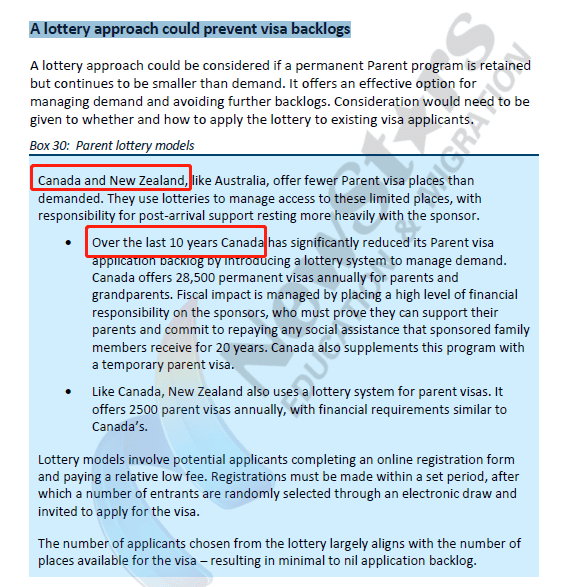
Canadahas used a lottery system very effectively over the past 10 years to ease the backlog of parent migration applications. Canada grants 28,500 places a year for parents and grandparents
New Zealandhas also recently introduced a lottery system for parent migration.Likewise, by setting requirements, it shifts the fiscal burden of parent migration from the country onto the applicant’s own family.
The above is how the report describes the New Zealand and Canada policies. We’ve since done some research of our own, so here is a brief rundown of the parent migration policies in New Zealand and Canada.
Canada parent migration
has long used a lottery system, with an annual quota generally above 20,000; the most recent year’s quota is 28,500.
Application requirements:
– The sponsor must, while holding a PR visa, meet the income requirement for 3 years
– The income requirement is set according to the size of the sponsor’s family, at CAD 7,000 per person
For example, a couple of two has an income requirement of CAD 14,000; a couple of two plus two children has a requirement of CAD 28,000
Invitation rules:
– Once the sponsor meets the requirements, they submit an EOI for their parents/grandparents; this EOI stays valid in the pool until it is drawn
–A lottery is held once a year, drawing all the places in a single round with no order of priority — purely random
Processing time:
– Once drawn, the visa processing wait is roughly 2 years, and the visa fee is CAD 1,500
In other words, if a new migrant starts preparing as soon as they obtain PR, it is reasonable to expect parents/grandparents to obtain a migration visa within 5-10 years
Benefits after the visa is granted:
– No access to welfare benefits for 20 years
– Immediate access to a Medicare-style health card
New Zealand parent migration
New Zealand’s parent migration policy has had its share of twists and turns. Previously, as in Australia, you could lodge once you met requirements such as income, and then simply wait. Because the pandemic closed the programme for 3 years and the requirements were raised sharply, the previous system somewhat fell apart.
It has now switched to a lottery system, with transitional arrangements; New Zealand’s parent migration quota is about 2,500 a year.
Transitional arrangements:
– For applications lodged before the lottery system came into effect, a set number of places is allocated each year — around 2,000 — expected to clear the backlog in 5-6 years. These older applications are processed in order until the backlog is cleared.
– For applications lodged after the lottery system came into effect, you submit an EOI and are drawn at random, with 500 places available. New submissions have been open since November last year; the first draw will be in August this year, with draws held every three months thereafter。
–Those who have already lodged an older application may also submit a new application and wait to be drawn at random
Application requirements:
– An applicant may sponsor only one of their parents, and must have income of at least 1.5 times the median wage
– Siblings may also act as joint sponsors, two people together
– Joint sponsors must reach 2 times the median wage (the previous rule was 2 times and 3 times the median wage respectively)
– A maximum of six parents may be sponsored. For each additional parent sponsored, the income threshold rises by 0.5 times
Benefits after the visa is granted:
– Eligible for the pension after 10 years of residence
– Immediate access to a Medicare-style health card
Our analysis:
The most important point about Canada’s policy is that there are at least 20,000 places a year; with tens of thousands of places each year, even without a lottery the backlog situation would be far better.
For New Zealand, what we focus on most is the transitional arrangement; this is fairly similar to Australia’s situation: if reform really happens, what becomes of all the applications already backlogged? If Australia followed New Zealand’s two-step approach — allocating a set number of places each year to process older applications in order — how long would the wait be?After all, New Zealand’s backlog is only a few thousand to ten thousand, whereas our contributory stream alone already has more than 60,000.
Of course, what New Zealand and Canada have in common is that they both raise the application requirements on the sponsor (the PR child), the key one being an income requirement, in order to ensure that the financial burden of the elderly parents is borne by the family itself, not the government.
The report also raises issues with the Subclass 870 visa, considering it of limited appeal and overly expensive. It recommends replacing it with a 10-year long-stay visa allowing 12 months’ stay in every 18-month period.

Parent migration reform is unlikely to be settled any time soon
If you can lodge, lodge as soon as possible
It must be stressed that this is only a reform report, putting forward a number of recommendations,which does not mean they will be implemented straight away. Many of the issues are highly complex and affect tens of thousands of families, if not more. How are old and new applications to be reconciled? Questions like these leave us none the wiser, and they make reform difficult for the government too.And bear in mind that the Australian migration system is now said to be undergoing major reform — parent migration is not the only headache; other issues are giving them just as much trouble。
For those who have already lodged, the thing to do for now is to wait patiently and keep an eye on policy developments. If your parents’ application is already in, the main thing you can do is wait patiently.
For those who have not yet lodged, it’s actually worth getting your parents’ application in as soon as possible — there’s little downside for you (beyond the first-stage visa application fee). In all likelihood, applications already lodged won’t simply be cut off either; for instance, they may be given lottery priority.
On the whole, this report holds no real good news for parent migration. Set your own pace and lodge early~
Get in touch about
parent migration visas
parent visitor visas
parent long-stay visas

Catch up on past articles
The big shake-up of Australian migration explained in one read: points system / employer / 500 / 485 / parent / GTI / investment — all covered!

“How many points does my occupation need for an invitation?” April’s popular state-nomination invitation round-up is here!

Offshore Finance / Marketing / Conference and Event Organiser / Program Administrator / Information and Organisation — invitations keep coming at low points!

Migration news sharing group
2023
Step 1: Press and hold to add our consultant

Step 2: After adding, please


Study Abroad · Migration · Visas — we’re the professionals



Attention!Please verifya genuineNewstars consultant!

Study-abroad and migration enquiries — consultants by location

Sydney

Melbourne

Canberra

Brisbane

Adelaide

Hobart

Beijing

Guangzhou
Follow the Newstars official account
Reply on the official account with any of the numbers below or any keyword (not in the comments at the bottom of the article) to get the most timely and professional migration news!Reply [A] to view the directory (covering every topic)!
Reply: 0000 → view the 16 Nov new-policy update (491 + skilled migration points)
Reply: 000 → latest visa/citizenship processing wait times
Reply: 001 → latest Subclass 189 EOI official round
Reply: 002 → Subclass 189 Skilled Independent migration
Reply: 003 → Subclass 190 state nomination by state
Reply: 004 → Subclass 489 regional state nomination
Reply: 005 → student startup and investor migration
Reply: 006 → parent migration visas
Reply: 007 → employer-sponsored visas
Reply: 008 → Subclass 485 visa
Reply: 009 → partner migration / extra points
Reply: 010 → work-experience points
Reply: 011 → PY points
Reply: 012 → NAATI/CCL points
Reply: 013 → regional-area points
Reply: 014 → tourist and family-visit visas
Reply: 015 → working holiday visa
Reply: 016 → TAFE study
Reply: 017 → Australian students migrating to Canada
Reply: 018 → Subclass 407 Training visa
Reply: 019 → Subclass 408 Temporary Activity visa
Reply: 020 → New Zealand migration
Recommended for 2023