Under 30, an outstanding Australian graduate invited straight to PR through the NIV
Visa Grant Records
The client’s background
The client was an international graduate who had already secured a job offer back home before finishing his degree, and was working in Shanghai by the time he came to us for advice. At the same time he loved Australia and wanted to keep a pathway open to stay here. Most international students look first at points-based skilled migration (such as Subclass 189 / 190 / 491); some find work, pick up employer sponsorship after a year or two, and go with a Subclass 482 or Subclass 186.
An exceptional applicant does not take the ordinary road
When our lawyers and migration agents ran their assessment, we learned that this client — still under 30 — had graduated from a leading Chinese university before taking up a PhD at the University of Sydney. He completed it last year and was immediately recruited on a high salary by a well-known AI laboratory back home. He has published dozens of works, strong in calibre as well as in volume. He holds multiple patents, including patents arising from international projects, and his list of awards runs long.
Points-based skilled migration would have meant a long grind to accumulate points in a fiercely competitive field, with no way of knowing how long an invitation would take. And with a job of real promise already underway back home, returning to Australia through employer sponsorship was not realistic either. So we set our sights on the National Innovation Visa (NIV) — a pathway Australia created specifically for talent in advanced technology and innovative investment.
How the NIV differs from ordinary skilled migration
The Subclass 858 under the National Innovation Visa (NIV) programme is a direct permanent residency visa. It can be lodged onshore or offshore, with no restriction on where the visa is granted, and once the primary applicant is invited the whole family can obtain permanent residency together.
Because the programme is built around global talent, the Department of Home Affairs does not require applicants to hold a skills assessment or to meet a specified English language requirement. The age ceiling is also more generous — generally 55, and applicants over 55 may still be exempted on the strength of their achievements.
A quick introduction to the NIV
The National Innovation Visa (NIV) replaces the former GTI ( Global Talent Visa Program ) and is designed to attract people who stand out in innovative investment and highly skilled fields. The Department of Home Affairs judges eligibility on the achievements set out in the applicant’s EOI (Expression of Interest) and on how well they match the NIV’s priority directions.
The NIV compared
Compared with the former GTI, the Australian Government wants NIV applicants to combine the strengths of the Subclass 188 Business Innovation and Investment (provisional) visa and the former Global Talent Visa Program.
Who the NIV is for
- -Researchers and academics of global standing-Successful entrepreneurs with technical skills
- -Innovative investors
- -Athletes and creative talent
A nominator is required
The other key to the NIV is the nominator. A nominator must be an Australian citizen or permanent resident, an eligible New Zealand citizen, or an Australian organisation, and must work in a field related to the applicant’s. The nominator’s field and standing are themselves a factor in whether an invitation follows. Our client’s nominator, for instance, also specialises in AI and sits at head-of-function level.
The four NIV priority groups
The NIV sets four priority groups, ranked from highest to lowest:
First priority group
Candidates who are world-leading experts in their field and have received an international “top award in the field”;
Second priority group
Candidates nominated by an Australian federal, state or territory government agency through an approved Form 1000 (most states have not yet published their state-nomination rules; only Queensland has released a draft, and it was never finalised)
Third priority group
Candidates with outstanding and exceptional achievements in the following tier-one fields
- Critical technologies
- Health industries
- Renewables and low-emissions technologies
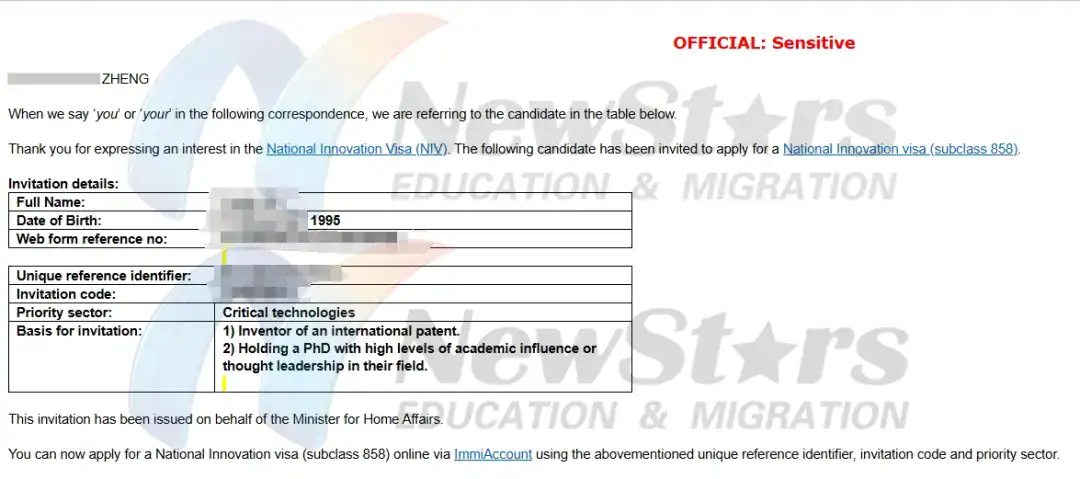
Our invited client sat in the third priority group — critical technologies
Fourth priority group
Candidates with outstanding and exceptional achievements in the following tier-two fields:
- Agrifood and agricultural technology
- Defence capability and space
- Education
- Financial services and fintech
- Infrastructure and transport
- Resources
Awards and achievements
A “top-level award in the field” that qualifies for the National Innovation Visa (NIV) is an international award recognising outstanding and exceptional achievement in a given field, including but not limited to the Nobel Prizes.
Restructuring an academic record so its strengths stand out
The client had not only published dozens of high-calibre academic papers, but placed many of them in the top journals and conferences of the artificial intelligence field internationally. Beyond the papers, he holds multiple patents both in China and overseas, including significant patents arising from research and development on international projects. Running alongside all of this is a steady line of academic awards, research honours and industry recognition across his studies and research career.
For a researcher of this calibre, the hardest part is rarely whether the achievements exist. It is how to turn them into a body of evidence that a case officer can understand, recognise and accept within the framework of migration law.
Many applicants assume that a high degree, plenty of papers and plenty of patents will carry an application through. In reality the Department of Home Affairs is not assessing an academic CV — it is assessing a visa application that must map strictly onto legal criteria.
In this case our work was not simply gathering documents. It was systematically reviewing and restructuring the client’s entire academic record from a migration-law perspective.
We helped the client to:
- analyse in depth the international influence and originality of his research within the AI field;
- screen and categorise dozens of papers so that his core contributions and citation value came to the front;
- assemble the evidence for his patents in China and overseas, setting out his personal contribution and the significance of each technical innovation;
- collate supporting evidence — awards, media coverage, academic invitations, project experience — into a complete picture of professional achievement;
- start from the legal criteria and convert a large body of specialist technical material into evidentiary reasoning a case officer can follow;
- set the overall application strategy so that every piece of evidence corroborates the rest, forming a persuasive portrait of the talent behind it.
For talent in AI, research and advanced technology, an application never turns on how many achievements you hold. It turns on how you evidence the international influence, professional recognition and industry contribution those achievements represent.
After a wait of just a few months, the client received his NIV invitation through the EOI. Less than six months later the NIV Subclass 858 was granted — permanent residency, and genuinely fast.
Related case studies
State government backing, then a formal invitation through the federal NIV innovation talent pathway
Read the full case study →Offshore IT professional granted a Subclass 482 through employer sponsorship in 6 months
Read the full case study →A husband-and-wife employer sponsorship granted: his company sponsored her as an accountant
Read the full case study →Your situation deserves a professional assessment first
Every visa application turns on different criteria, evidence and timing. Tell us about your situation and our registered migration agents and lawyers will assess the pathways open to you.
Get a free assessment of your visa options →