An Appeal With a Human Touch: He Came Within Days of Being Sent Home Alone
This successful ART review involved a visitor visa. The case itself was not complicated, but the warmth shown by the Tribunal member left a deep impression on us — a reminder that alongside the long hours and the strain, this work also brings real satisfaction.
Visa Grant Records

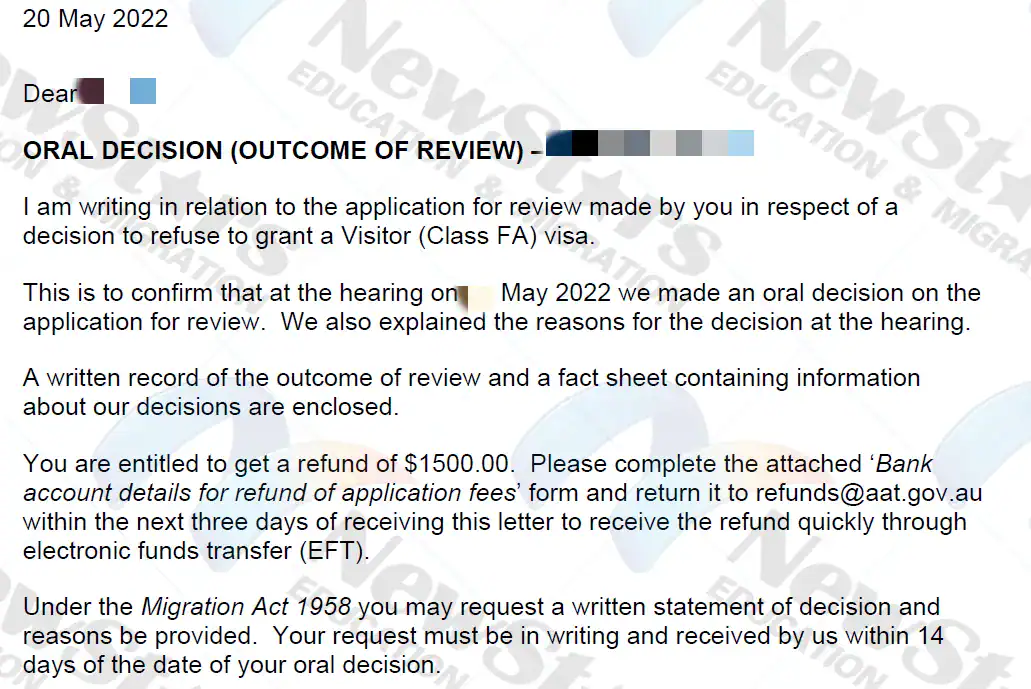
Case background
Our client was an elderly gentleman from Shanghai. He had tried to renew his visitor visa himself, but a delay in his BPay payment clearing meant the application was never successfully lodged. The old and the new visa did not line up, and by the time he realised, the earlier visitor visa had already expired — which meant he was in overstay in Australia, or as people put it colloquially, he had gone unlawful.
He then lodged another visitor visa application, but because of that overstay history he could not meet the requirements of PIC 3001 and 3004, and the application was refused.
Schedule 3 is a grant requirement on certain visas
Public Interest Criterion 3001 ——
If you do not hold a substantive visa when you apply and you want to lodge onshore in Australia, the new application must be lodged within 28 days of your last substantive visa ceasing.
Public Interest Criterion 3004——
If you do not hold a substantive visa when you apply and you need to lodge onshore, it must be because of factors beyond the applicant’s control, and the applicant must show that compelling reasons exist, among other things.
By this point more than 28 days had passed since he last held a visitor visa — that is, a substantive visa — and the waiver threshold under 3004 is very high: you have to prove that reasons beyond your control stopped you from lodging the renewal on time.
Why we did not lodge offshore
A PIC 3004 waiver is very hard to obtain, so most people in this position choose to lodge offshore, where Schedule 3 does not apply. This gentleman’s circumstances were different. He and his wife had been in Australia to be with their daughter and grandson, and he has an eye condition that means his wife must accompany him whenever he travels in or out of the country. His wife had lodged and paid a day earlier, so her application succeeded. If his appeal failed, however, he would have to leave Australia within 35 days — and even with a ticket in hand, making that trip on his own was bound to be difficult.
So we recommended applying to the ART for review. The client decided to take our advice,
Once the retainer was signed we did everything we could to prepare the evidence. Our submission set out his predicament in detail, and we even asked at the end that, if the Tribunal affirmed the original decision, it might take his practical situation into account and allow a short delay before handing that decision down, so he would have time to buy a ticket and put his affairs in order.
Even so, we asked him and his daughter to prepare themselves. An ART member must decide according to law, and on our facts it was hard to point to anything beyond our control that had stopped the application being lodged on time.
The hearing takes an unexpected turn
Once the hearing began, the first half went much as we had expected. The Tribunal member pointed out that BPay states clearly that you should not use this payment method if your visa expires within 3 days, and that the invoice carries the same warning. At that point, things looked to be going against us.
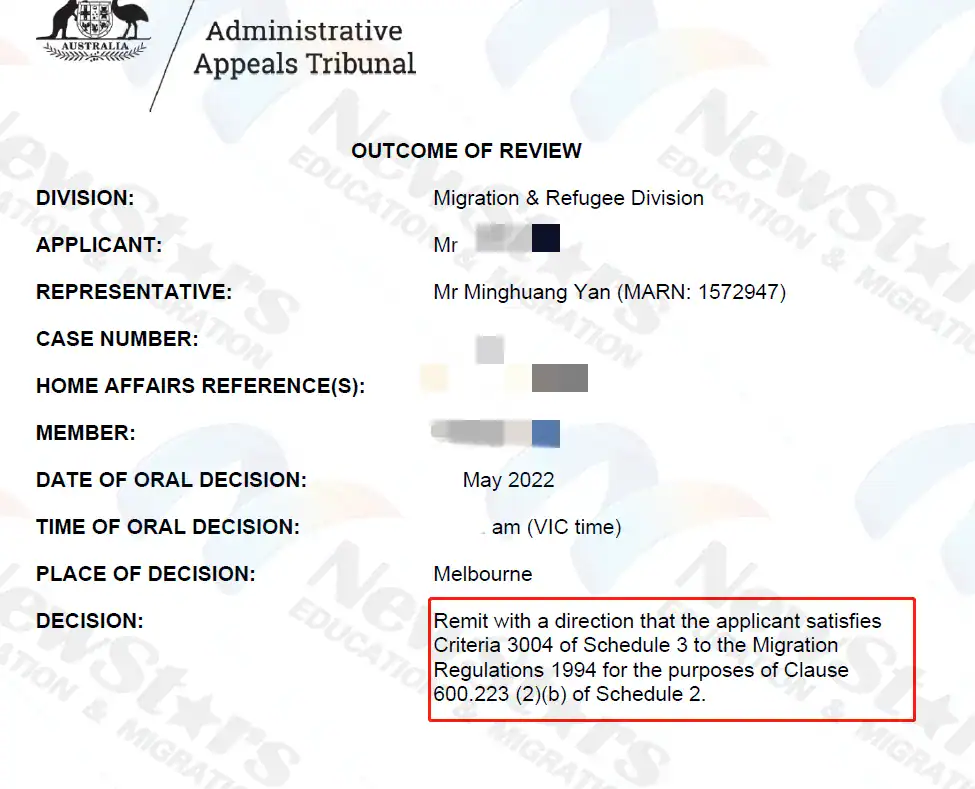
Then came the turning point: the Tribunal member gave an oral decision from the bench in the applicant’s favour
Because of his eye condition, the application process was not entirely within the applicant’s control and the fault did not lie wholly with him; the applicant therefore met the relevant provisions of PIC 3004, and the Department of Home Affairs should reconsider the application
The decision delighted both the client and me, and it deepened our sense that the law is not divorced from human feeling.
Within the powers the law gives him, the Tribunal member took the trouble to understand the facts fully and, on those facts, found the applicant a legal footing — one that let him lawfully meet the requirements and stay with his family in Australia.
At the close of the hearing the whole family thanked the Tribunal member, and I thanked him too — for digging into the facts and for weighing the applicant’s own circumstances as a whole.
This visitor visa case was not a complicated one, but being part of it from beginning to end, seeing the better side of human nature along the way and helping the client reach the outcome he hoped for, was a genuine joy.
A reminder, again: no visa matter is a small matter. Even a seemingly “simple” visitor visa for the parents of a permanent resident or citizen can cost you time and money if one small step goes wrong — and even when the result finally goes your way, you have taken on trouble you never needed.
Related case studies
From unlawful to lawful: BVC work rights, a Schedule 3 waiver and a Subclass 820 grant
Read the full case study →Three refusals for a parents’ visitor visa, granted on the fourth
Read the full case study →The Department moved to cancel his PR — several strategies kept his permanent residence
Read the full case study →Your situation deserves a professional assessment first
Every visa application turns on different criteria, evidence and timing. Tell us about your situation and our registered migration agents and lawyers will assess the pathways open to you.
Get a free assessment of your visa options →