Years on, the Department moved to cancel her PR — a layered strategy kept it
Visa Grant Records
Case background
The client was granted a Subclass 309 Partner (Provisional, offshore) visa and then moved to the Subclass 100 Partner (Permanent, offshore) visa. While the Subclass 100 was still being processed, the relationship between the applicant and the sponsor broke down. The Department of Home Affairs was not updated on the breakdown at the time, and the Subclass 100 was granted afterwards. Three years after the grant, in September 2024, she received a NOICC (Notice of Intention to Consider Cancellation): the Department took the view that the applicant had not notified the change in her relationship circumstances, in breach of section 104 of the Migration Act, and moved to cancel the visa.
Another DIY application, another urgent call for help
Another DIY applicant, who only came to us — in a panic — after the Department’s NOICC arrived. Once we understood the facts, our first point as professionals was this: because she has an Australian-citizen child with her former husband, the Subclass 100 could still have been granted at the time of application, even with the relationship broken down, had that been disclosed honestly to the Department of Home Affairs.
Working from the facts as they stood, and from similar matters we had taken on where the visa was retained, we helped her assemble the evidence and prepared a submission running to several dozen pages. It was framed above all from the child’s perspective: the grounds for cancellation existed, but we asked the case officer not to exercise the power to cancel.
That attempt did not succeed. On 7 November 2024 the case officer took the strict view and cancelled the visa, reasoning that the child was living in China in the care of grandparents rather than in her mother’s primary care, and that although the child is an Australian citizen, she was not in Australia and so would not be affected.
Plan B
We went straight to the next step already built into the plan and lodged the ART application the same day. Having assessed the position, we also judged that an expedited listing could be sought for the client: her seven-year-old child had been due to return to Australia for school at the end of the previous year, and the visa problem had put all of that on hold. The ART accepted our request for an expedited listing, so the first hearing came on about three months later, in February 2025. It closed without a result, and the Tribunal member listed a second hearing for 1 May.
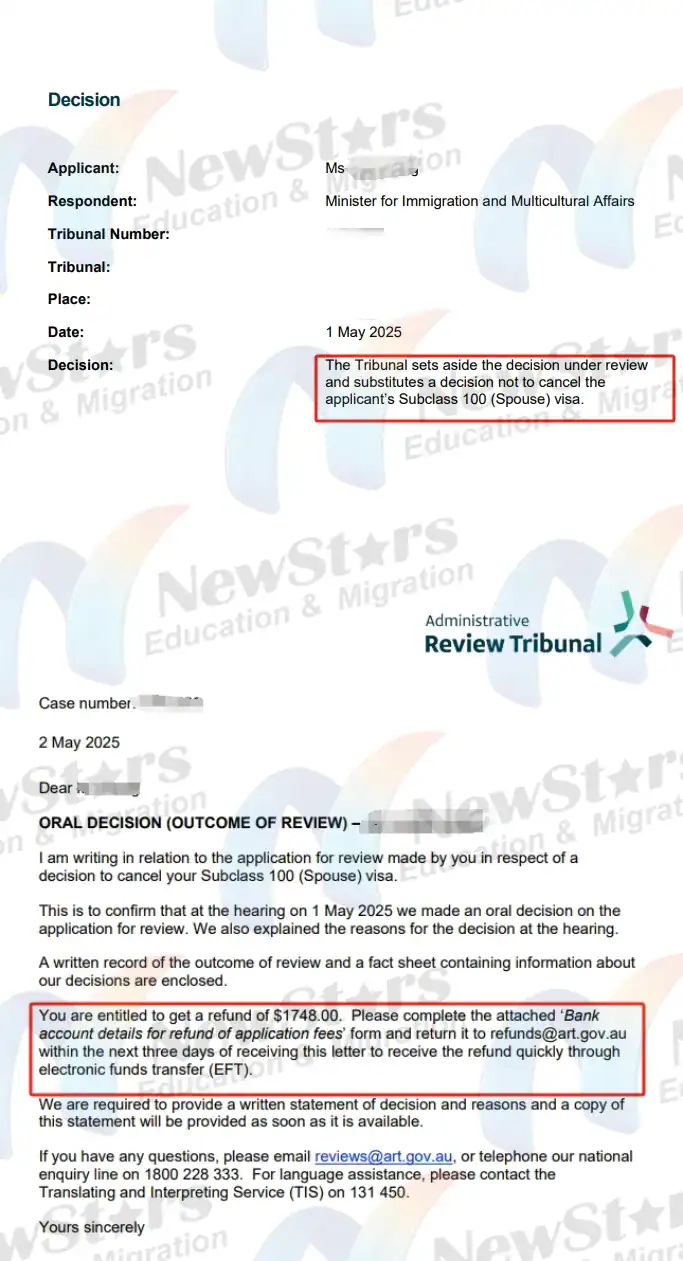
In preparing the ART matter we assembled further material, including a recent FCC decision we found in March, which we filed as an additional submission. The first hearing dealt with whether the grounds for cancellation existed; the second with whether, if both the grounds and the power existed, that power should be exercised. The second hearing ran for half a day. The Tribunal member was clear that, in their view, the applicant had not complied with the relevant legal requirements and that the grounds for cancellation plainly existed. She was fortunate: taking into account the family’s circumstances as they now stood, and in particular the best interests of the child, the member gave an oral decision on the spot setting aside the Department of Home Affairs’ cancellation decision. The client kept her permanent residency.
Related case studies
PR cancelled, overturned at the ART: a 19-page explanation and a 6-hour hearing
Read the full case study →Student visa NOICC: a five-day emergency rescue
Read the full case study →The most tangled partner-migration turnaround: conflict, separate countries, a pregnancy, refused and refused again
Read the full case study →Your situation deserves a professional assessment first
Every visa application turns on different criteria, evidence and timing. Tell us about your situation and our registered migration agents and lawyers will assess the pathways open to you.
Get a free assessment of your visa options →