Main Applicant Aged 50+ With a 17-Year-Old Child: A High-Risk TAFE Student Visa Combination, Granted Together in the End!
A main applicant aged 50+, bringing a 17-year-old child and having already lived in Australia for quite a long time, who this time chose a TAFE course with a strong employment and migration orientation: stacked together, these factors in themselves make for a combination that carries relatively high risk in student visa assessment.
When the client came to us before formally applying, we drew on our experience and told her clearly from the outset: this case would not be easy, and the Genuine Student (GS) requirement in particular was very likely to become a key focus of the Department of Home Affairs’ scrutiny. Having fully understood the risks, the client still wanted to seize the opportunity and give it her best shot, so from the early stage of the application we began preparing for the problems that might arise, rather than waiting for the Department to raise doubts and then explaining reactively.
Visa Grant Records


Client Background:
The main applicant was 52 years old and planned to continue studying a TAFE course, in early childhood education at that; she already had a long history of studying as an international student, and wished to bring her 17-year-old child with her on the same student visa application.
With a background like this, the Department can easily look more closely at several questions: Why return to study at the 50+ stage of life? Why choose this particular course? Is there a reasonable connection between the new study plan and the applicant’s past education and work experience? What practical value will completing the course bring the applicant? And is the applicant’s main purpose in continuing to study genuinely to improve her skills, or to remain in Australia on a student visa?
Particularly as the client had already lived in Australia for a long time and had chosen a course with an obvious vocational orientation, simply explaining ‘I am interested in this field’ was clearly not enough to support the whole application.
That is why, from the very start, we did not treat this case as an ordinary ‘choose a school, get a COE, lodge the student visa’ matter. Instead, we carried out a comprehensive review in advance around the client’s past experience, why she needed to study at this stage, her course choice and her future plans, and prepared ahead for any GS concerns that might arise.
The Biggest Hurdle in This Application: A Serious S57 Letter Questioning Her Study Motivation
At the end of June, we helped the client formally lodge her 500 Student visa application.
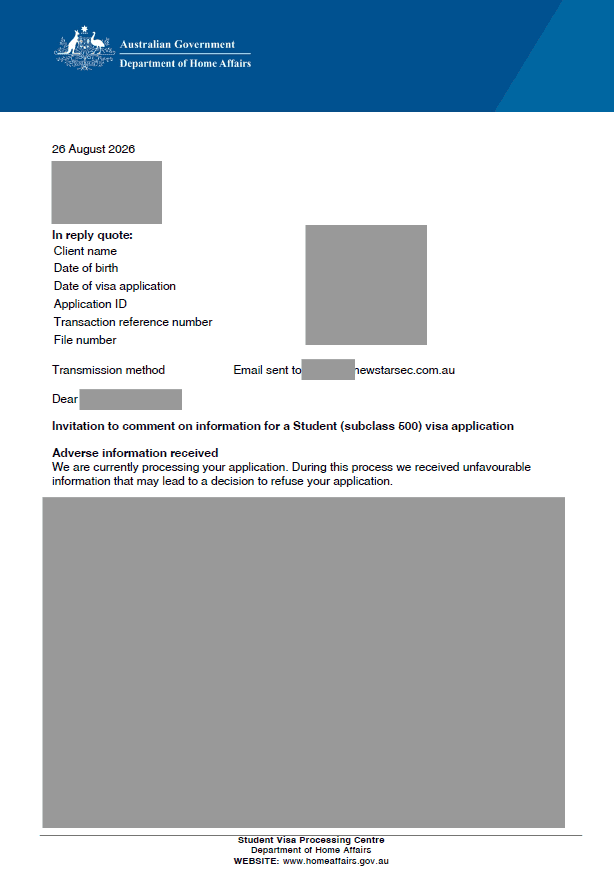
About two months later, the application entered a critical stage, just as we had expected — seeing the client’s long history of visa renewals and her continuous time in Australia, the Department’s visa officer issued a serious S57 letter inviting comment on adverse information, clearly questioning the client’s genuine motivation to study.
This became the most important hurdle in the whole case. Receiving an S57 means the case is no longer a matter of routinely supplying further documents. The visa officer has already formed doubts about certain key issues in the application, and if the response does not address those issues in a targeted way, the visa may face the risk of refusal.
For this client, her age, her long time in Australia and her choice of course this time all had to be explained together. We could not simply answer ‘why do you want to study this course’; we needed to go further and help the visa officer understand why the client had made this study decision at this stage of her life, whether the decision was consistent with her personal history, and what practical and reasonable development the study could bring to her future.
How We Overcame It: Extensive Supporting Documents + a 5-Page Submission in One Focused Response
After receiving the S57, we broke down the visa officer’s concerns again one by one, reorganised the evidence in light of the client’s full background, and ultimately prepared a large volume of Supporting Documents and a Submission of about 5 pages as a systematic response.
The response as a whole did not sidestep the unfavourable factors in the case. More importantly, we did not explain each issue in isolation; instead, we connected the client’s past experience, why she was choosing to study now and her plans after completing the course, so that her whole study pathway formed one coherent line of reasoning from start to finish.
At the same time, because the application also included a 17-year-old child as a secondary applicant, we checked and strengthened the child’s documents in parallel, ensuring that the family relationship and accompanying arrangements were consistent with the application as a whole, so as to avoid raising new concerns on top of the main applicant’s GS issues.
From the initial lodgement, to receiving the S57, to preparing a large volume of documents and a 5-page Submission in response, what this case really tested was not ‘the more documents, the better’, but whether each document could precisely answer the issues the Department was genuinely concerned about.
After More Than a Month of Agonising Waiting, Mother and 17-Year-Old Child Granted Together!
After the S57 response was lodged, there was another wait of more than a month. For an application that had already received a procedural fairness letter, this period was undoubtedly agonising.
In the end, the good news arrived: the main applicant’s 500 Student visa was granted, and her 17-year-old child was granted together with her!
From knowing before the application that this was a high-risk combination, to actually receiving an S57 during processing, to responding systematically on study motivation, and finally to mother and child being granted together — this result did not come easily for the client.
This case shows once again that, in the current student visa assessment environment, being older, having spent a long time in Australia and choosing a course with a strong employment or migration orientation does not necessarily mean you cannot apply, but it does mean GS and the overall logic of the application must be handled with greater care. High risk does not mean no chance; the key is to know where the risks lie before you apply and to prepare your response in advance, rather than waiting until an S57, or even a refusal, arrives before thinking seriously for the first time about why your course makes sense.
Student visa assessment is becoming increasingly strict. If your study and your plans for staying in Australia are already clear, and a suitable application opportunity is genuinely in front of you, we recommend getting assessed early and preparing early. Policy and the assessment environment are constantly changing: hesitate a little less, prepare a little more, and when the right opportunity appears, do your best to seize it.
Similar cases
462 Expiring in 10 Days, Refused on English: ART Review Won and the 500 Student Visa Granted
See the full case →Overturned Without a Review Right: Visa Granted and the Three-Year Bar Removed
See the full case →A Rare Outcome: Department of Home Affairs Acknowledges Its Error and the Student Visa Is Approved
See the full case →Your situation deserves a professional assessment first
Every visa application has different requirements, different documents and different timing. Tell us about your situation and our registered migration agents and lawyers will assess the pathways open to you.
Get a free assessment of your visa options →